To request further details about this lot, please email fineart@freemansauction.com
Please email fineart@freemansauction.com for any additional information or questions you may have
Sale 6445
| Philadelphia
| Philadelphia
To request further details about this lot, please email fineart@freemansauction.com
Please email fineart@freemansauction.com for any additional information or questions you may have
Estimate$40,000 – $60,000
We are grateful for the research conducted by Susan Weininger, Professor Emerita, Roosevelt University.
Exhibited:
Chicago, Illinois, Corbett vs. Dempsey, "Nuth'n to Hyde" Gertrude Abercrombie and the Hyde Park Ethos, 1935-1975, June 20-August 2, 2025
Lot Essay:
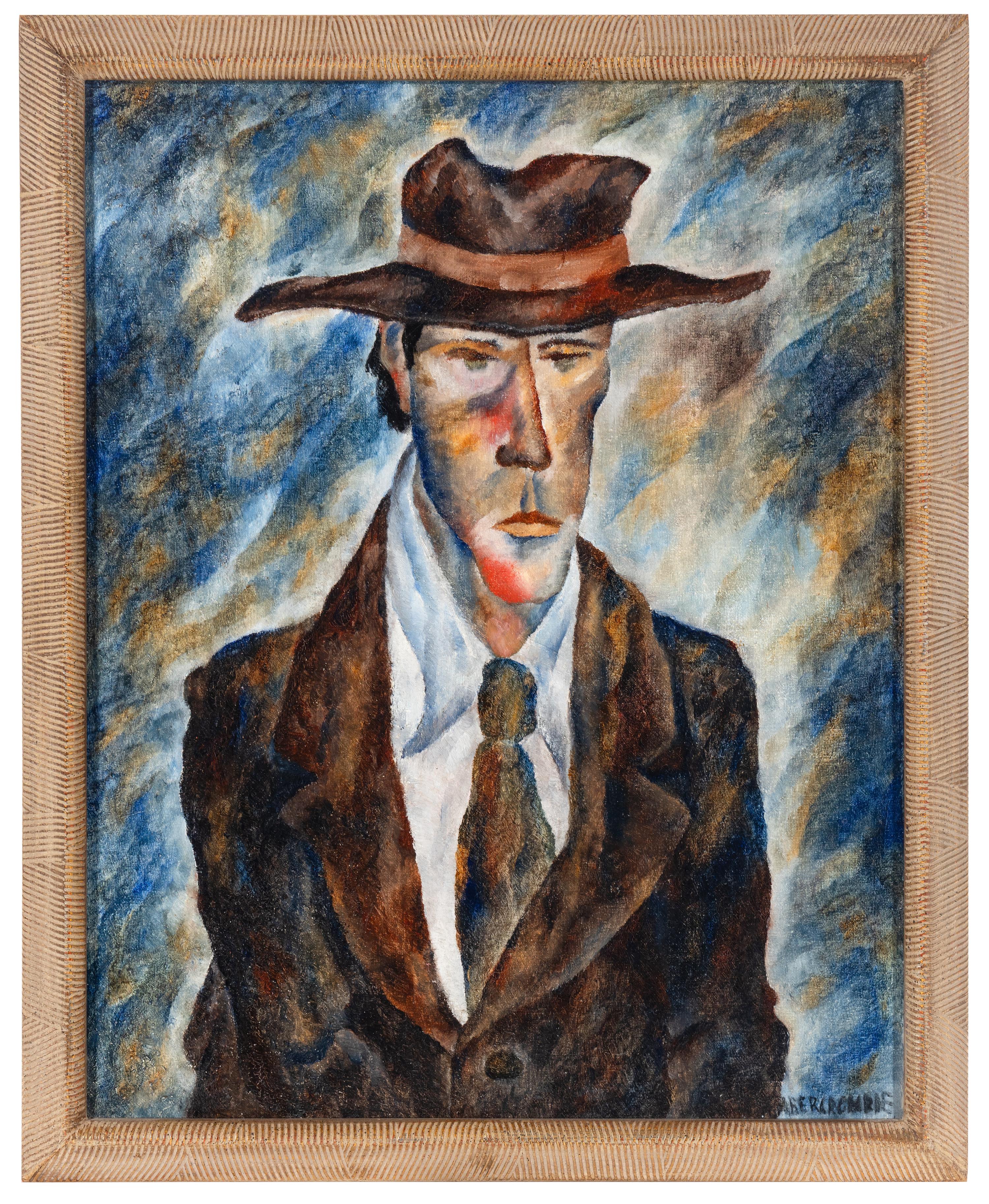
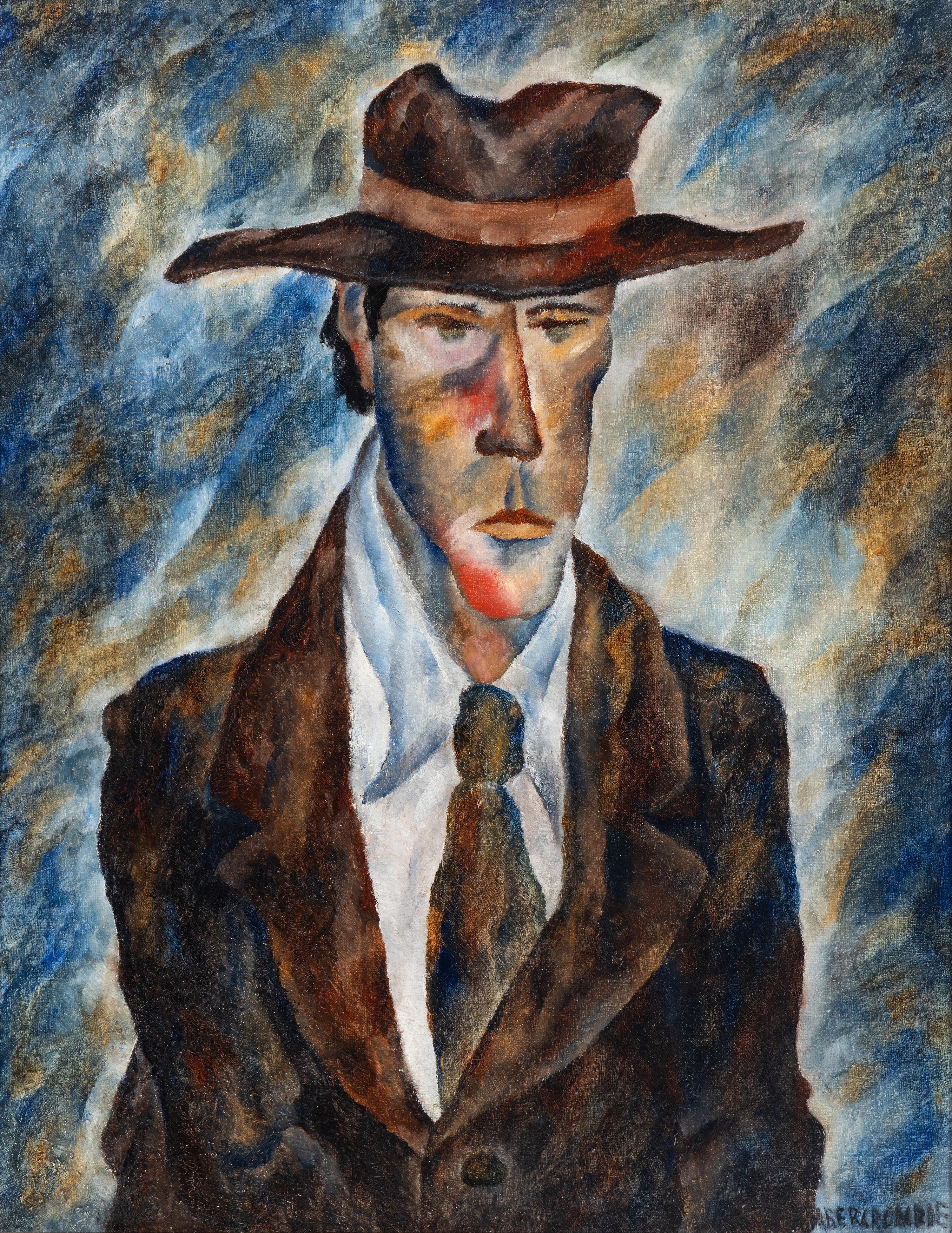
Man in a Hat is one of a number of portraits Abercrombie painted early in her career. Many of these works were of friends, relatives, and herself—willing subjects providing the opportunity for the artist to sharpen her skills, but this painting is particularly significant in that the sitter was not personally known to the artist. Rather, based on his resemblance to the figure in two paintings Abercrombie did in the early 1940s that depict his role in the film Man Hunt (1941), the subject appears to be actor John Carradine. By the early 1940s, Abercrombie painted relatively few images of anyone besides herself, and even fewer of male figures. Abe Lincoln appears a few times, there are one or two appearances of each of her husbands, and then there are the two images that are clearly meant to be John Carradine, who seems to have been an object of fascination for the artist (coincidentally, or not, Carradine portrayed Abe Lincoln in the 1938 film Of Human Hearts).
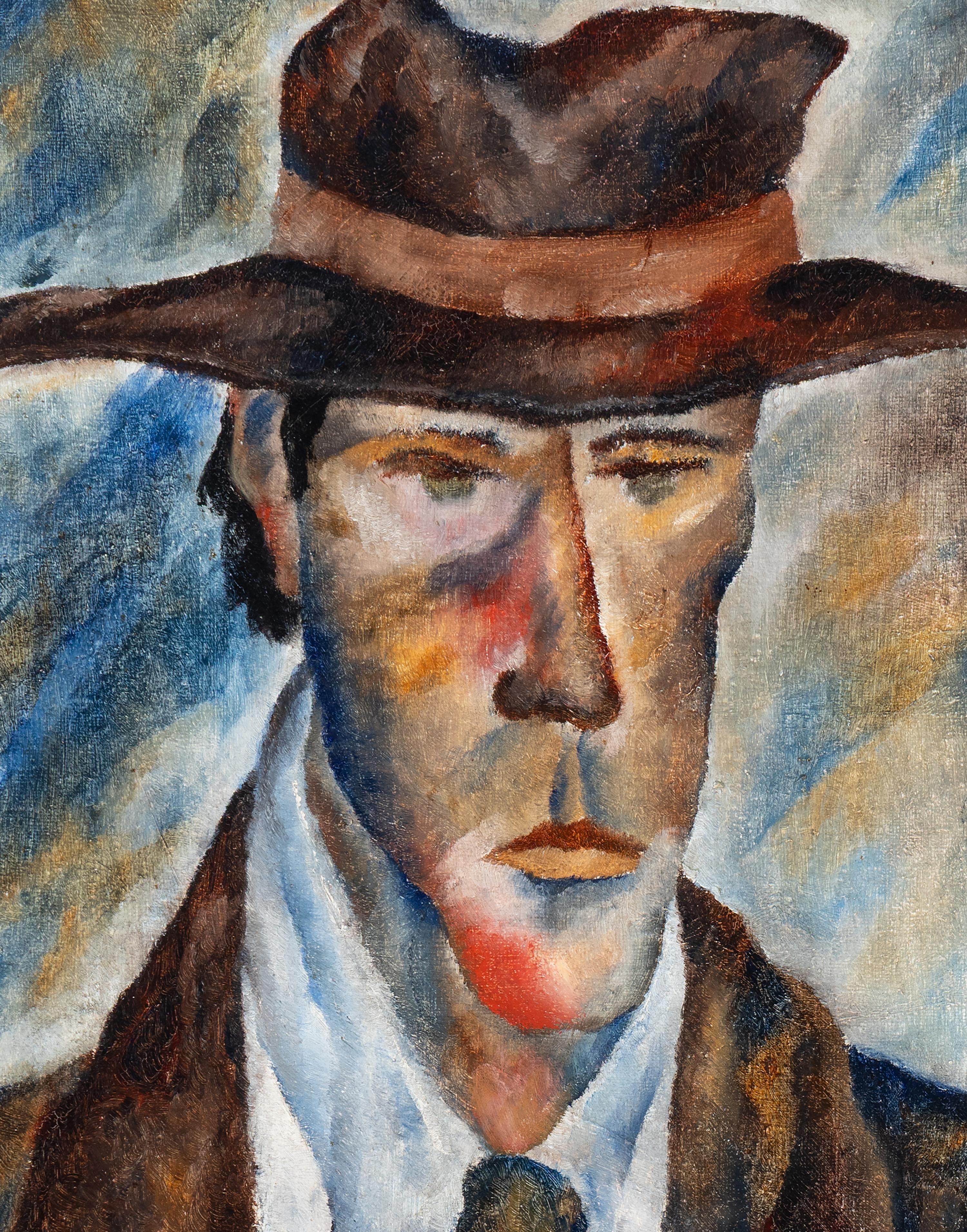
Man in a Hat remained in Abercrombie’s possession until the time of her death in 1977. The keeping of this work could indicate that it had personal meaning to Abercrombie or else she may have thought that her patrons were not as fascinated with Carradine as she was. The subject is a half-length man facing forward, dressed in suit and tie, wearing a wide brimmed fedora. The image is done in an expressionist style, with shape and size distortions combined with vibrant color that lend an energy to the composition that animates the stony-faced figure. The loose, visible brushstrokes in both the figure and the background also enliven the image. This figure has an experimental quality that is characteristic of the artist, who tried different styles and materials throughout her career, and while it perfectly complements the subject here, she does not pursue it in her more mature paintings. The element that is most interesting in light of the young John Carradine’s performances, however, is the man’s features: his long, thin face lent itself to stylization. Here, his angular and elongated face takes up fully one third of the total height of the canvas. While both the film Man Hunt, a political thriller, and John Carradine’s portrayal therein are stylistically very different than the expressive, coloristic Man in a Hat, they do appear to illustrate the same person and underscore Abercrombie’s early interest in the actor.
The style of Man in a Hat is reminiscent of other Chicago artists such as William Samuel Schwartz, whose work would have been familiar to Abercrombie from exhibitions at the Art Institute of Chicago and elsewhere at this time. Schwartz used a similar kind of expressive abstraction in some of his work and, while Abercrombie did not credit the influence of other artists in her paintings, she was certainly aware of the local art scene.
There is no way to know exactly what constituted Carradine’s appeal for Abercrombie. This painting was done early in Carradine’s acting career, but he was already often identified as a kind of rebellious or villainous character, which may have held some appeal for Abercrombie, who was drawn to outsiders. Her depiction of Man in a Hat is one that distorts even the long faced Carradine, elongating his head beyond reality for its expressive potential, something she did often with her own countenance. Her painting of Helen Mann (Private Collection), a writer and critic in Chicago, of about the same date as Man in a Hat, likewise features this artificial elongation, where Abercrombie stretches Mann’s features for (successful) expressive reasons.
This painting reflects some of the mystery seen so often in Abercrombie’s later work, as well as offering a rare example of a portrait that is not a friend, acquaintance, or relative. The artist imbues Man in a Hat with an appealing nervous energy that Carradine, often cast as a villain, embodies. The ambiguity in the image is characteristic of her best work.
Framed: 25 3/4 x 20 3/4 inches.
The physical condition of lots in our auctions can vary due to age, normal wear and tear, previous damage, and restoration/repair. All lots are sold "AS IS," in the condition they are in at the time of the auction, and we and the seller make no representation or warranty and assume no liability of any kind as to a lot's condition. Any reference to condition in a catalogue description or a condition report shall not amount to a full accounting of condition. Condition reports prepared by Freeman's staff are provided as a convenience and may be requested from the Department prior to bidding.
The absence of a posted condition report on the Freeman's website or in our catalogues should not be interpreted as commentary on an item's condition. Prospective buyers are responsible for inspecting a lot or sending their agent or conservator to inspect the lot on their behalf, and for ensuring that they have requested, received and understood any condition report provided by Freeman's.
Please email fineart@freemansauction.com for any additional information or questions you may have regarding this lot.