To request further details about this lot, please email antiquities@hindmanauctions.com

Jacob Coley
Senior Vice President, Head of Department, Antiquities and Ancient Art
Sale 6428
| Chicago
| Chicago
To request further details about this lot, please email antiquities@hindmanauctions.com
Jacob Coley
Senior Vice President, Head of Department, Antiquities and Ancient Art
Estimate$80,000 – $120,000
Provenance:
Jules Charvet (1824-1882), Château du Donjon, Le Pecq, France.
Julien Gréau (1810-1895), Troyes, France, acquired 1866-1878.
Hôtel Drouot, Paris, Collection Julien Gréau: Catalogue des bronzes antiques et des objets d’art du Moyen-âge et de la Renaissance, 1-9 June 1885, Lot 935. [illustrated]
Kevorkian, Paris, 2005.
Sotheby’s, New York, Antiquities, 10 December 2008, Lot 34.
Phoenix Ancient Art, New York, 2016 (Crystal 6, pp. 92-97, no. 16); where acquired by the present owner.
Exhibited:
France, Paris, Musée rétrospectif, Palais de l'Industrie, Champs-Elysées, 1865.
France, Paris, Exposition Universelle (Third Paris World's Fair), Palais du Trocadéro, 1 May-10 November 1878.
Published:
Union Centrale Des Beaux-Arts Appliqués a l'Industrie, Exposition de 1865. Palais de l'Industrie. Musée Rétrospectif, Catalogue, Paris, 1865, p.7, no. 66.
F. Lenormant, "Union Centrale des Beaux-Arts appliqués à l'Industrie. Musée rétrospectif. Les antiques," Gazette des Beaux-Arts, vol. I, 1866, pp. 174-175. [illustrated]
F. Lenormant, "Books and Monuments Bearing upon Figured Representations of Antiquity," The Contemporary Review, London, vol. XXXIII, September 1878, p. 849.
O. Rayet, "L'art grec au Trocadéro," in L. Gonse, ed., L'art ancien au exposition de 1878 , Paris, 1879, pp. 75-76; p. 70. [illustrated]
F. Wieseler, "Archäologische Excurse zu Pausanias I, 24,3 und I, 27,8," Nachrichten von der königl. Gesellschaft der Wissenschaften und der Georg-Augusts-Universität, 1886, p. 45.
K. Sittl, Archäologie der Kunst, Munich, 1895, p. 237, note 18.
S. Reinach, Répertoire de la statuaire grecque et romaine, vol. II.2, Paris, 1908, p. 333, no.1.
International Herald Tribune, advertising supplement, Saturday- Sunday, 7-8 January, 2006, p. 12. [illustrated]
Apollo Magazine, February 2006, p. 27 (advertisement).
The New York Times, Sunday, 18 March 2007, section 3, p. 3. [illustrated]
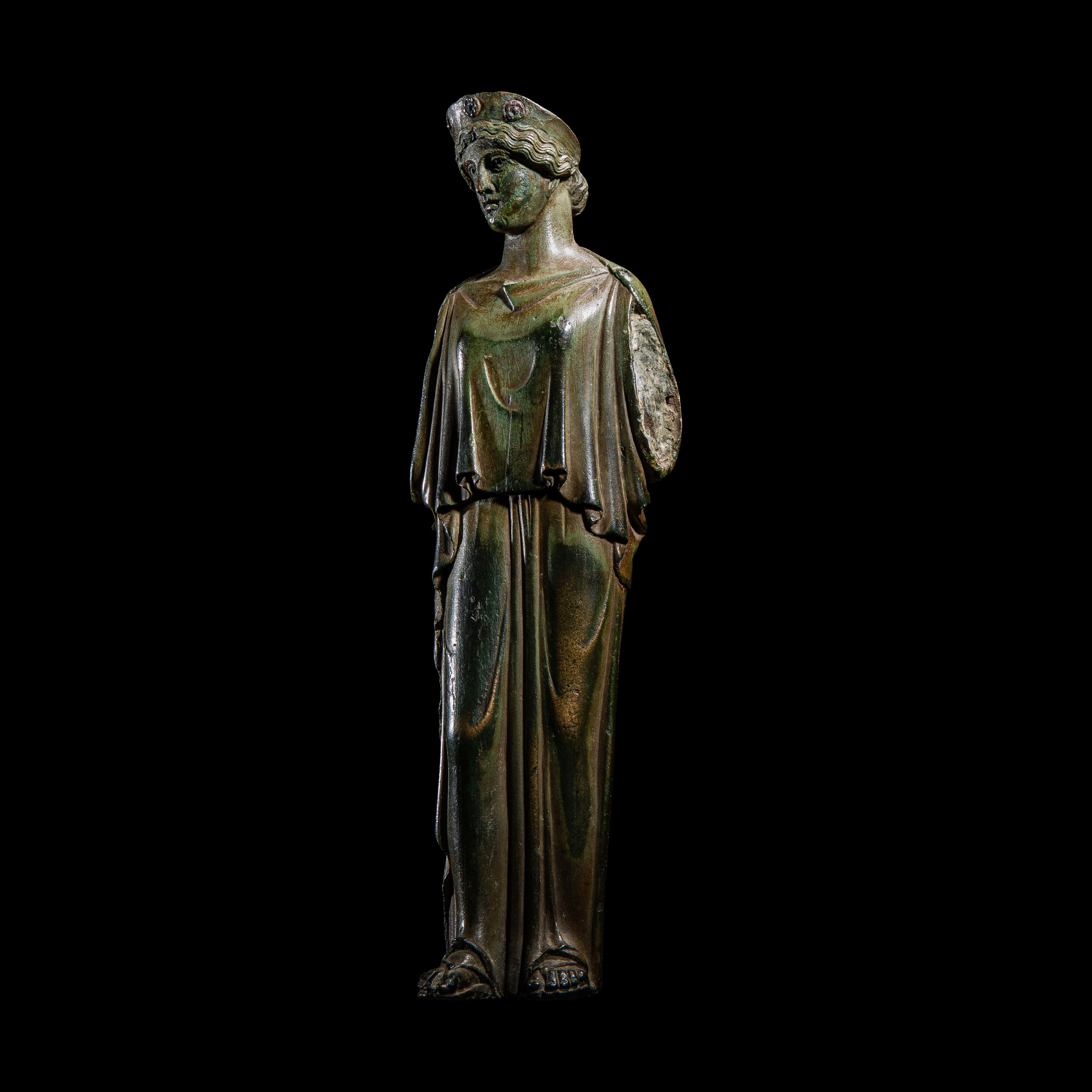
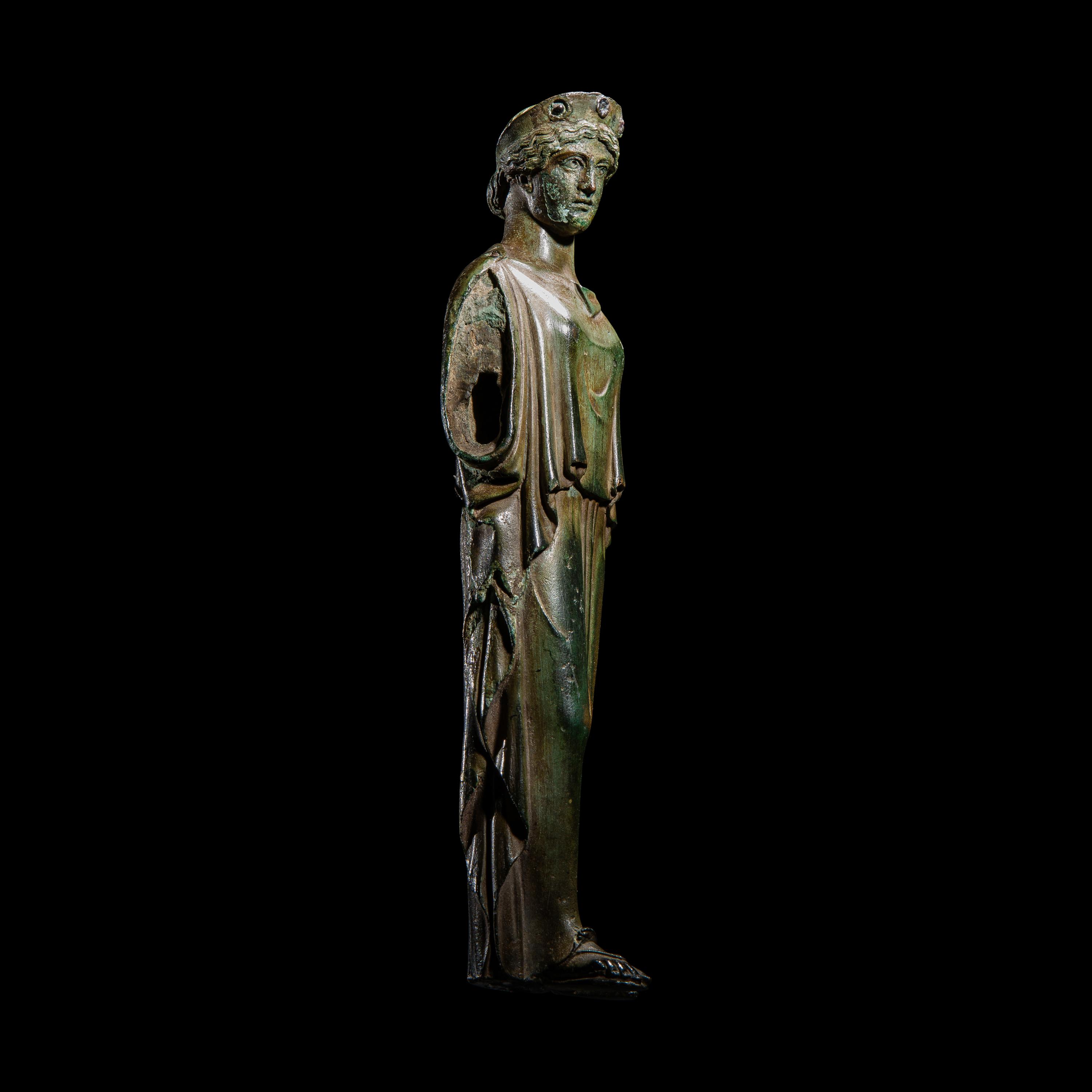
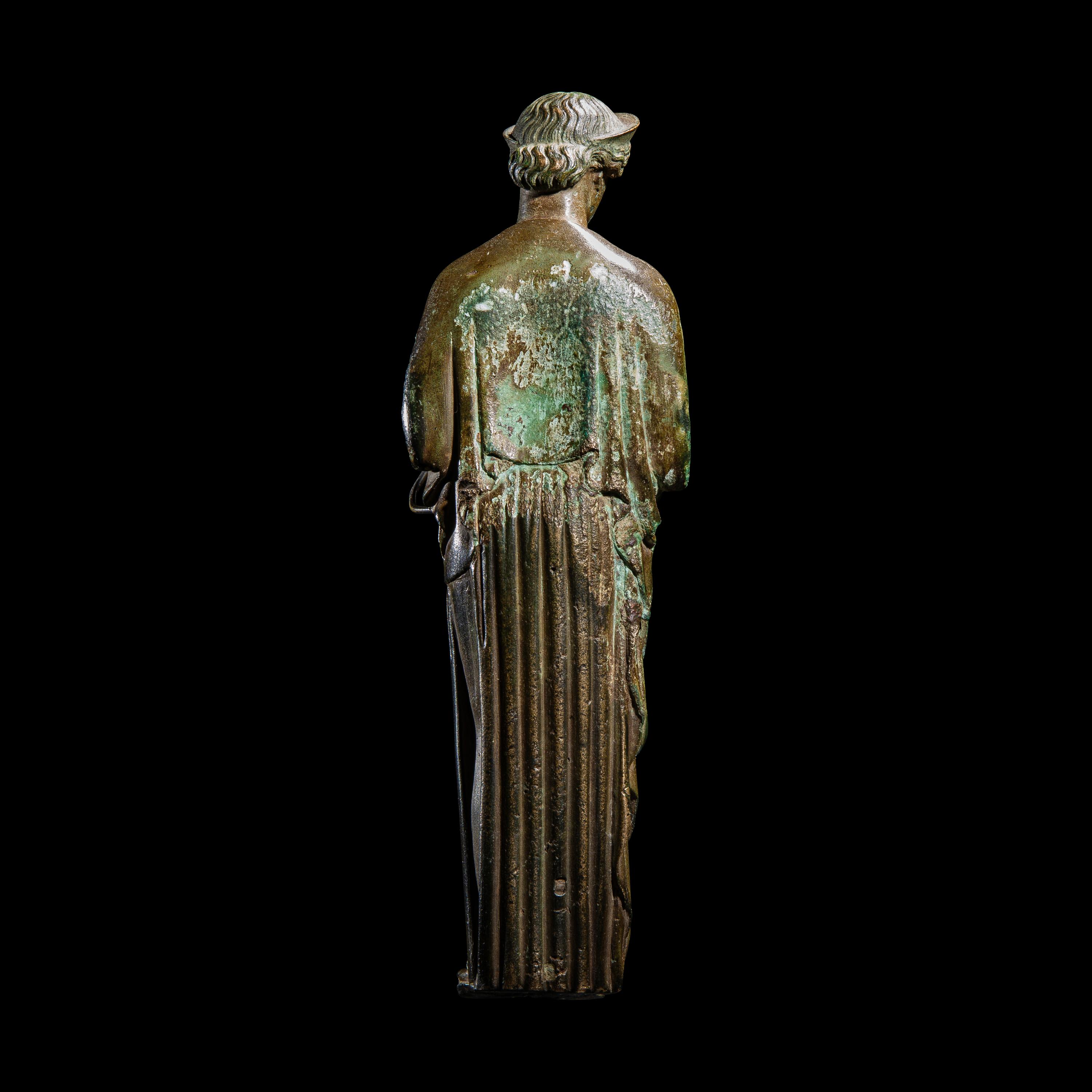
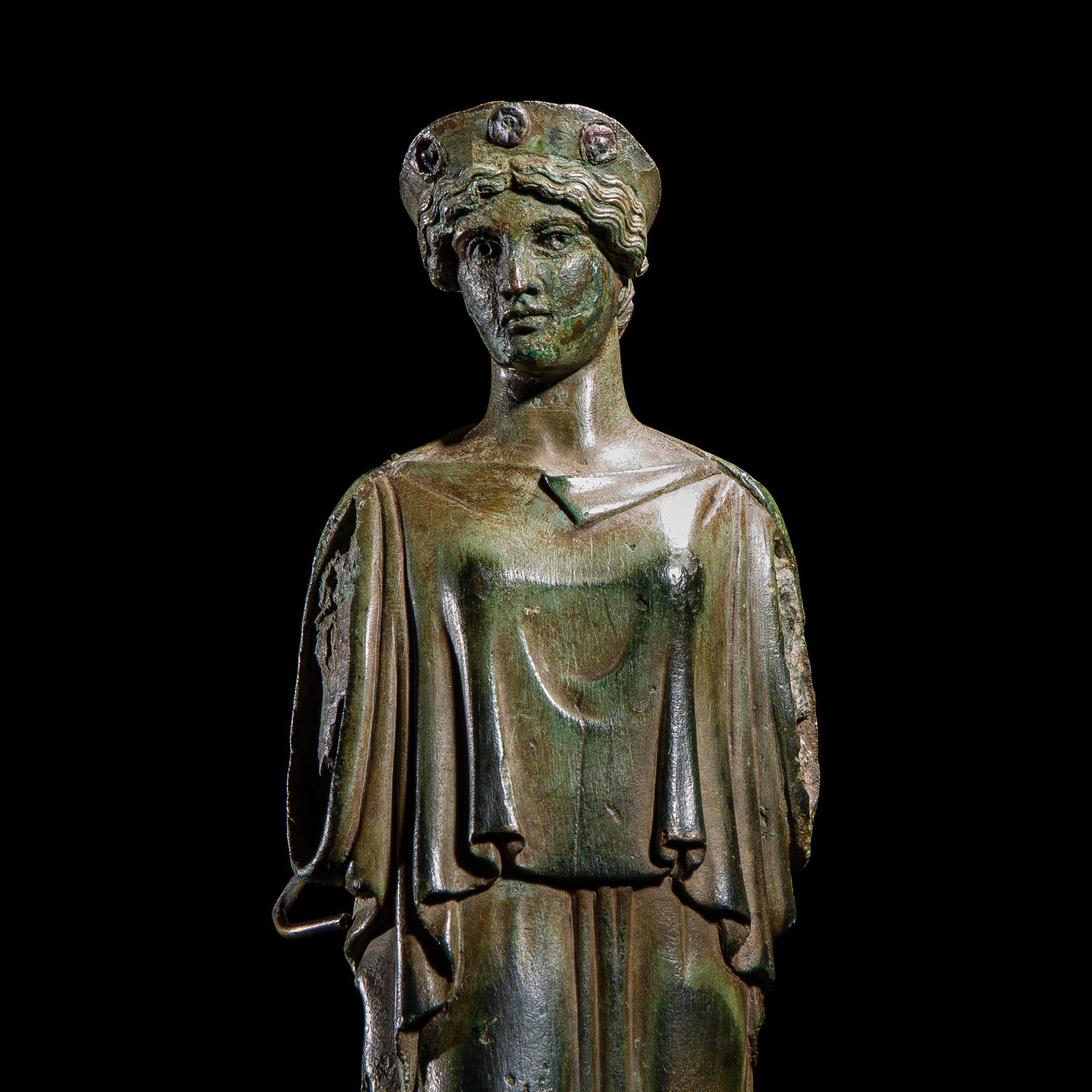
Regal in miniature, the pleasure of this statuette lies in the abundant attention the sculptor has lavished upon each detail, from elements of posture and costume to the inscrutable expression on the goddess’s fair face. Standing tall, she is by no means stiff or trapped in a generic contrapposto, but rather shifts her weight subtly in a small forward step. She wears a peplos, a woolen garment originating in Archaic Greece, where it was used to dress both maidens and matrons, as well as mortals and divinities. Here, the woven rectangular cloth is wrapped around the body, pinned at each shoulder, and belted at the waist. The overhang (apoptygma) falls in symmetrical folds over the high bosom and drapes artfully at the hips with much longer sections forming swallow-tail pleats down the sides. The arms were likely separately cast and are now missing. At the front, the skirt is enlivened by her forward movement, with the right knee pressing against the fabric and creating a channel between the legs, whereas at the rear, the drapery descends column-like to the feet. Remarkably, both feet survive, are clad in thong-style sandals, and have been rendered in exceptional detail down to each toenail.
No less attention has been spared above the shoulders, where a clear understanding of anatomy is evident at the neck, with subtly tensed muscles supporting the slightly turned and inclined head. The face itself is a soft oval dominated by large eyes with deep, focused pupils beneath a smooth brow. The full lips bear no hint of a smile, and, with the positioning of the head and imposing eyes, the overall effect is somewhat imperious. The hair is a mass of wavy locks parted centrally, combed over the temples and ears, and gathered in a chignon at the nape. A high crown is nestled within this coiffure, adorned by gilded rosettes. Such floral diadems have no clear Greek antecedents (although lofty polos crowns are the eventual precursors) and instead seem to be rooted in Italic tradition or Roman invention, reserved to adorn the brows of goddesses. Loose parallels can be found in a marble archaistic Athena in New York (Metropolitan Museum of Art, inv. no. 12.157) and the famous terracotta Faliscan bust of Juno in Rome’s Museo Nazionale Etrusco di Villa Giulia.
The sculptor drew heavily on the so-called ‘Severe style’ of the second quarter of the 5th century B.C., both for the goddess’s costume and facial features. One source of artistic inspiration was certainly bronze mirror handles in the form of peplophoroi that were produced in some quantity in Athens and mainland Greece during that period (for example, see in Paris, Musée du Louvre inv. no. MNC 1022; Br 1691 and London, British Museum inv. no. 1854,0810.1). The present statuette displays none of the coquettish plucking at skirts that these maidens are prone to. Rather, the dignified drape of her peplos and somewhat commanding gaze suggest a mature goddess at the height of her powers. While Athena is best known for wearing the peplos as part of her no-nonsense wardrobe, the garment was also frequently worn by Hera (Latinized to Juno), queen of the Olympian pantheon and a formidable player in both divine and mortal realms. The ornate crown further supports this identification, clearly indicating regal status and deployed in Greek and Roman tradition for depictions of Juno/Hera.
A masterful example of early Imperial eclecticism, the statuette demonstrates the remarkable fluidity with which Roman artists adapted centuries-old styles and formats, while creating aspects of movement and mood not displayed by potential prototypes. This statuette caused a sensation in late 19th-century Paris among an educated public that appreciated such nuance and has been exhibited frequently since.
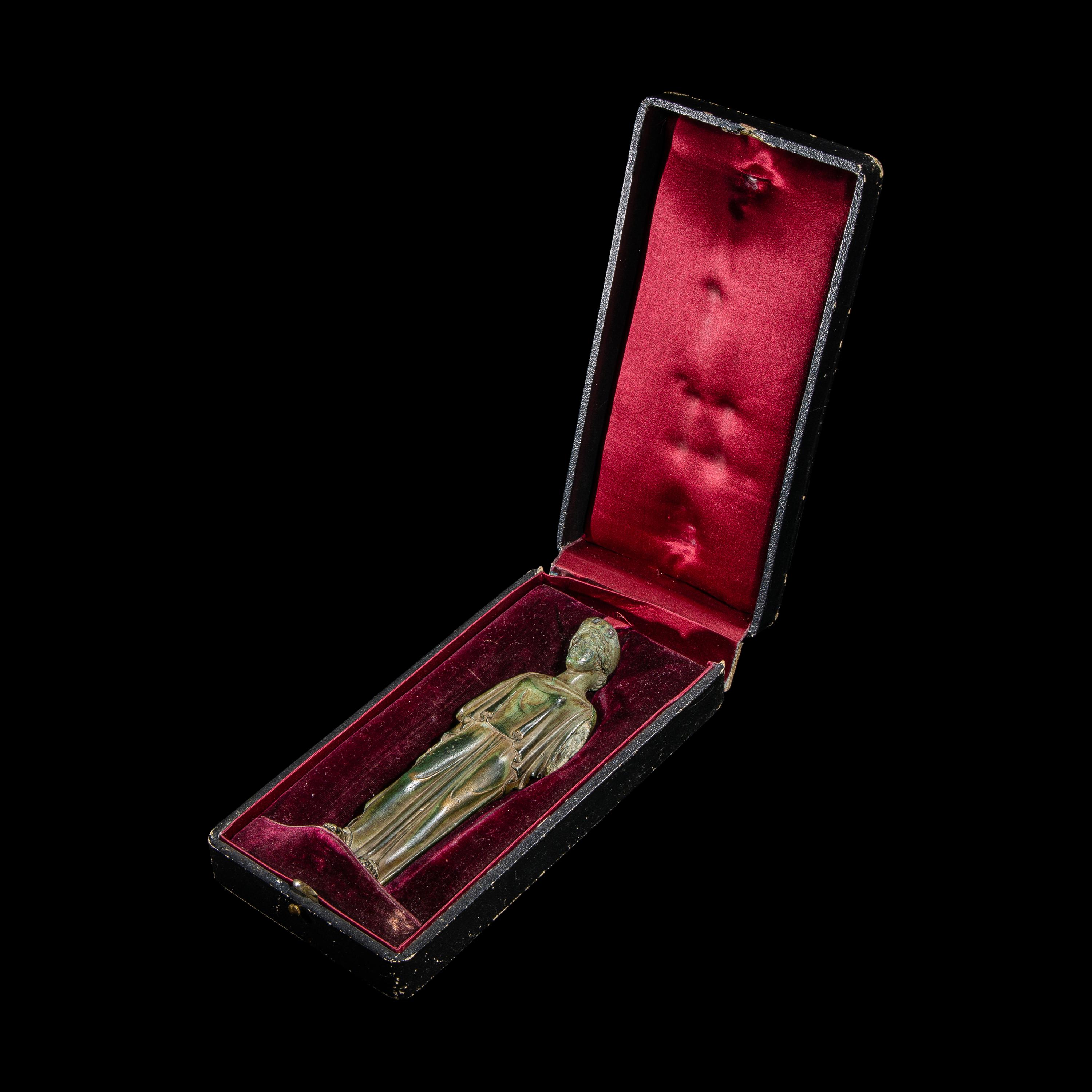
Inspected under UV light and 10x loupe. Moderate abrasions to upper back with mild corrosion and areas of reddish patina. Some notable oxidation to the face and small areas of the drapery at the proper right side and back. Scratches, wear, and losses commensurate with age. Weathering and fragmentation to rosettes on the diadem. Interior with lead deposits. Overall in remarkable condition. See additional images.
The physical condition of lots in our auctions can vary due to age, normal wear and tear, previous damage, and restoration/repair. All lots are sold "AS IS," in the condition they are in at the time of the auction, and we and the seller make no representation or warranty and assume no liability of any kind as to a lot's condition. Any reference to condition in a catalogue description or a condition report shall not amount to a full accounting of condition. Condition reports prepared by Freeman's staff are provided as a convenience and may be requested from the Department prior to bidding.
The absence of a posted condition report on the Freeman's website or in our catalogues should not be interpreted as commentary on an item's condition. Prospective buyers are responsible for inspecting a lot or sending their agent or conservator to inspect the lot on their behalf, and for ensuring that they have requested, received and understood any condition report provided by Freeman's.
Please email antiquities@hindmanauctions.com for any additional information or questions you may have regarding this lot.