To request further details about this lot, please email antiquities@hindmanauctions.com

Jacob Coley
Senior Vice President, Head of Department, Antiquities and Ancient Art
Sale 6428
| Chicago
| Chicago
To request further details about this lot, please email antiquities@hindmanauctions.com
Jacob Coley
Senior Vice President, Head of Department, Antiquities and Ancient Art
Estimate$60,000 – $80,000
Provenance:
Ariadne Galleries, New York.
Private Collection, Chicago, acquired from the above, 23 February 1989.
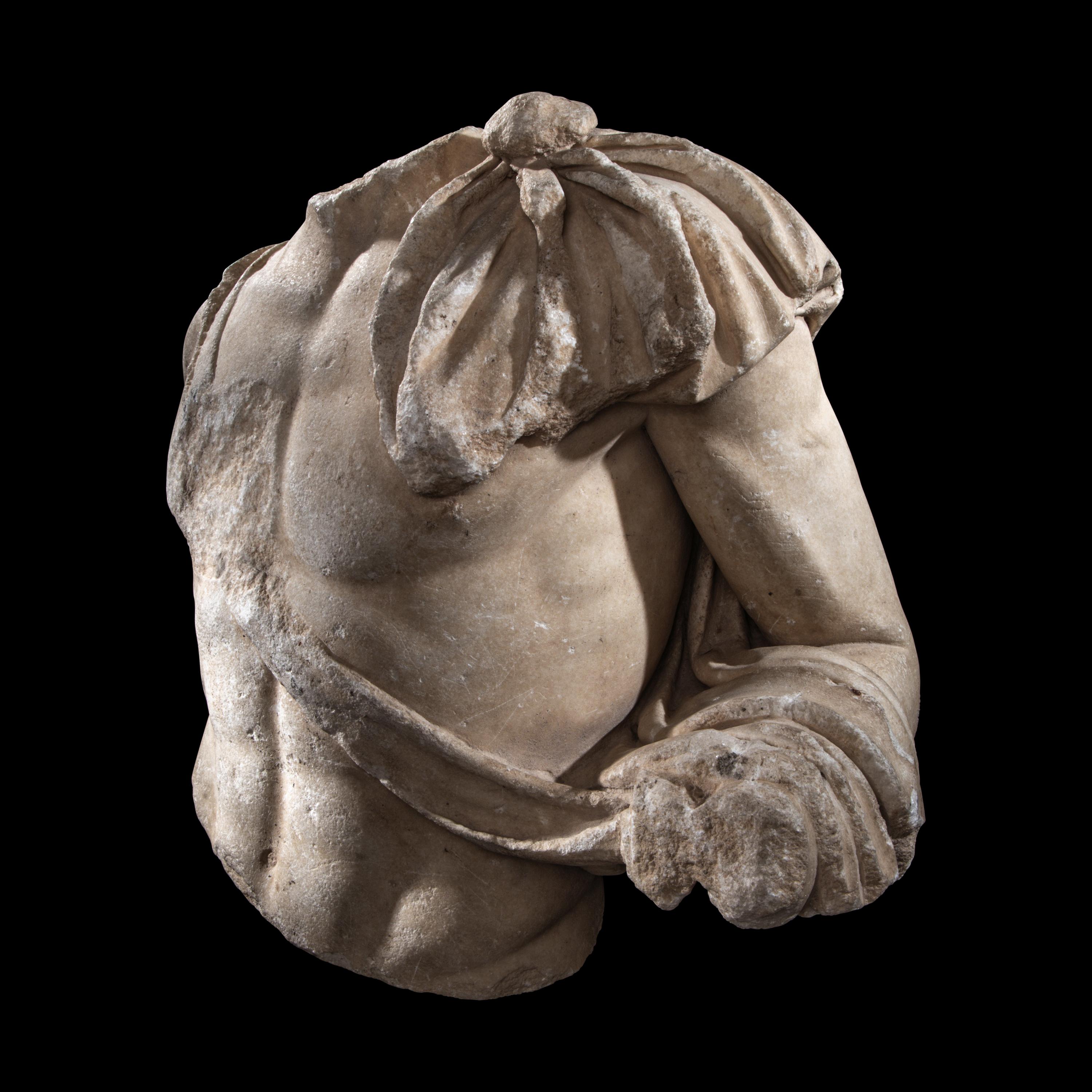
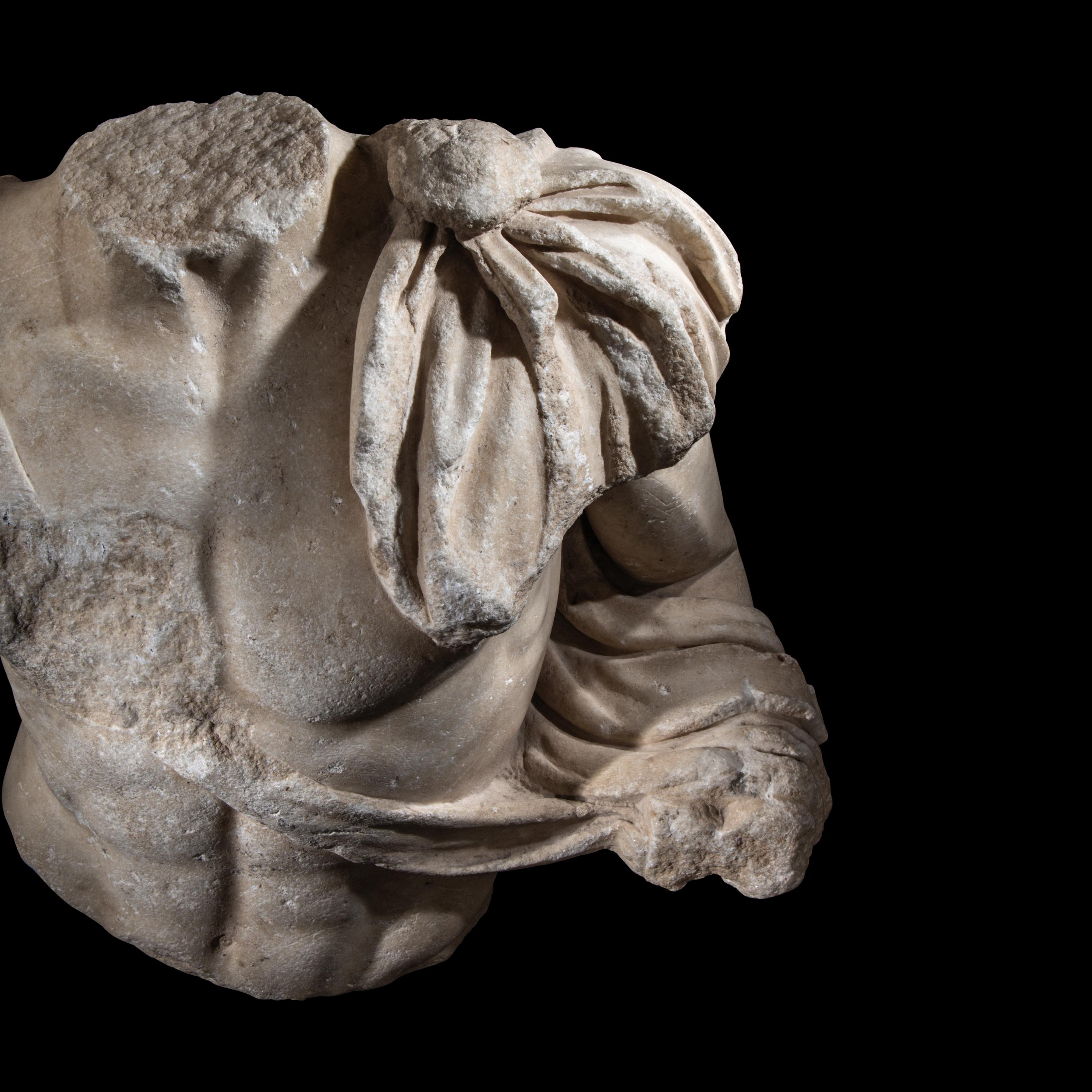
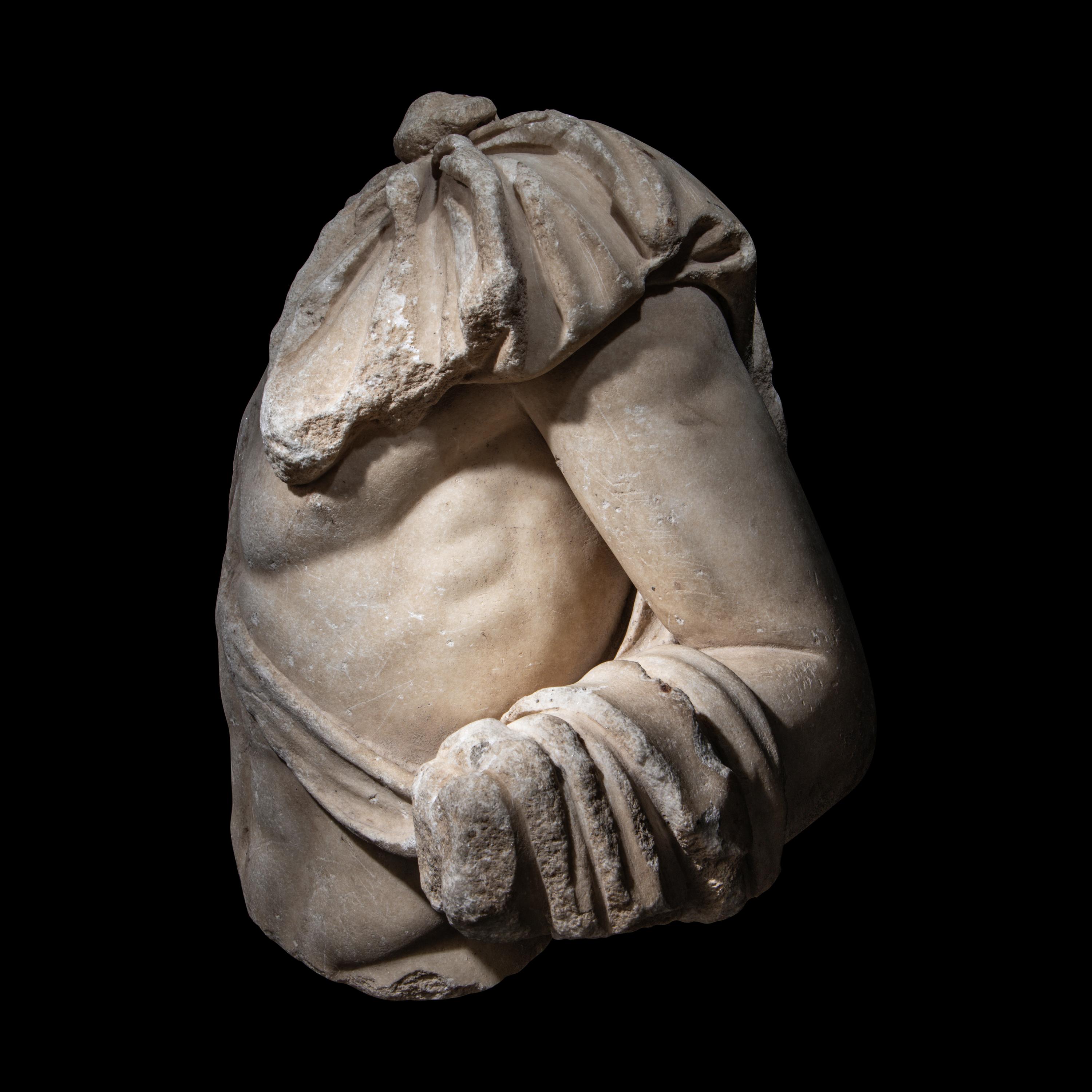
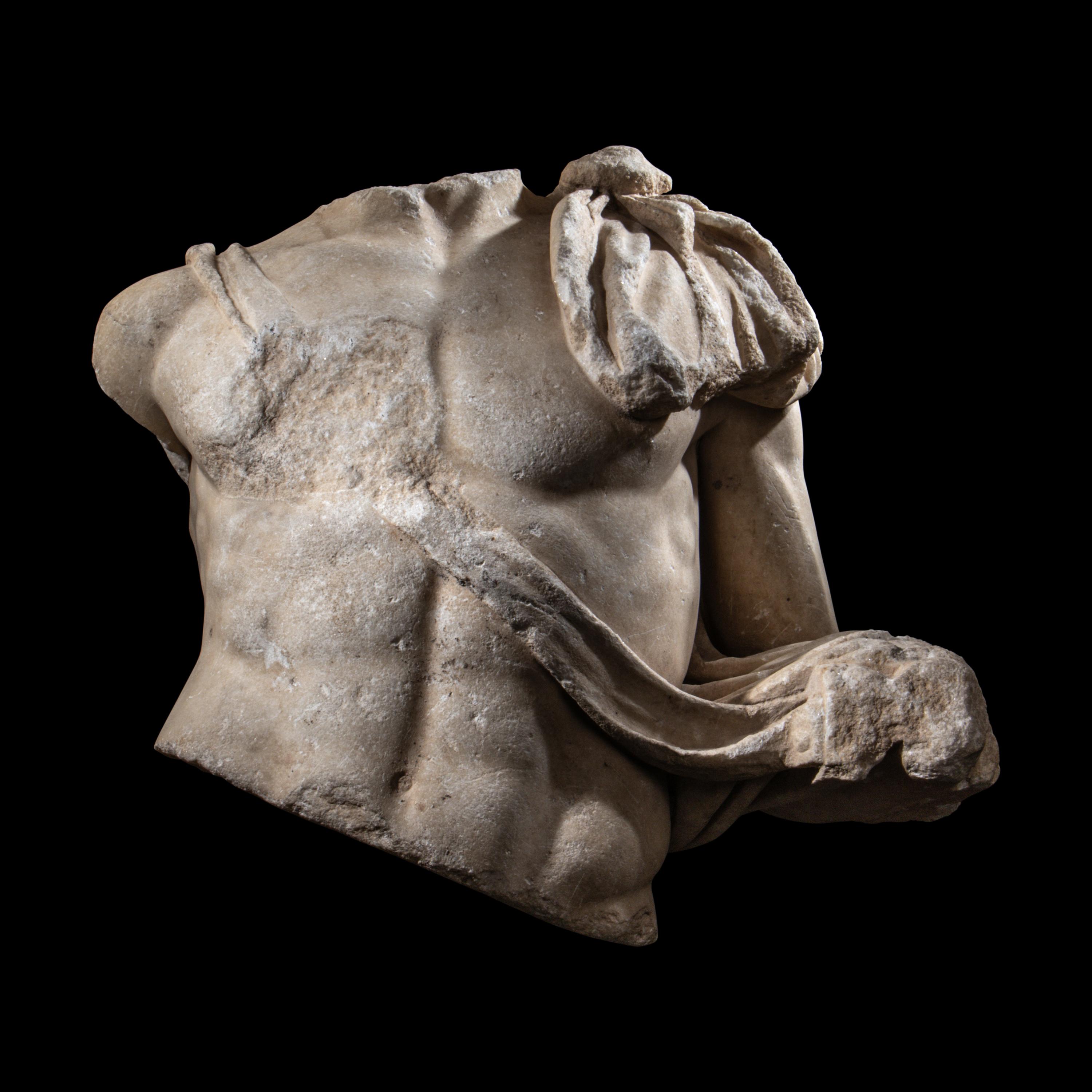
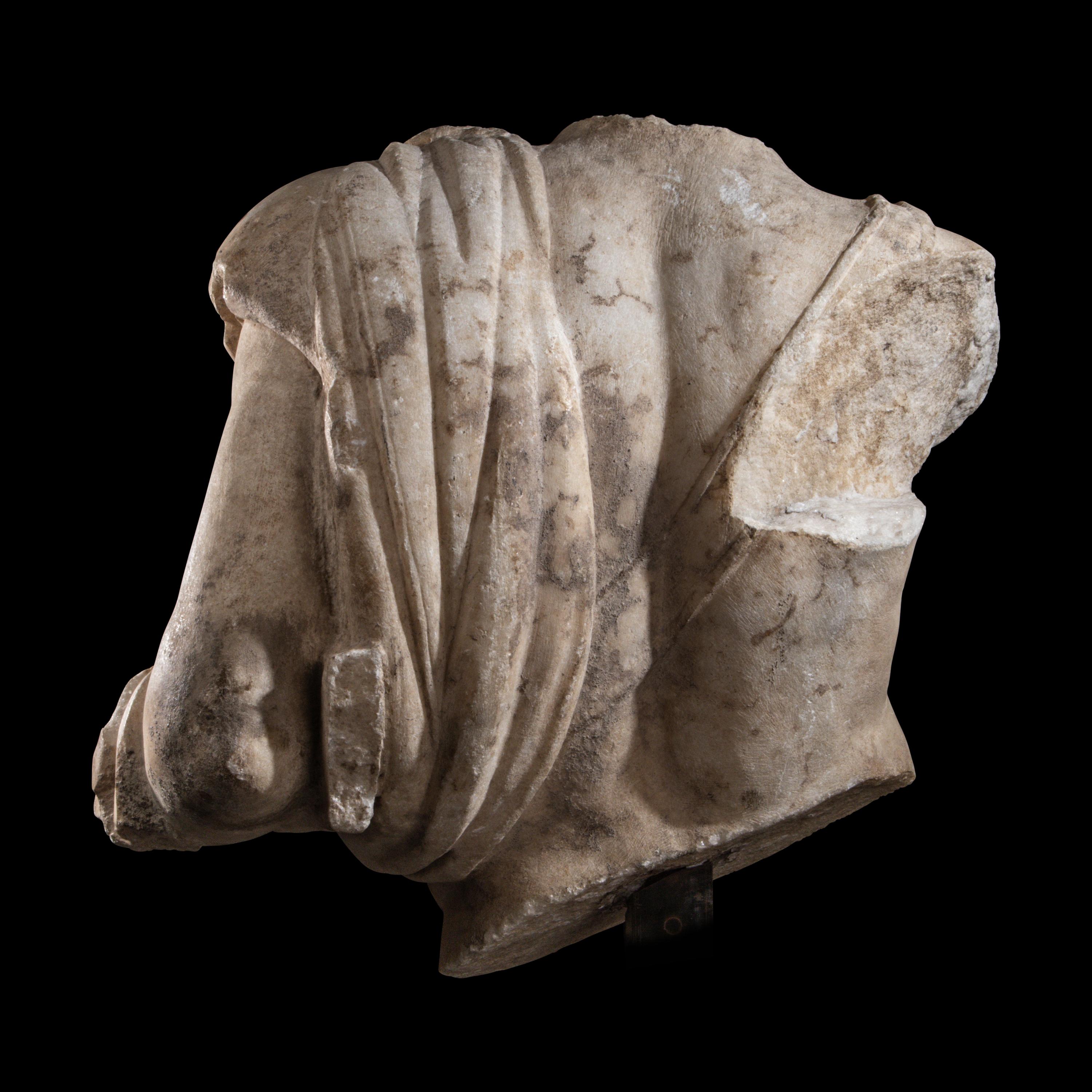
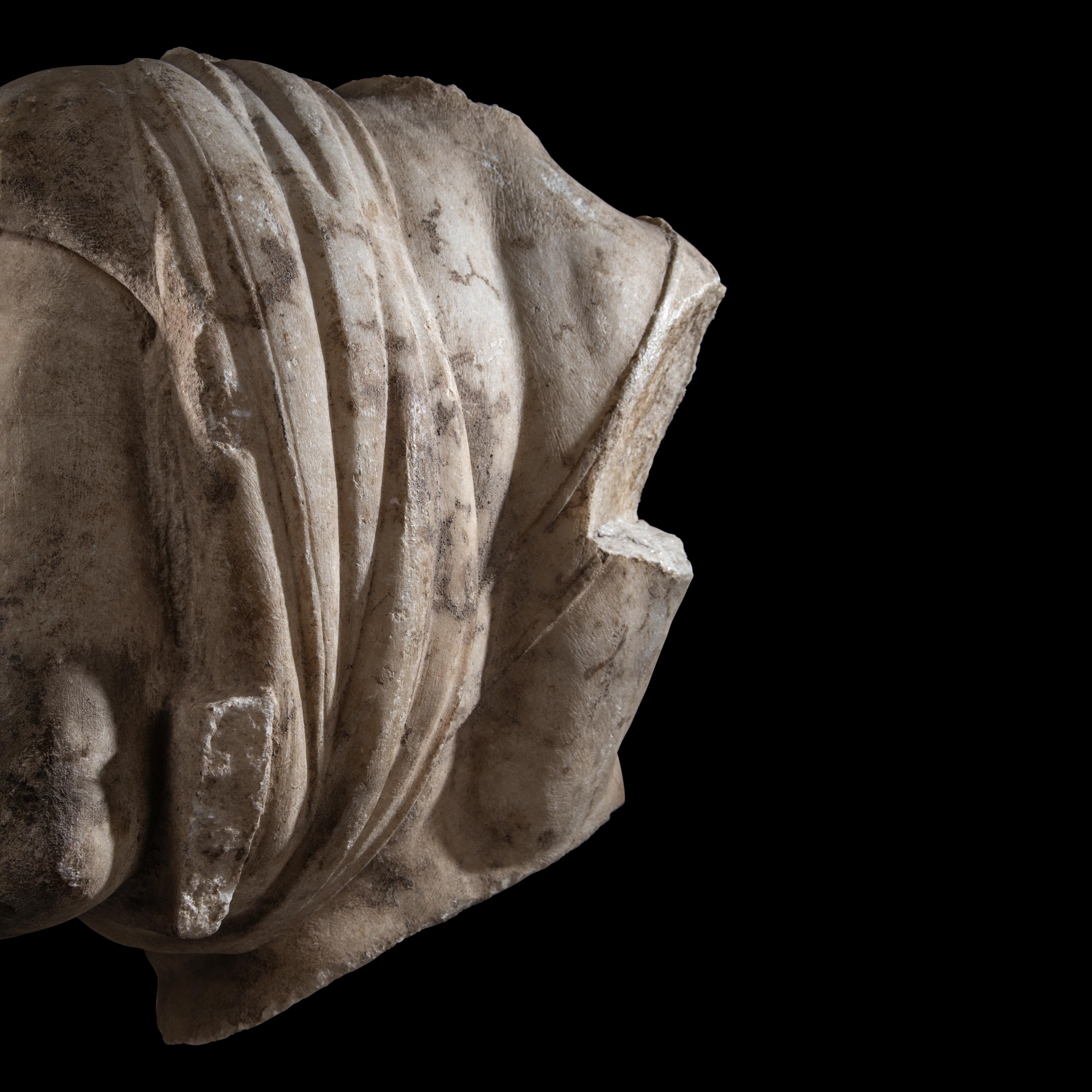
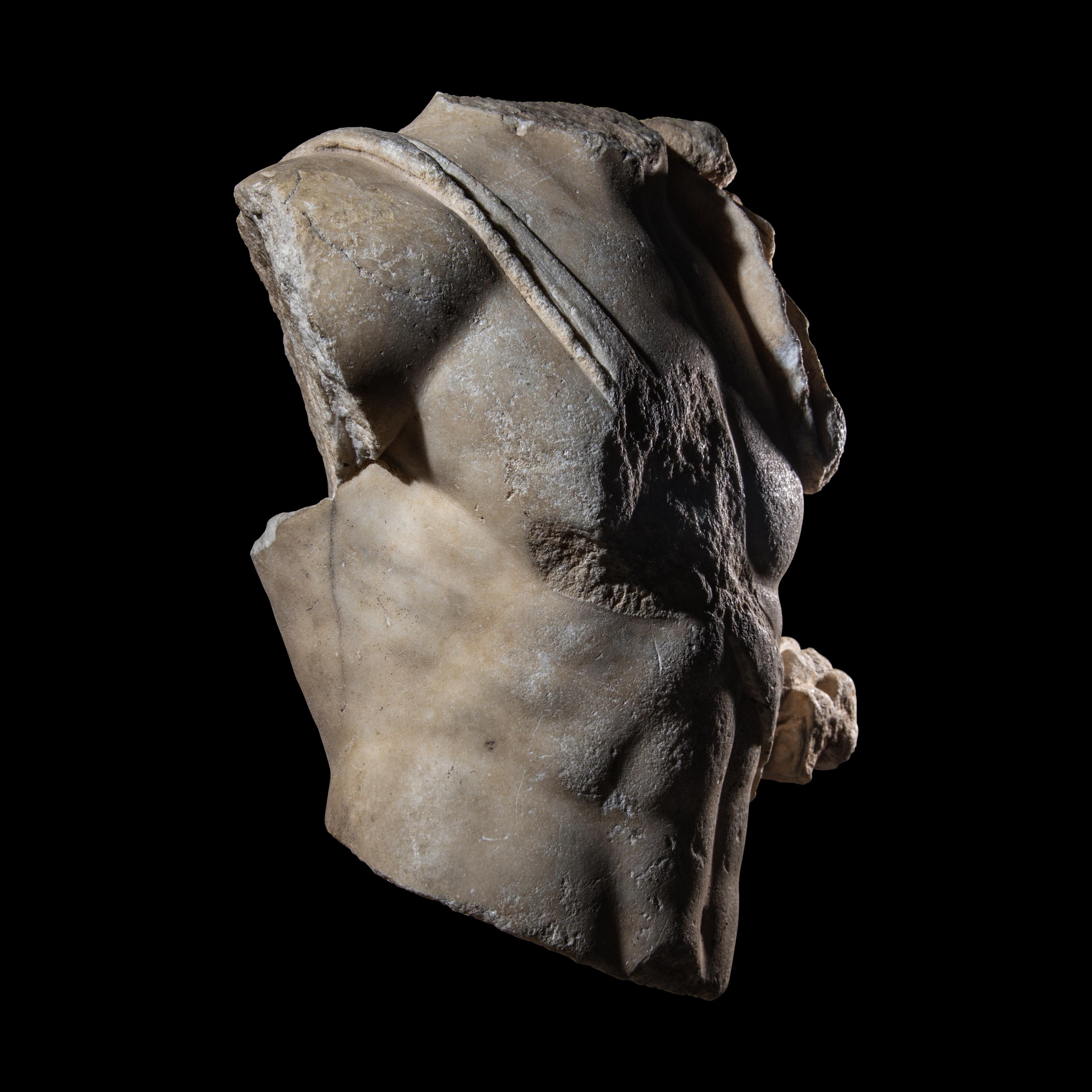
Nude apart from the chlamys (mantle) pinned and partially draped over one shoulder and the balteus (sword-strap) slung across the broad chest, this torso belonged to the full-length statue of an idealized hero or perhaps even a member of the Imperial family. With powerful shoulders and well-defined pectorals, the tensed abdominals, with a curved linea alba and corresponding curvature at the spine, indicate that the full-length statue stood in a pose rather more dynamic than a staid Polykleitan contrapposto. The chlamys covers the left pectoral to the nipple and the upper portion of the bicep, extends down the back on the same side, and is folded over the preserved forearm. The balteus crosses the torso diagonally, slackening towards the left hip, where it connects to the sword scabbard, which is raised slightly aloft and to the side. The quality of the carving is immediately evident in the deeply carved drapery of the chlamys, the great attention to detail paid to the texture and three-dimensionality of the leather balteus, and the subtleties of the anatomy, including the vein on the upper surface of the bicep, and the delicate rendering of the clavicles and jugular.
The distinctive movement of the torso takes direct inspiration from a late fifth-century B.C. statue of Diomedes attributed to the Greek sculptor Kresilas, who adapted the Polykleitan canon to depict the Homeric hero absconding with the Palladion of Troy. Surviving Roman copies and adaptations of the statue are classified as the ‘Cumae-Munich Diomedes’ type, named after the most famous surviving examples from Cumae (currently in the Museo Archeologico Nazionale di Napoli, inv. no. 144978) and in Munich (Glyptothek, inv. no. 304). While already admired in the Augustan period, the specific pose of this idealized body experienced a surge in popularity during the Hadrianic period, as discussed by C. Maderna (noted below).
While originally conceived to represent a mythological character, the body of the Cumae-Munich Diomedes type enjoyed arguably greater popularity when combined with portrait heads - a continuation and refinement of the quintessentially Roman tradition that began in the Republican period. This seems to be especially true for the portraiture of Hadrian and his successors. The best preserved of these includes the Hadrian (r. 117-138) found in the Roman theatre in Vaison-la-Romaine (Musée Archéologique Théo Desplans), and Lucius Verus (r. 161-169 A.D.) and the colossal Alexander Severus (r. 222-235 A.D.) with portrait head re-carved from that of Elagabalus in Naples (both from the Farnese collection, Museo Archeologico Nazionale di Napoli, inv. No 6095 and 4993 respectively).
The Diomedes-type served as an eminently adaptable visual paradigm - attractive and ideologically well-suited for imperial representation. Physically commanding, it combined an undeniable vigor with a simultaneous sense of restraint that visually embodied a host of moral virtues that appealed to Hadrian and his successors. The over life-sized proportions and high-quality of carving suggest that the present torso belonged to an important statue, but without the head, it is not possible to determine concretely whether a hero or emperor was represented.
Another instructive Roman copy of the type is in Rome (Galleria Borghese, inv. no. IX). For a full discussion and catalogue of Roman portraits joined to the body type of Diomedes, see C. Maderna, luppiter, Diomedes und Merkur als Vorbilder fur romische Bildnisstatuen (Heidelberg, 1988), 56-80, 196-222. On the heroic nude body deployed as a “costume” more generally, see C. Hallett, The Roman Nude: Heroic Portrait Statuary 200 B.C.-A.D (2005), with the Diomedes type discussed and illustrated on pages 183–184, 191-192, and 322-326. For a discussion of Hadrianic ethos and the use of the Diomedes body type in the portraiture of Hadrian and his successors, see F. C. Albertson, “A Portrait of Hadrian as Diomedes," Muse (Vol. 27, 1993–94 ), 11-29.
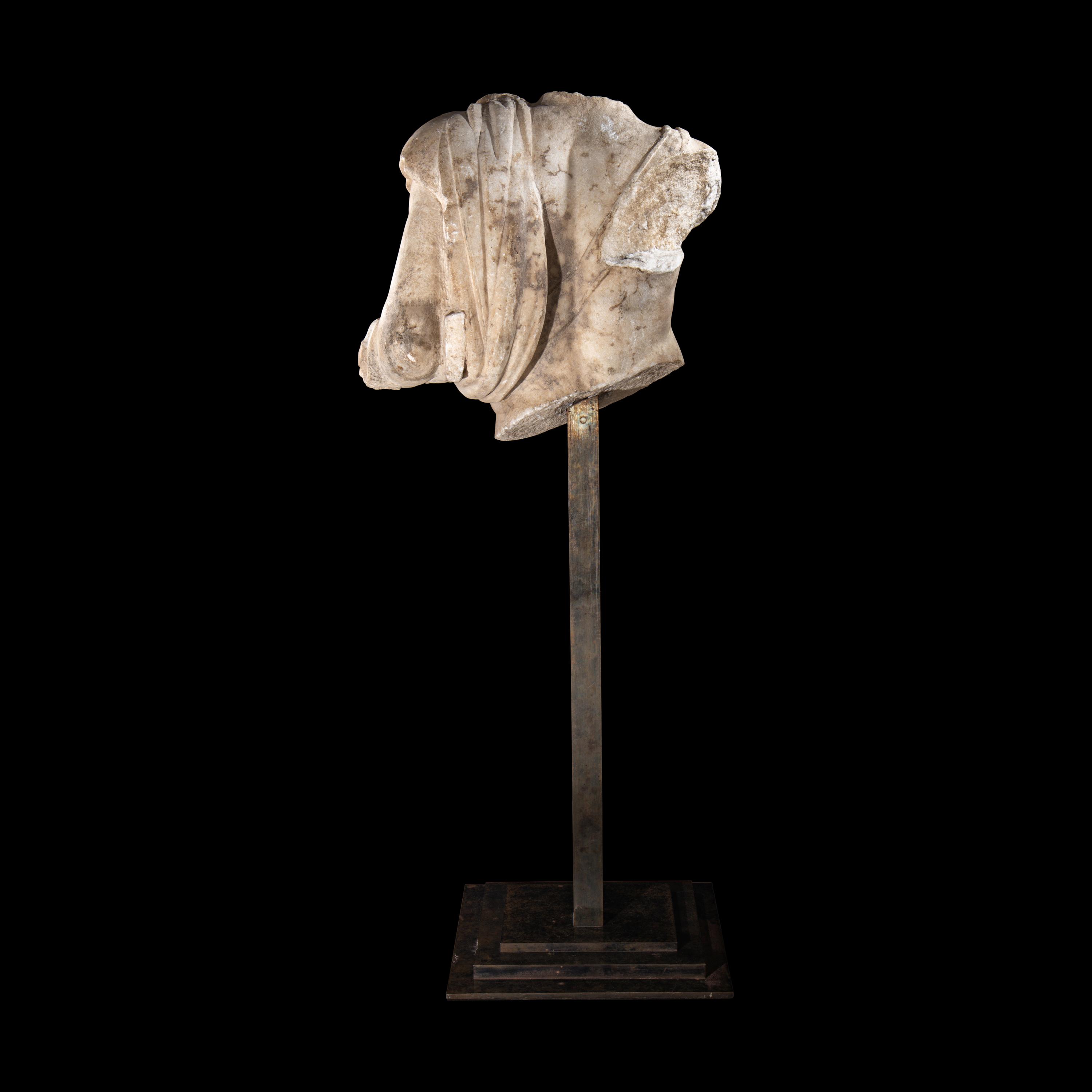
Inspected under UV light and 10x loupe. Areas of encrustation with significant deposits notable on back of chlamys. Some red iron deposits. Large loss at proper right back and arm. Loss to proper right pectoral. Scratches and chips throughout revealing scintillation of the marble below old collection patina. Notable surface crack at remaining section of proper right arm. Overall in excellent and attractive condition. See additional images. Affixed to metal stand. Height with stand 168.9 cm (66 1/2 inches). Over 450 lbs.
The physical condition of lots in our auctions can vary due to age, normal wear and tear, previous damage, and restoration/repair. All lots are sold "AS IS," in the condition they are in at the time of the auction, and we and the seller make no representation or warranty and assume no liability of any kind as to a lot's condition. Any reference to condition in a catalogue description or a condition report shall not amount to a full accounting of condition. Condition reports prepared by Freeman's staff are provided as a convenience and may be requested from the Department prior to bidding.
The absence of a posted condition report on the Freeman's website or in our catalogues should not be interpreted as commentary on an item's condition. Prospective buyers are responsible for inspecting a lot or sending their agent or conservator to inspect the lot on their behalf, and for ensuring that they have requested, received and understood any condition report provided by Freeman's.
Please email antiquities@hindmanauctions.com for any additional information or questions you may have regarding this lot.