To request further details about this lot, please email antiquities@hindmanauctions.com

Jacob Coley
Senior Vice President, Head of Department, Antiquities and Ancient Art
Sale 6428
| Chicago
| Chicago
To request further details about this lot, please email antiquities@hindmanauctions.com
Jacob Coley
Senior Vice President, Head of Department, Antiquities and Ancient Art
Estimate$60,000 – $80,000
Provenance:
Karl Wittgenstein (1847-1913), Vienna; thence by descent to his daughter, Margaret Wittgenstein-Stonborough (1882-1958); thence by descent.
Christie's, New York, Antiquities, 25 October 2016, Lot 97.
Phoenix Ancient Art, New York, 2019 (Salon Art + Design, no. 25); where acquired by the present owner.
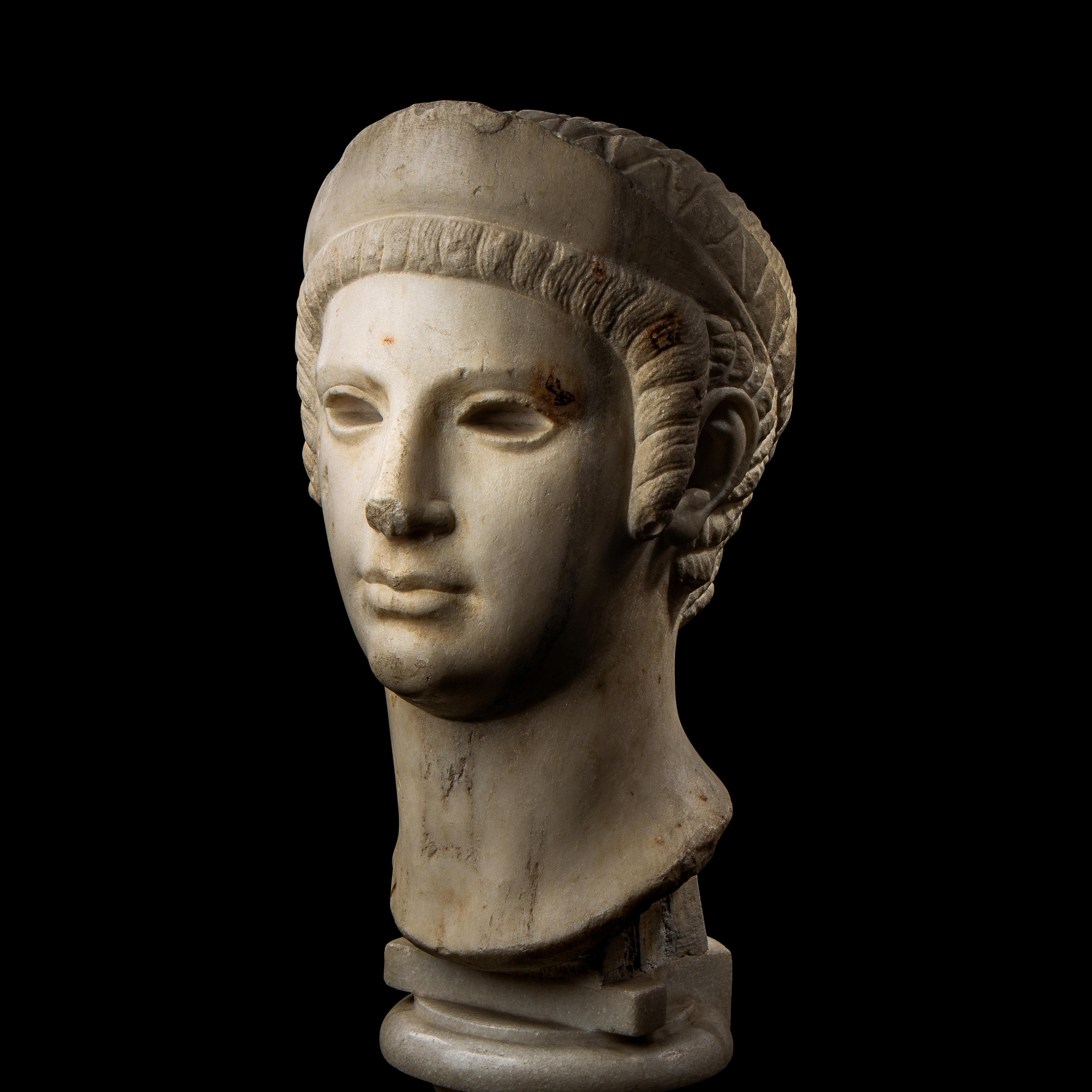
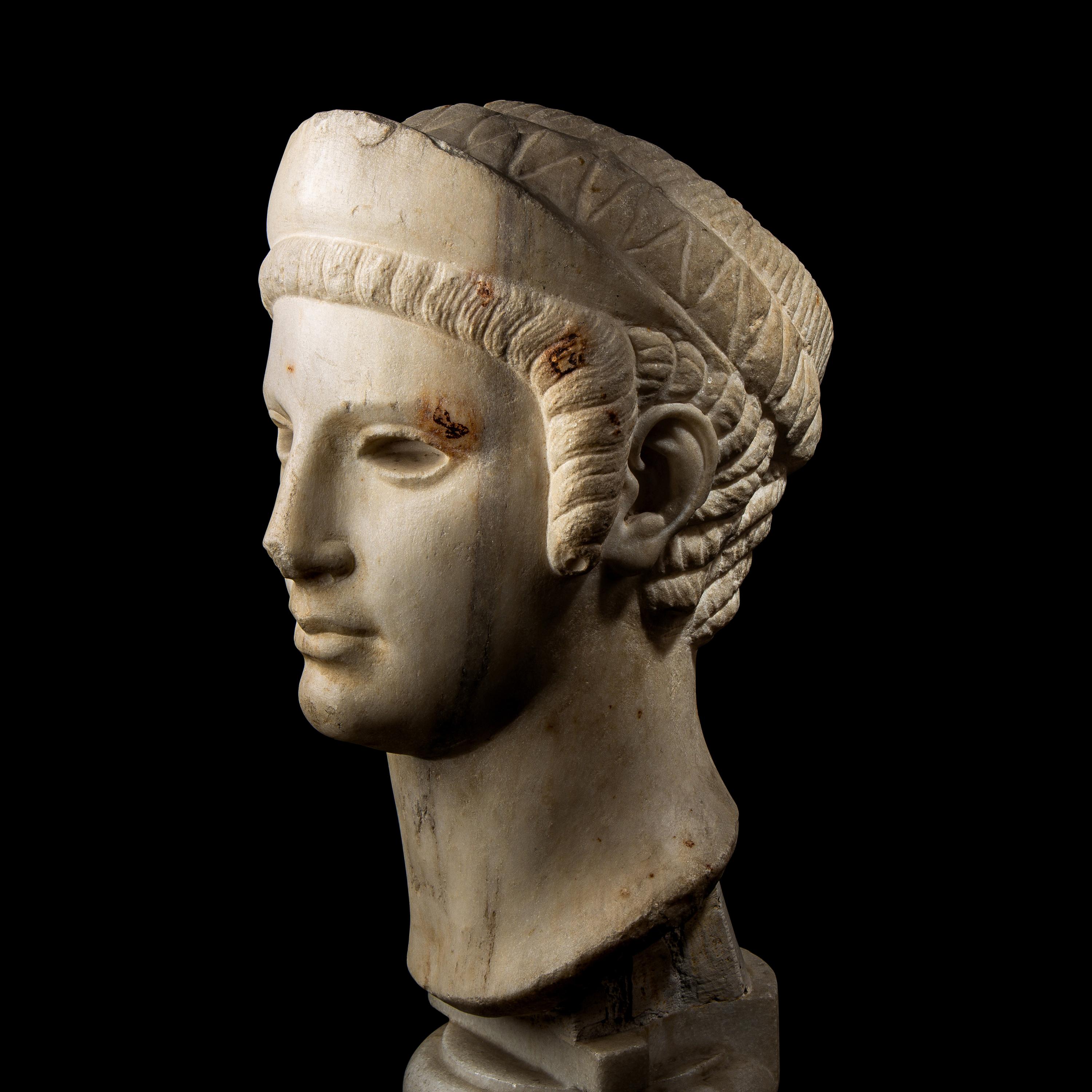
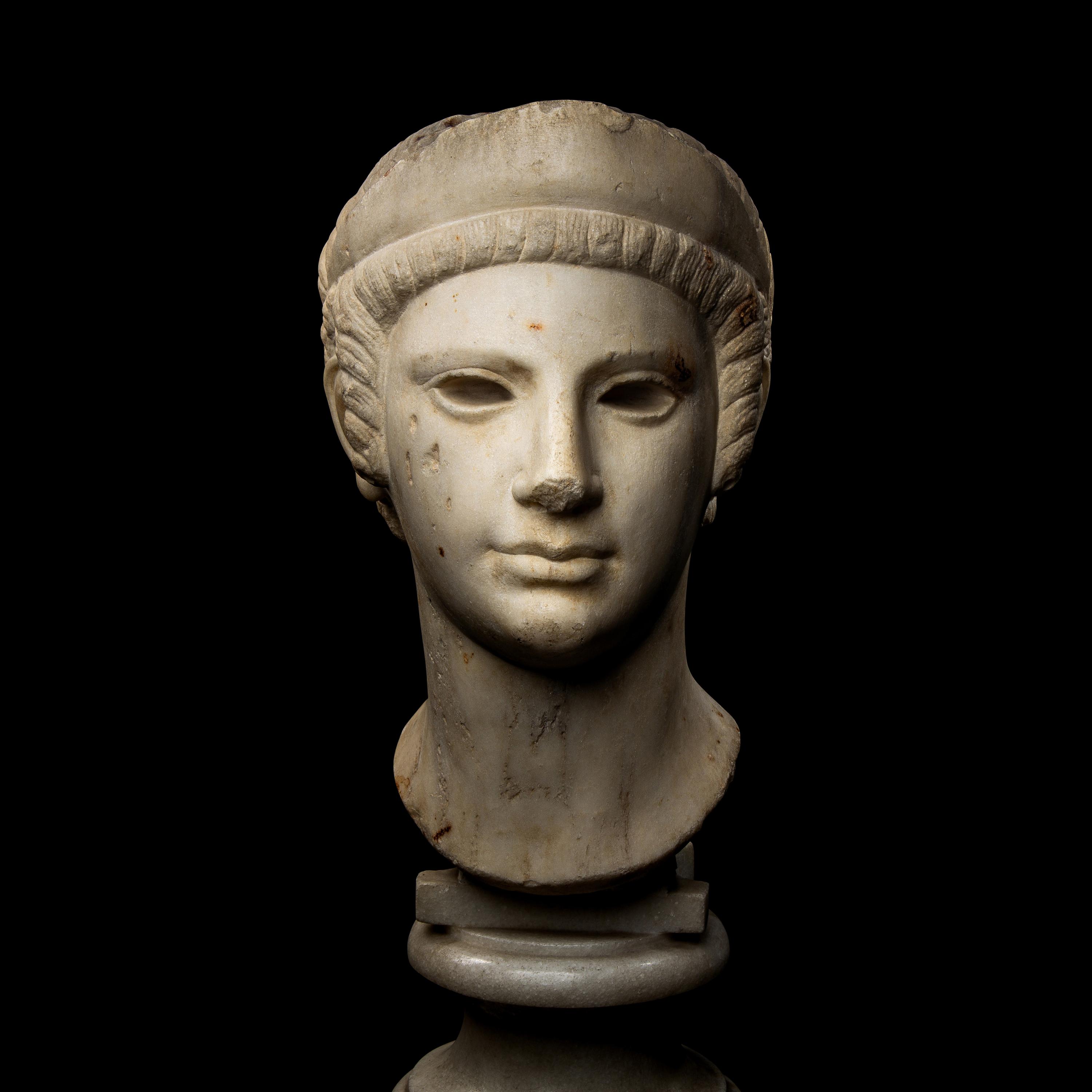
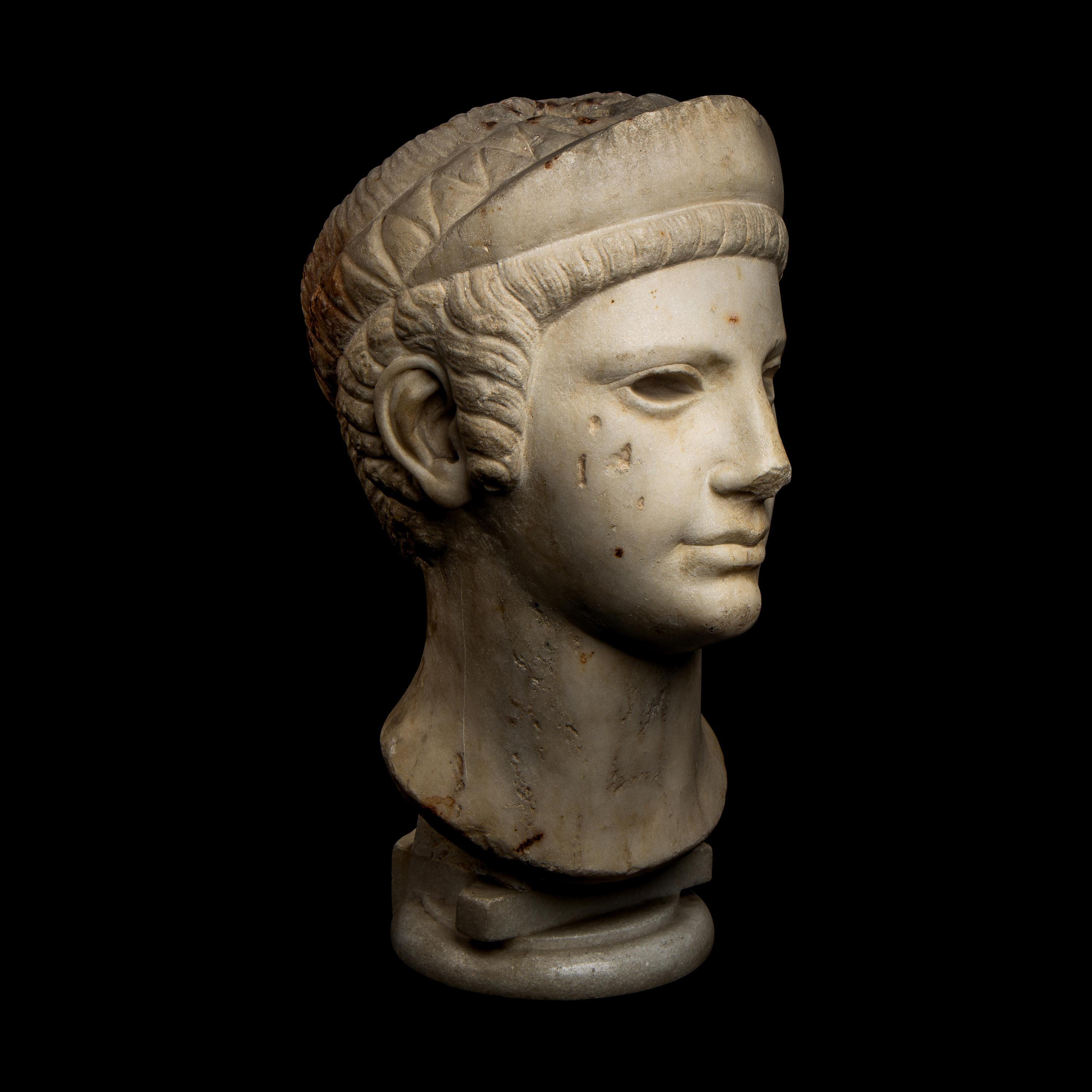
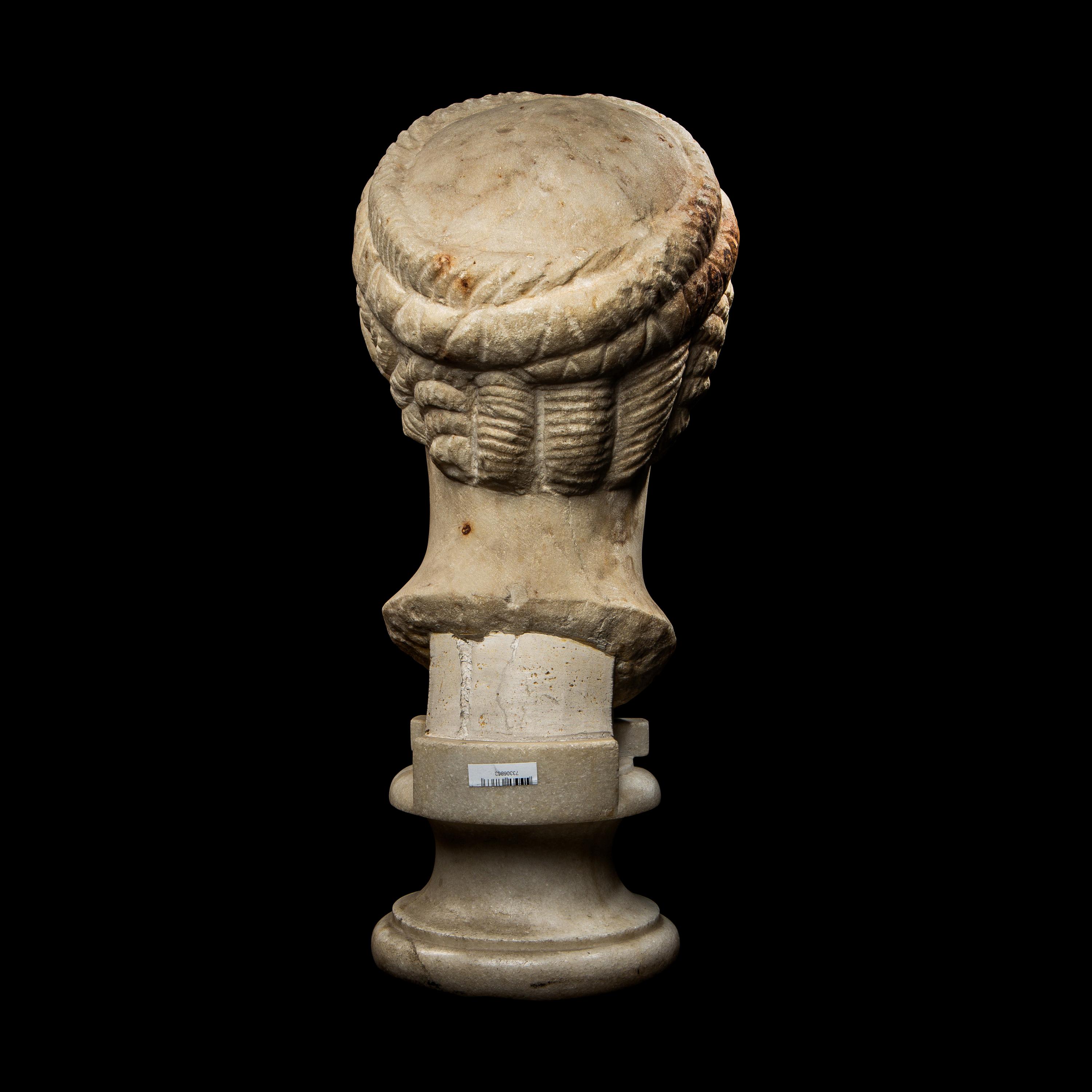
With stark frontality, cool half-smile, and complex coiffure, the present head is a masterful Roman creation harkening back to a sculptural style originating nearly five centuries earlier in Greece. The idealized facial features are characterized by almond-shaped eyes (originally inlaid in contrasting materials) beneath a smooth brow with contours descending to a straight nose. The full lips are arranged in a faint smile, and the rounded chin is slightly dimpled. The hair is organized in an ornate array of plaits, some vertical, originating at the nape, which converge into long braids wound around the head several times. At the front, a cropped fringe lies against the brow, with longer corkscrew curls lying against each cheek. A smooth, upstanding crown is nestled within this fantastical arrangement.
These cultivated anachronisms made up a retrospective style that became wildly popular in metropolitan Rome during the last decades of the 1st century B.C. and into the 1st century A.D. The phenomenon was largely borne of Augustus’ concerted interest in reviving the perceived virtues of bygone Greece – in calculated opposition to the profligate luxury of the Hellenistic kingdoms that he mightily opposed and eventually quashed with his victory over Marc Antony and Cleopatra in 31 B.C. Archaistic and Classical styles were deployed frequently for depictions of the new princeps’ patron god Apollo, and the present head could represent that deity if not for the prominent crown; with it, a mature goddess is certainly intended - perhaps Juno.
The eclectic nature of Roman archaizing and classicizing styles precludes exact parallels to the present head. Inlaid eyes were a rare feature, but find parallels in the famous Athena ‘Carpegna’ at Palazzo Massimo alle Terme (Museo Nazionale Romano, inv. no. 55051), an Augustan Athena at the Metropolitan Museum of Art (inv. no. 12.157), a 1st century ‘kore’ currently in Melbourne (National Gallery of Victoria, inv. no. 1045B-D4), and a fragmentary head from Ostia in the Vatican (Musei Vaticani, inv. no. 36849) that also exhibits a similar arrangement of side-curls. While the archaistic and classicizing styles are generally associated with the Augustan period, during which they experienced a surge in popularity, such retrospective styles were pioneered in the late Hellenistic period (for example, see the dancer from the Attalid palace at Pergamon, Berlin Antikensammlung, Staatliche Museen zu Berlin inv. no. AvP VII 43). The suggestion has been made that the present head could represent Isis, presumably on account of the curls against her cheeks – but that need not be the case: the curls are more likely an effort to evoke those of Archaic korai. On Archaic and Classicizing styles deployed in Roman sculpture, see M.D. Fullerton, The Archaistic Style in Roman Statuary (Leiden, 1990), and E.B. Harrison, Archaic and Archaistic Sculpture. The Athenian Agora, vol. 11 (Princeton, 1965).
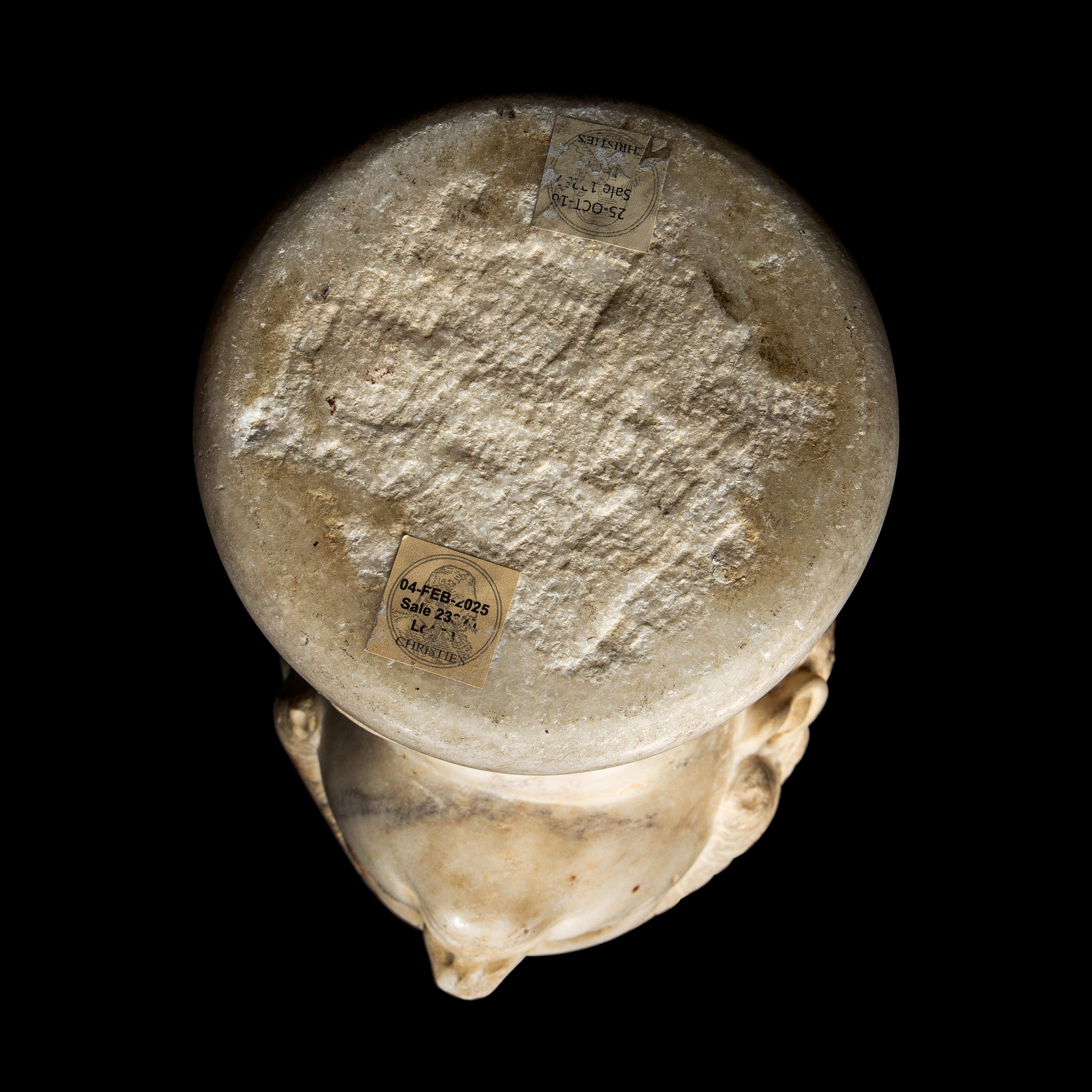
Inspected under UV light and 10x loupe. Areas of notable encrustation with significant iron deposits visible at proper right back of head.. Notable scratch at proper right neck. General wear consistent with age including chips to face and nose, and dent at the top. Overall in fine and attractive condition. See additional images. Socle mounted to old collection base which has some loss. Height with stand 42 cm (16 9/16 inches).
The physical condition of lots in our auctions can vary due to age, normal wear and tear, previous damage, and restoration/repair. All lots are sold "AS IS," in the condition they are in at the time of the auction, and we and the seller make no representation or warranty and assume no liability of any kind as to a lot's condition. Any reference to condition in a catalogue description or a condition report shall not amount to a full accounting of condition. Condition reports prepared by Freeman's staff are provided as a convenience and may be requested from the Department prior to bidding.
The absence of a posted condition report on the Freeman's website or in our catalogues should not be interpreted as commentary on an item's condition. Prospective buyers are responsible for inspecting a lot or sending their agent or conservator to inspect the lot on their behalf, and for ensuring that they have requested, received and understood any condition report provided by Freeman's.
Please email antiquities@hindmanauctions.com for any additional information or questions you may have regarding this lot.