To request further details about this lot, please email westernart@hindmanauctions.com

Adam Veil
VP, Head of Department, American Art and Pennsylvania Impressionists
Sale 6381
| Denver
| Denver
To request further details about this lot, please email westernart@hindmanauctions.com
Adam Veil
VP, Head of Department, American Art and Pennsylvania Impressionists
Estimate$100,000 – $150,000
The present lot is recorded under No. 1631 in the E. I. Couse Catalogue Raisonné maintained by the Couse-Sharp Historic Site, Taos, New Mexico. We're grateful for their assistance in the cataloguing of this work.
Provenance:
Kanst Art Gallery, Los Angeles, 1918.
Hardy's Gallery, Colorado Springs, Colorado, 1918.
Eanger Irving Couse Estate, Taos, New Mexico, 1936.
Kibbey W. Couse Estate, Taos, New Mexico, 1978.
Jerry W. Freeman, Sr., Irving, Texas.
Zaplin-Lampert Gallery, Santa Fe, New Mexico.
Acquired directly from the above, 1988.
Exhibited:
New York, National Academy of Design, "Winter Exhibition," December 18, 1915 –January 16, 1916, no. 172 (as The Prehistoric Image).
New York, City Club, unidentified clipping "There are to be found Indian figures set in landscapes or in in living quarters and landscapes in which the figures are but incidents. Such a picture is the Casin-like 'Indian Camp on the Columbia,'" January 9 – 30, 1917.
Santa Fe, Museum of Fine Arts, "Inaugural Exhibition," November 1917.
Canyon, Panhandle Plains Museum, "A Retrospective Showing of Paintings by E. Irving Couse," February 5 – 28, 1967, no. 30 (as The Prehistoric Image Maker, although dimensions differ from recorded size of this piece).
Santa Fe, Museum of New Mexico, "50th Anniversary Exhibition," November 12, 1967 – January 21, 1968.
Dallas, Dallas Museum of Art, "Visions of the West," September 28 – November 30, 1986.
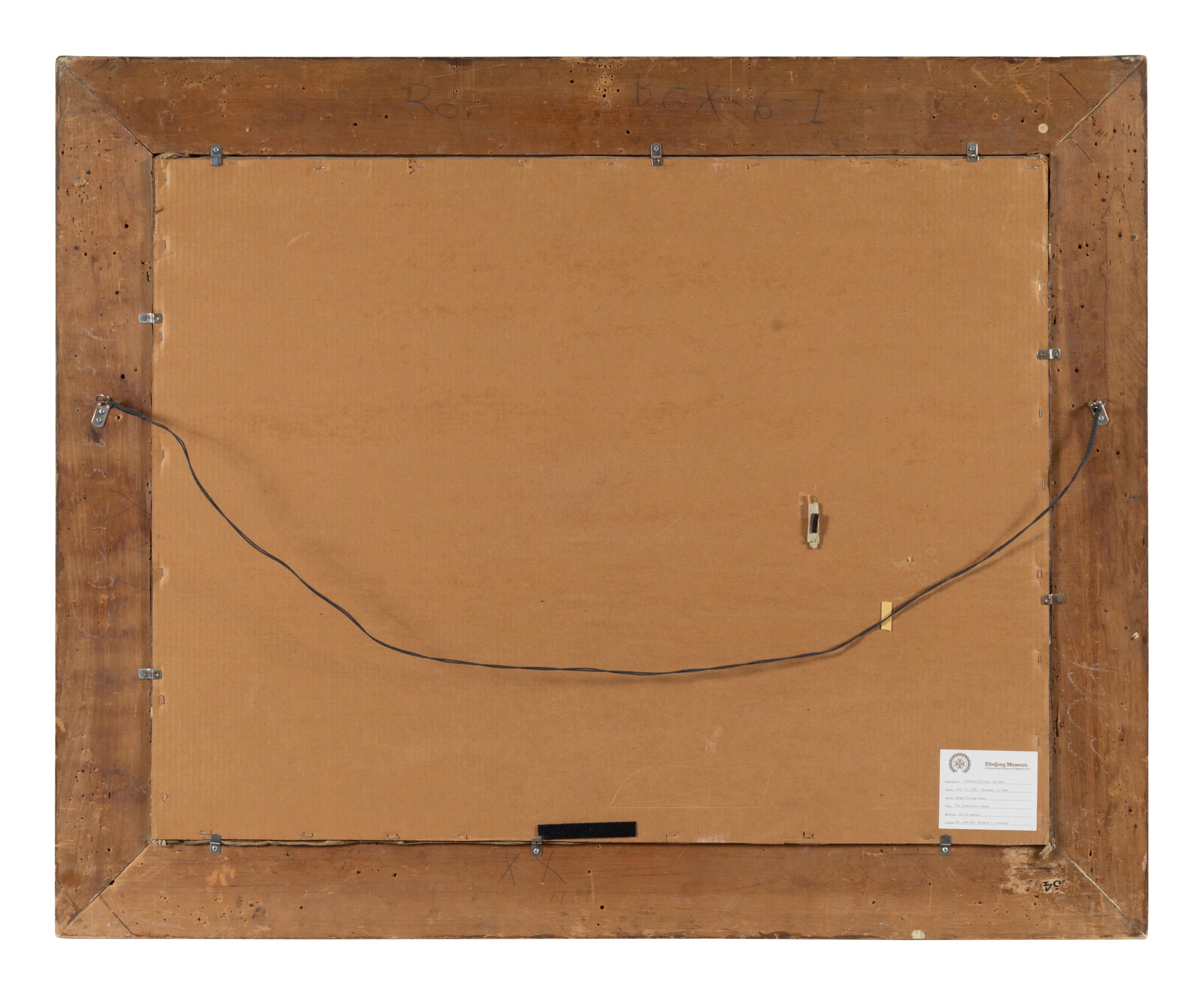
Indianapolis, Eiteljorg Museum of American Indian and Western Art, "Indiana Collects the West," July 16, 1994 – November 6, 1994 (as The Prehistoric Image).
Literature:
Santa Fe New Mexican, December 12, 1917.
Art & Archaeology, Vol. VII, no. 1-2 (1918), p. 54, listed.
Los Angeles Times, January 6, 1918.
American Magazine of Art, "Taos: A Unique Colony of Artists," Vol. 17, no. 9 (September 1926), pg. 450, illustrated.
Panhandle Plains Museum, A Retrospective Showing of Paintings by E. Irving Couse, exhibition catalogue, 1967, no. 30 (as The Prehistoric Image).
Nicholas Woloshuk, E. Irving Couse: 1866-1936, Santa Fe, 1976, pg. 99, illustrated.
Dallas Museum of Art, Visions of the West, exhibition catalogue, 1986, no. 18 (as The Prehistoric Image).
Lot Note:
Hailing from Saginaw, Michigan, Eanger Irving Couse elected Taos, New Mexico, as his home and artistic platform at the turn of the 20th century. Involved early on with the Taos Art Colony, he became a founding member and first president of the Taos Society of Artists in 1915. When Couse was painting the Taos Indians, the Southwest was still somewhat preserved from the westward expansion that would, in time, permanently alter the local landscapes and cultures.
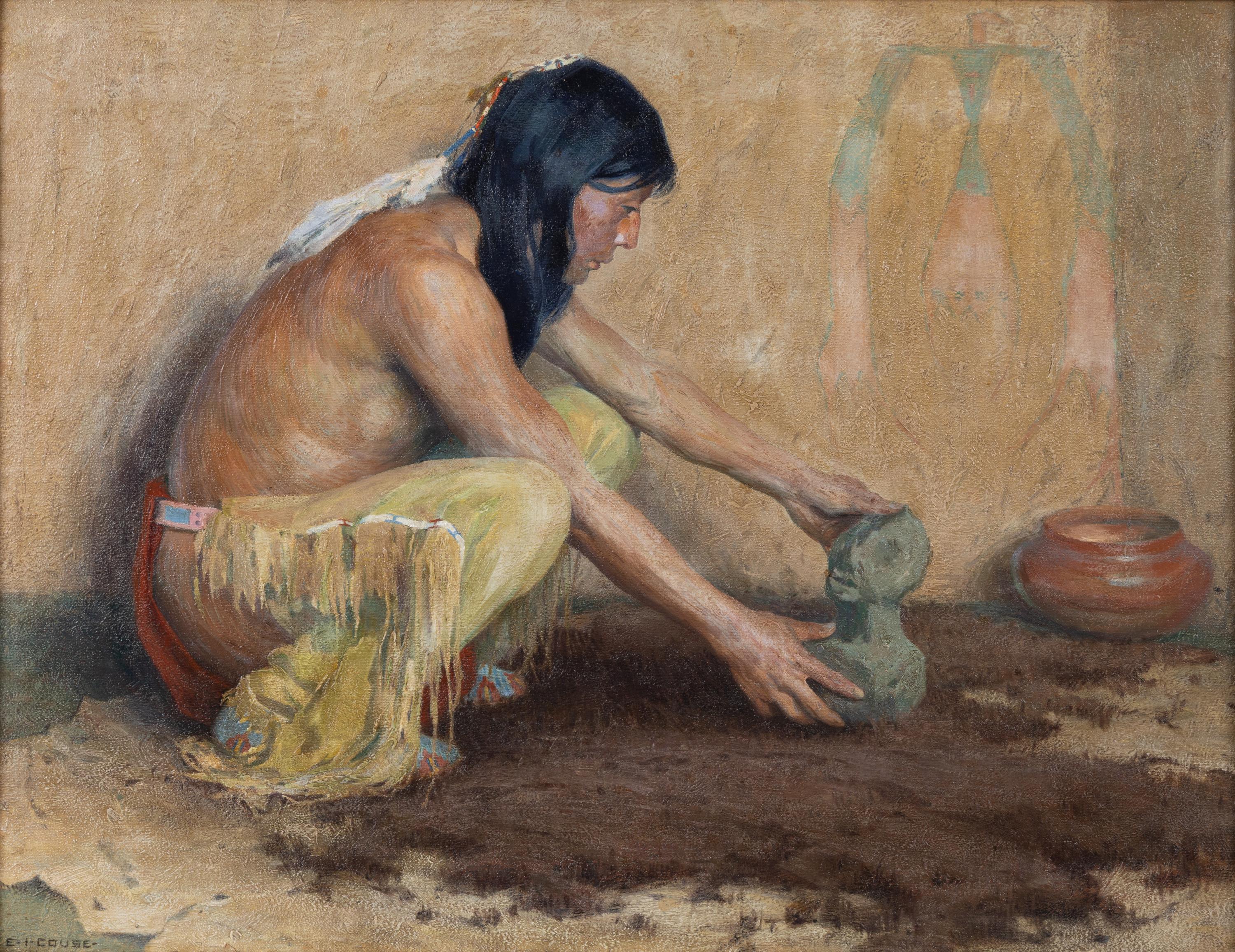
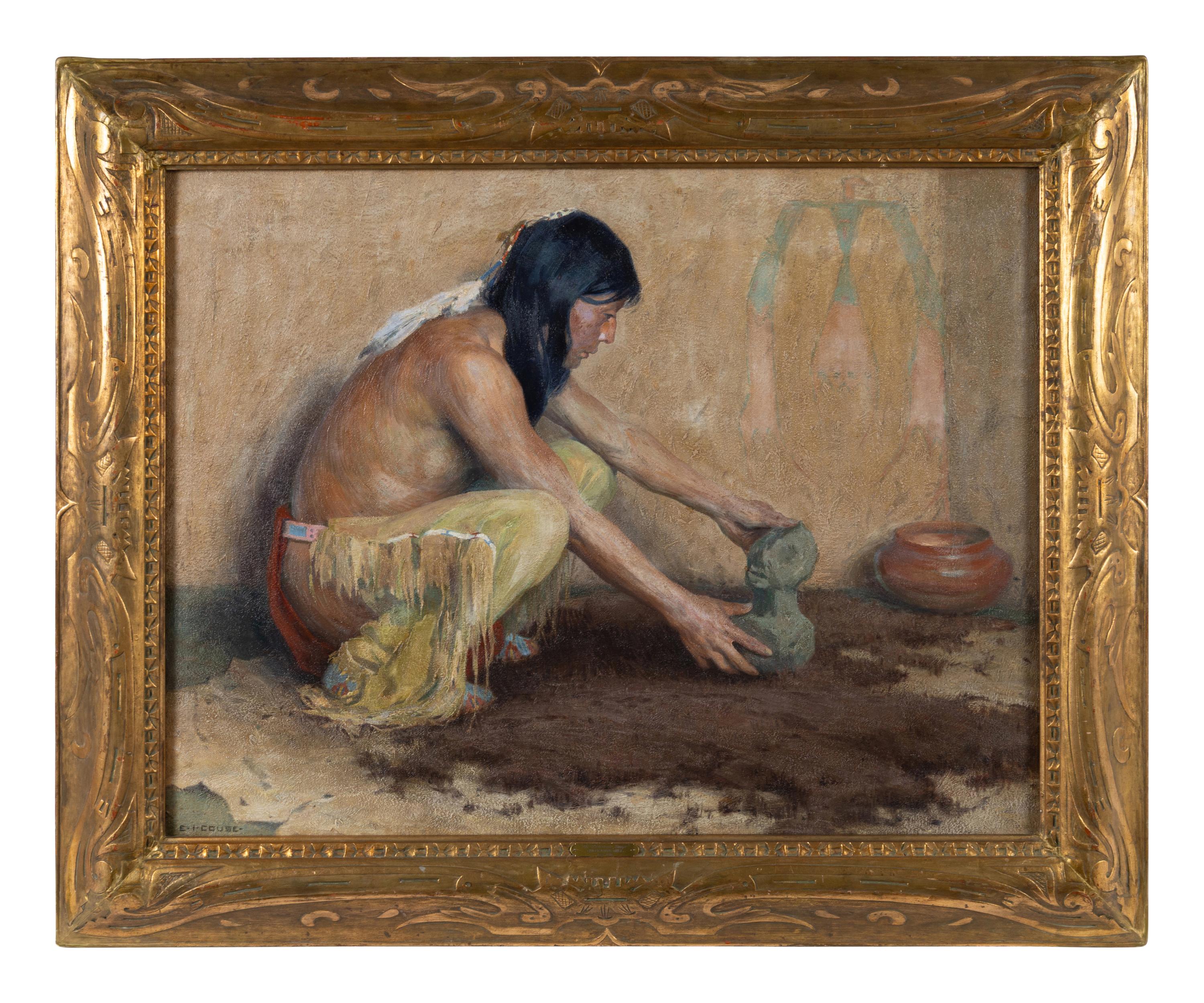
In The Prehistoric Image, the sitter, gently kneeling over his craft, dominates the composition. Viewers are immersed in his world, with no conspicuous hint of outward encroachment, instead focusing on tradition embodied by the carving, pot and Thunderbird. But the figure’s extended arms and his downward gaze are gestures of care and retention. The carving’s indistinct features, the very soft palette on the wall, and the pot left in the corner, to the confines of the image, all point to impending loss.
Nonetheless, Couse’s depiction seems spontaneous and complicates the commonly held assumption that native cultural paradigms were bound to vanish. The sitter, likely Ben Lujan, who modeled extensively for Couse, was a familiar figure, making him a fully-fledged subject, not a fabricated or simplified archetype. Purpose and resilience, rather than passivity, emanate from the scene. The slow, steady rhythm and soft sounds of craft-making can be felt throughout, and the painting is suffused with a sense of immutability in spite of the imminent overhaul hurtling at the region from the East. Couse’s gaze, benevolent and empathetic, certainly signals a desire to document and celebrate what may soon disappear. Yet, it also reveals in subtle ways the meaningful tension between the relentless pressure to assimilate and the driven, albeit quiet, resistance that seeks to perpetuate the cadence and materiality of the Taos culture.
Framed: 46 x 56 1/2 inches.
The physical condition of lots in our auctions can vary due to age, normal wear and tear, previous damage, and restoration/repair. All lots are sold "AS IS," in the condition they are in at the time of the auction, and we and the seller make no representation or warranty and assume no liability of any kind as to a lot's condition. Any reference to condition in a catalogue description or a condition report shall not amount to a full accounting of condition. Condition reports prepared by Freeman's staff are provided as a convenience and may be requested from the Department prior to bidding.
The absence of a posted condition report on the Freeman's website or in our catalogues should not be interpreted as commentary on an item's condition. Prospective buyers are responsible for inspecting a lot or sending their agent or conservator to inspect the lot on their behalf, and for ensuring that they have requested, received and understood any condition report provided by Freeman's.
Please email westernart@hindmanauctions.com for any additional information or questions you may have regarding this lot.