To request further details about this lot, please email mflack@freemansauction.com
Please email mflack@freemansauction.com for any additional information or questions you may have
Sale 6343
| Philadelphia
| Philadelphia
To request further details about this lot, please email mflack@freemansauction.com
Please email mflack@freemansauction.com for any additional information or questions you may have
Estimate$60,000 – $80,000
Provenance:
The family of the Artist's nephews Benedetto and Cesare Gennari, Bologna, until c. 1719 (their inscription 10 P. ' Dol.)
Francesco Forni, Bologna
John Bouverie (died 1750)
By inheritance to Anne Bouverie, widow of the above (died 1757)
By inheritance to John Hervey, brother of the above (died 1764)
By inheritance to Christopher Hervey, son of the above, Christopher Hervey (died 1786)
By inheritance to Elizabeth Bouverie, aunt of the above (died 1798)
Bequeathed to Sir Charles Middleton, later 1st Baron Barham (died 1813)
Thence by inheritance Charles Noel, later 1st Earl of Gainsborough, grandson of the above, (died 1866)
Archibald G. Russell, his mark stamped at lower right (Lugt 2770a)
Sold: Sotheby's, London, May 22, 1928, Lot 60
John Nicholas Brown, Providence, Rhode Island, by 1930
David Tunick Inc., New York, 1986
Jeffrey E. Horvitz Collection, Boston, by 1991
Sold: Sotheby's, New York, January 23, 2008, Lot 50
Exhibited:
London, Burlington Fine Arts Club, May-July, 1923, pl. 52, illus.
London, Magnasco Society, Catalogue of a Loan Exhibition of Drawings, XVII-XVIII Century, 1927, no. 6
London, Royal Academy, Italian Art: 1200-1900, January-March, 1930, no. 651a
Gainesville, Florida, University of Florida, Samuel P. Harn Museum of Art, Italian Old Master Drawings from the Collection of Jeffrey E. Horvitz, July 12 - September 8, 1991, no. 20, pp. 80-83, (and traveling) (as Head of a Monk, Possibly St. Francis)
Literature:
A.G.B. Russell, Drawing by Guercino, London, 1923, pp. 20-21; 58, pl. XVII, illus. (as Profile of a Monk)
T. Borenius (anonymously), "Drawing in the Collection of Mr. Archibald G.B. Russell," The Connoisseur, vol. LXVI, May 1923, pp. 3-12, pl. V, illus.
H. Tietze, European Master Drawings in the United States, New York, 1947, no. 56, p. 112, illus. (Profile Head of a Monk)
Sir Denis Mahon, I disegni del Guercino della collezione Mahon, Bologna, 1967, p. 18, note 49
D.M. Stone, Guercino, Master Draftsman: Works from North American Collections, Cambridge, Massachusetts, 1991, no. 182, pp. 223; 233, pl. E, illus.
Lot Essay:
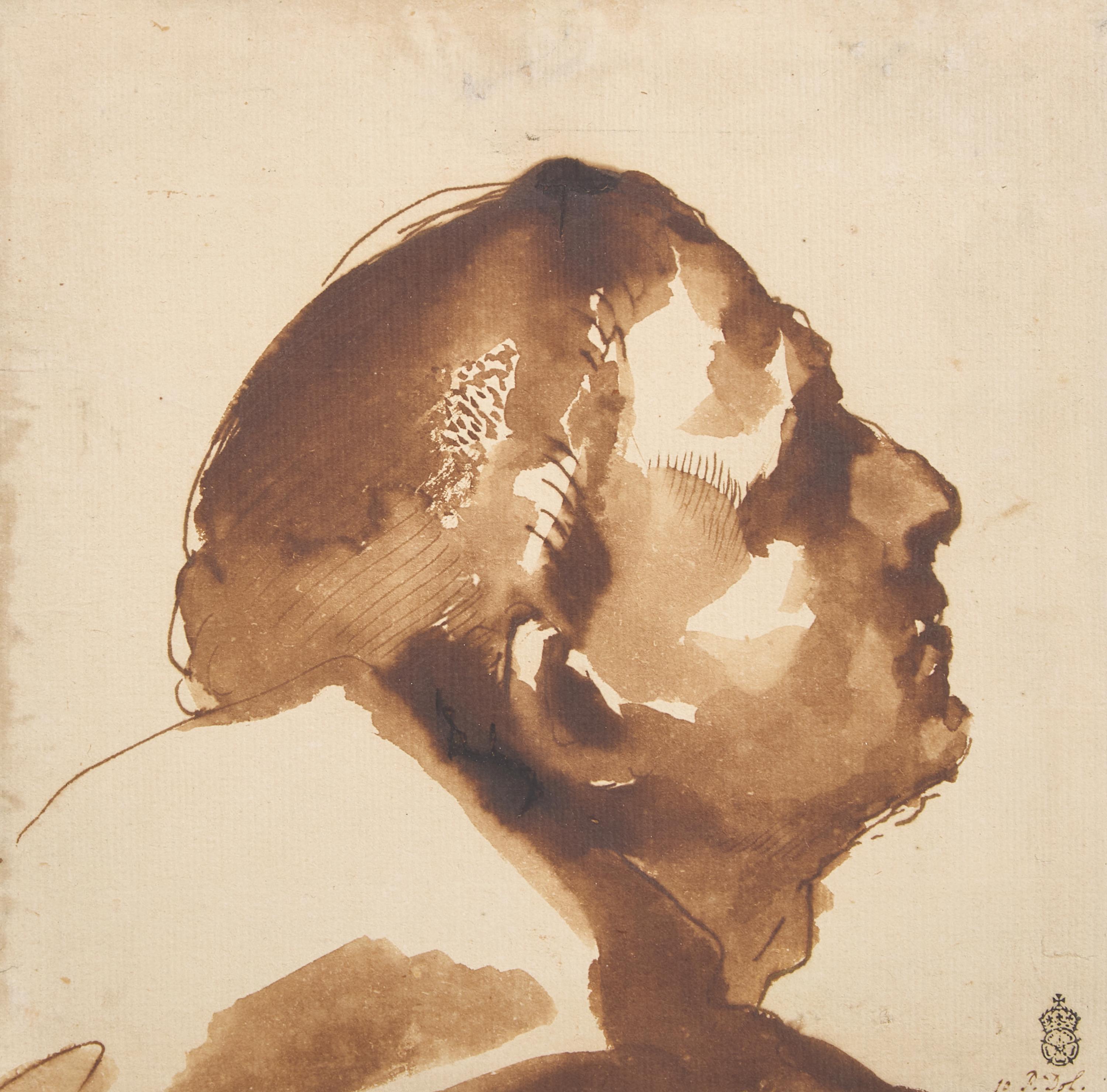
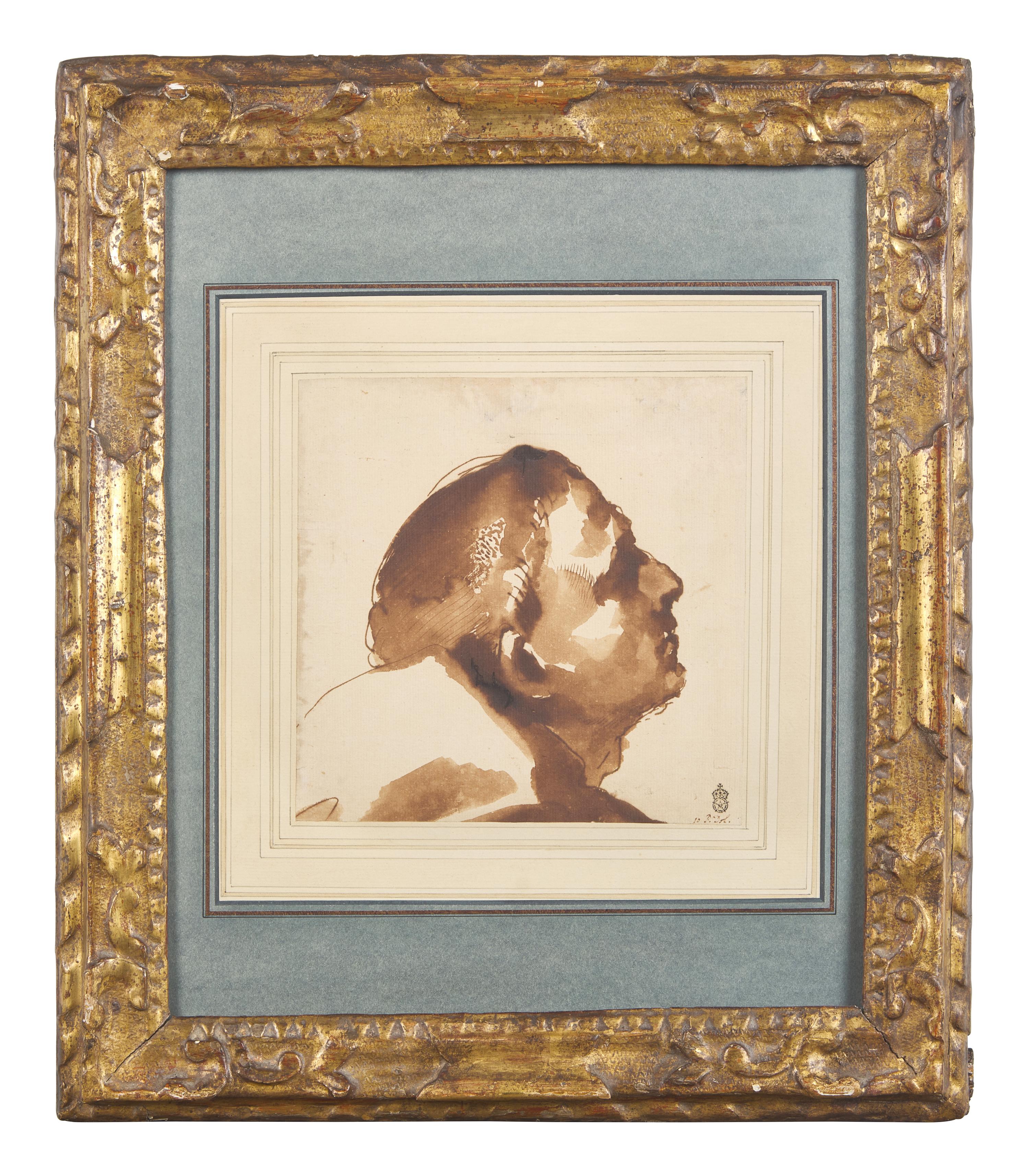
The present lot was once part of the large group of drawings which, on Guercino's death, were inherited by his nephews Benedetto (1633-1715) and Cesare (1637-1688) Gennari. By the middle of the eighteenth century, the drawings passed to Cesare's grandson, Carlo Gennari (1712-1790), by whom the group was dispersed. At this point, many drawings, including this sheet, were obtained by the Bolognese dealer, Francesco Forni, who then sold them to John Bouverie. (N. Turner and C. Plazzotta, Drawings by Guercino from British Collections, exhibition catalogue, London 1991, p. 8) According to an inventory of the Gennari family's property taken in 1719, prior to the dispersal of the drawings, 1,689 of them were placed in eight large albums, which were organized according to the medium and subject of the drawing. (D. Mahon and N. Turner, The Drawings of Guercino in the Collection of her Majesty the Queen at Windsor Castle, Cambridge 1989, pp.xx-xxi) One of these albums was entitled Dissegni di Penna, et Acquarella di diverse grandezze, rapresentanti diverse Teste, Figure, e Puttini; it contained 297 drawings, of which the present study was most probably one. (See Gainesville, et al., 1991-93, loc. cit.)
In Linda Wolk-Simon's entry on this drawing in the catalogue of the 1991-3 Horvitz Collection exhibition, she suggested that it has certain affinities with the kneeling St. Francis in Guercino's altarpiece of 1639-41, which depicts the Madonna and Child with Ss. Francis and Clare (Parma, Galleria Nazionale). (See D.M. Stone, Guercino: Catalogo completo dei dipinti, Florence 1991, cat. no. 165) However, since the exhibition catalogue was published, an altarpiece by Guercino has come to light that may provide a stronger connection. The pala in question, which was documented but thought to have been lost, dates from 1663, and depicts the Madonna and Child appearing to Beato Marcolino Ammani di Forlí: it is to the latter figure that the present study appears to relate. The painting was discovered by Prisco Bagni, badly damaged and in storage at the Pinacoteca di Brera, Milan. It was subsequently cleaned, restored, and published by Bagni in 1991 as a late work, dating from 1663. Before the discovery of the painting, the composition was known, but only from a 1757 engraving by Bolzoni. (D. Mahon, P. Bagni et al, Giovanni Francesco Barbieri, il Guercino, 1591-1666, exh. cat., Bologna 1991, cat. no. 152; the engraving reproduced in P. Bagni's note on the painting in M. Foschi and G. Viroli (eds.), Il San Domenico di Forlí. La chiesa, il luogo, la città, exh. cat., Forlí, Oratorio di San Sebasiano, 1991, pp. 98, 101) Bagni also identified another drawing connected with the painting, a double-sided red chalk sheet, also in the Brera, which has a compositional study on the recto and a study for the kneeling friar on the verso. (P. Bagni in Il San Domenico di Forli, exh. cat., op. cit., pp. 99-100)
The present sheet is drawn in a notably different manner from the red chalk drawing, with broad, bold pen and brown ink, and wash, rather than the more tentative, loosely sculpted chalk of the double-sided study, which fits with what Nicholas Turner describes as the 'broken contours and lines of fluctuating intensity' of Guercino's late period. (Turner and Plazzotta, op.cit., p. 181) As Turner has also pointed out, the present study, on the other hand, can best be related stylistically to Guercino's drawings of the 1630s, and in particular to certain drawings of half- or bust-length single male figures that he made at this time, such as the Old Bearded Man (Royal Library, Windsor Castle), the Man Reading at a Table (Fogg Art Museum, Cambridge, Massachusetts), and the Bust of a Man, facing right (Metropolitan Museum of Art, New York). (Turner's observations cited by Wolk-Simon in the 1991-3 Horvitz exhibition catalogue, loc. cit.)
This difference in style between the two sheets may confirm Wolk-Simon's hypothesis that the present drawing was not drawn in preparation for a painting, but was instead an 'independent invention,' which accounts for the study's highly poetic nature, and the wonderfully broad, fluid manner in which it has been drawn. Indeed, considering it is thought that Guercino drew far less in the 1650s and 60s, and that his doctor had apparently forbidden him from drawing on account of chest pains, the idea that the artist might have used an earlier design, from one of his most intensive periods of draftsmanship, as inspiration for his last painting seems both appealing and plausible. (Turner and Plazzotta, op. cit., p.181)
Framed: 16 3/4 x 14 1/4 in.
The physical condition of lots in our auctions can vary due to age, normal wear and tear, previous damage, and restoration/repair. All lots are sold "AS IS," in the condition they are in at the time of the auction, and we and the seller make no representation or warranty and assume no liability of any kind as to a lot's condition. Any reference to condition in a catalogue description or a condition report shall not amount to a full accounting of condition. Condition reports prepared by Freeman's staff are provided as a convenience and may be requested from the Department prior to bidding.
The absence of a posted condition report on the Freeman's website or in our catalogues should not be interpreted as commentary on an item's condition. Prospective buyers are responsible for inspecting a lot or sending their agent or conservator to inspect the lot on their behalf, and for ensuring that they have requested, received and understood any condition report provided by Freeman's.
Please email mflack@freemansauction.com for any additional information or questions you may have regarding this lot.