To request further details about this lot, please email mflack@freemansauction.com
Please email mflack@freemansauction.com for any additional information or questions you may have
Sale 6343
| Philadelphia
| Philadelphia
To request further details about this lot, please email mflack@freemansauction.com
Please email mflack@freemansauction.com for any additional information or questions you may have
Estimate$30,000 – $50,000
Provenance:
Sold: Chartres, Lelièvre, Maiche, Paris, October 24, 1999, Lot 182 (as 'Attributed to Rosalba Carriera')
Jean-Luc Baroni, Ltd., London
Private Collection
Sold, New York, Sotheby's, January 31, 2018, Lot 164
Literature:
N. Jeffares, Dictionary of pastellists before 1800, online edition, no. J.9.5817 (under 'Anonymous French School')
Lot Essay:
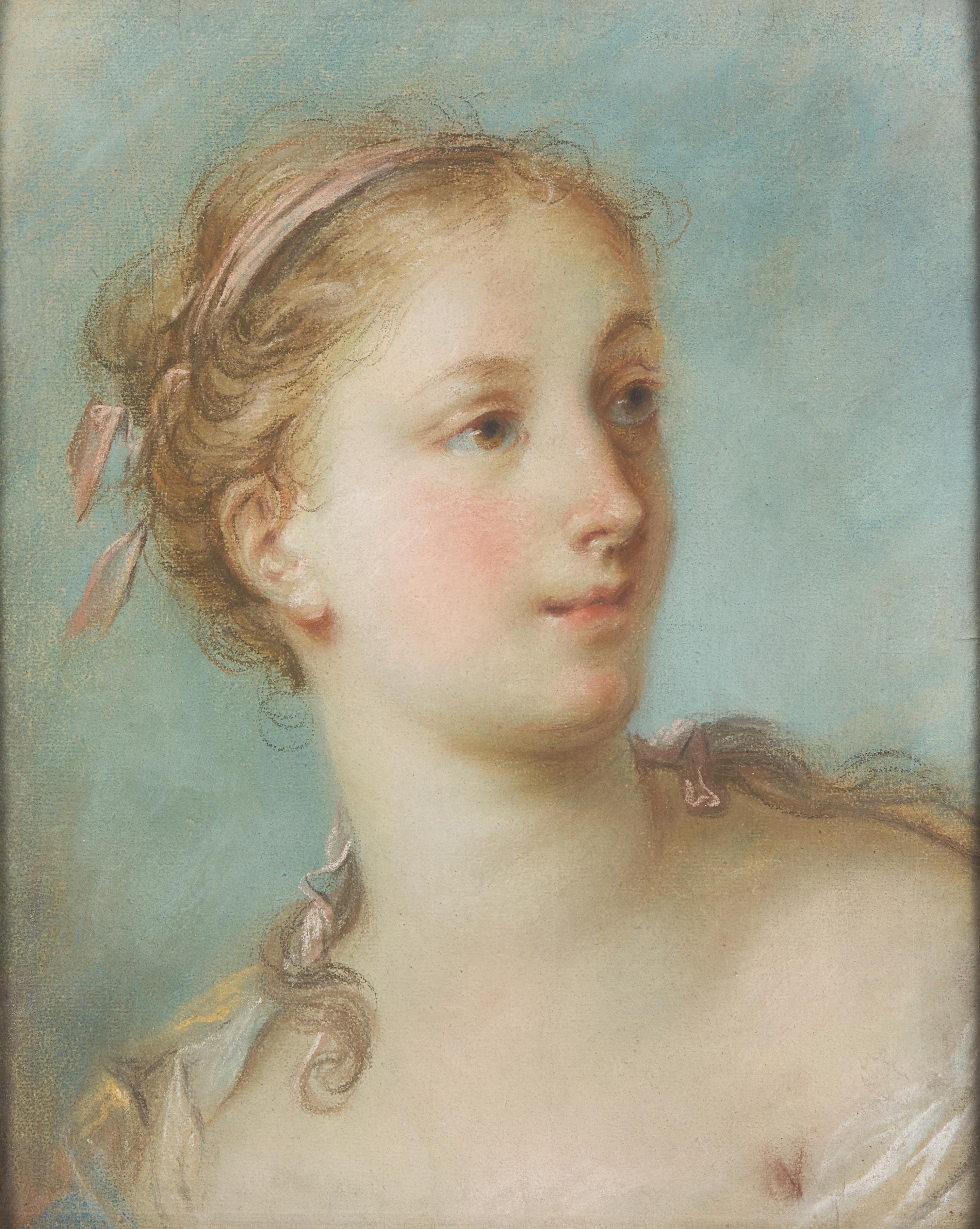
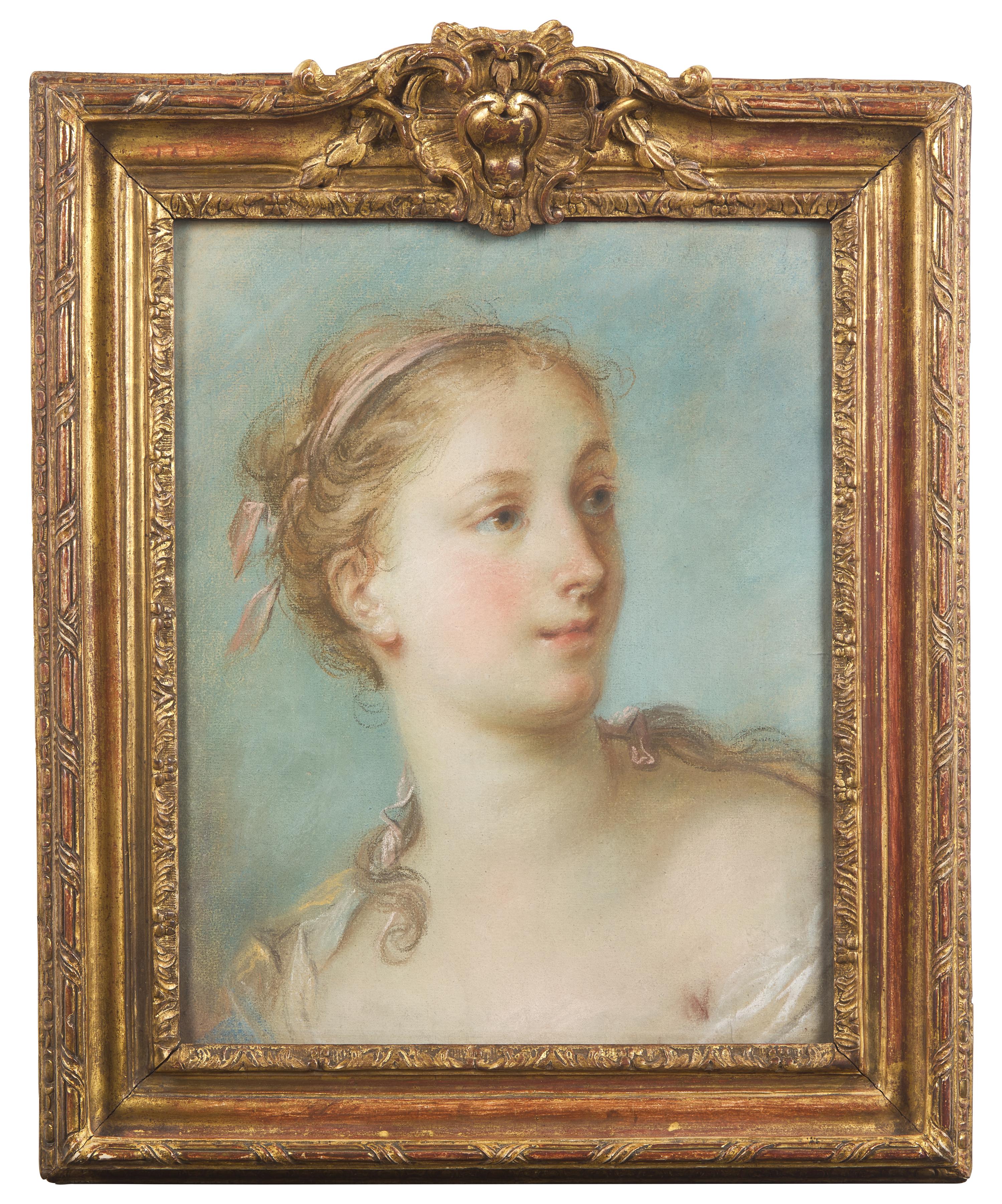
Unique within Le Moyne’s known oeuvre, the present pastel depicts an attractive young woman, her head turned to the right and in a loose chemise. It is a compelling addition to the very few pastels by the artist that survive today.
François Le Moyne, pupil of Louis Galloche (1670-1761), won the coveted Prix de Rome in 1711 but was not offered the traditional trip to Rome due to the economic climate in France at the time. Le Moyne only travelled to Italy in the early 1720s and stayed for a few short months. While there he was greatly influenced by Italian artists such as Correggio and Pietro da Cortona, and the Sienese painter Federico Barocci.
Elected professor of the Académie de Peinture in 1733, Le Moyne's pupils included Charles Joseph Natoire and François Boucher. Le Moyne was held in high regard during his lifetime and produced magnificent ceiling decorations at Versailles, including for the famous Salond'Hercule. His drawings were collected by the most discerning connoisseurs of the century.
Throughout his short career, Le Moyne used three basic techniques when working on his drawings. His methods are concisely documented by Jean-Luc Bordeaux, in his 1984 monograph on the artist, as red chalk drawings on beige paper; black chalk studies heightened with white chalk on blue or grey paper; and finally trois crayons and/or pastels. (Jean-Luc Bordeaux, François Le Moyne and his Generation, 1688-1737, Neuilly-sur-Seine, 1984, p. 139) Bordeaux highlights the fact that works in both trois crayons and pastel are rare but remarks that Donat, one of Le Moyne’s first biographers, "reported that Le Moyne took great pains in making specific pastel studies of heads of the principal figures in his most important commissions…" (Ibid.) This revealing comment suggests that this was an important element in Le Moyne’s artistic endeavors, despite very few surviving pastels.
In a communication to a previous owner, Jean Luc Bordeaux supports the attribution of the present pastel to Le Moyne. While the head study does not relate directly to any known painting, Bordeaux identifies a number of painted figures by the artist to which she can be plausibly compared, on the basis of the facial type and tilt of the figure's head, as well as a variety of other nuances. He likens this beautiful head to the maiden in A maiden soaking a small piece of cloth in a fountain (known in two versions, in private collections), in which the facial features are similarly rendered in terms of the eyes and lips, and the manner in which the artist has handled the hair and ribbon is also comparable. Bordeaux also cites the figure of Andromeda in the Perseus and Andromeda in the Wallace Collection, where again facial features such as the chin and almond shaped eyes are very comparable, and the Venus in Venus and Adonis in the Nationalmuseum, Stockholm, in which once more the nose and lips, and handling of the hair, are all very similar.
Other stylistic elements identified by Bordeaux as typical of the artist's work include the rapid, rounded strokes made with a hard pastel stick to define the hair, and the light stumping around the corners of the figure's mouth, eyebrows, and eyelids. Also noted by Bordeaux is Le Moyne's overall preference for the consistency of softer pastel sticks and colors, often blended with cloth or brush, to convey the luminosity and smooth uninterrupted tonal textures of the sitter's skin. This softness is emphasized by the artist's more sculptural and angular treatment of the border of her negligée and the lively hair tendrils curling over the sitter's neck and along her shoulders. stands out against the more angular lines used to describe the borders of her garment. It is difficult to find close comparisons to the present pastel and others by the artist, as almost all of Le Moyne's known works in pastel or colored chalks are representations of men.
Le Moyne’s close relationship with his patron and friend François Berger has led Bordeaux tentatively to suggest that this beguiling and beautiful young woman may have been a member of the social circle of Berger and his wife. Her identity is, however, irrelevant to our appreciation of this refined image, or to the light that it sheds on our understanding of Le Moyne's work in this medium, a fascinating aspect of the artist's short but fruitful career.