To request further details about this lot, please email awolkenberg@freemansauction.com

Raphaël Chatroux
VP, Head of Department, Impressionist & Modern Art
Sale 6342
| Philadelphia
| Philadelphia
To request further details about this lot, please email awolkenberg@freemansauction.com
Raphaël Chatroux
VP, Head of Department, Impressionist & Modern Art
Estimate$50,000 – $70,000
The present lot is not recorded in the archives of the Art Loss Register.
Provenance
The Artist.
(Likely) a gift from the above.
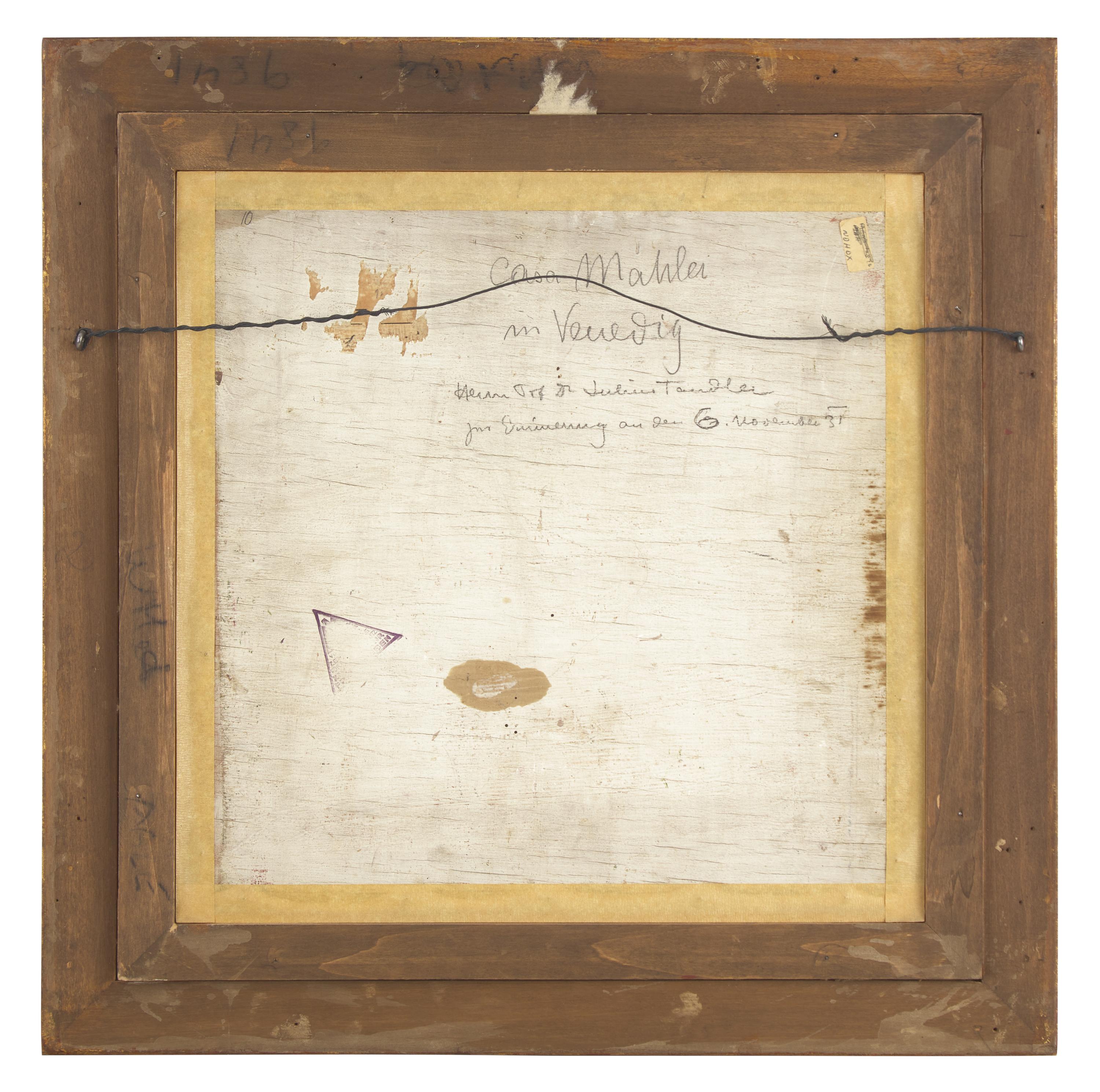
Collection of Dr. Julius Tandler, Vienna, Austria (per pencil inscription verso)
Hermitage House, Inc., New York, New York.
Acquired directly from the above in 1974 by the present owner.
Literature:
Arthur Roessler, "Carl Moll: A contribution to Contemporary Artist History," in Der getreue Eckart, No. 1, Vienna, October 1928, p. 30 (illustrated).
Karl Strobl, "Venice as an Artistic Experience," in Art in the People. Journal for Friends of the Fine Arts, Vol. 5, No. 5/8, Vienna 1954, p. 164 (illustrated).
Monika Fritz, The Viennese Painter Carl Moll, dissertation, Innsbruck 1962, p. 149, no. 67.
Carl Moll. His Friends ∙ His Life ∙ His Work, Galerie Welz, Salzburg 1985, pp. 68; 170, no. 79 (illustrated and dated to 1926).
Cornelia Cabuk, Carl Moll. Monograph and catalogue raisonné, Vienna, 2020, vol. 11, p. 218, no. GE 355 (illustrated).
Lot Essay:
Although Carl Moll remains relatively unknown outside of his native Austria, he was one of the leading artists in Vienna at the turn of the 20th century. In 1897, along with Gustav Klimt, Otto Wagner, and Josef Hoffman, Moll co-founded the Viennese Secession, with the goal of breaking free from the inherent conformity dictated by Vienna’s Academy of Fine Arts and to promote new forms of creation. This movement in turn revitalized what is considered to be modern Austrian Art. While Moll is mostly known for the serene and elegant interior scenes he produced throughout his entire career, as exemplified by Weißes Interieur (White Interior), which Freeman's sold for a world-breaking $4.7M in 2021, he also painted colorful landscapes and still lifes, mostly parks and riversides executed en plein air, and inspired by French Impressionism.
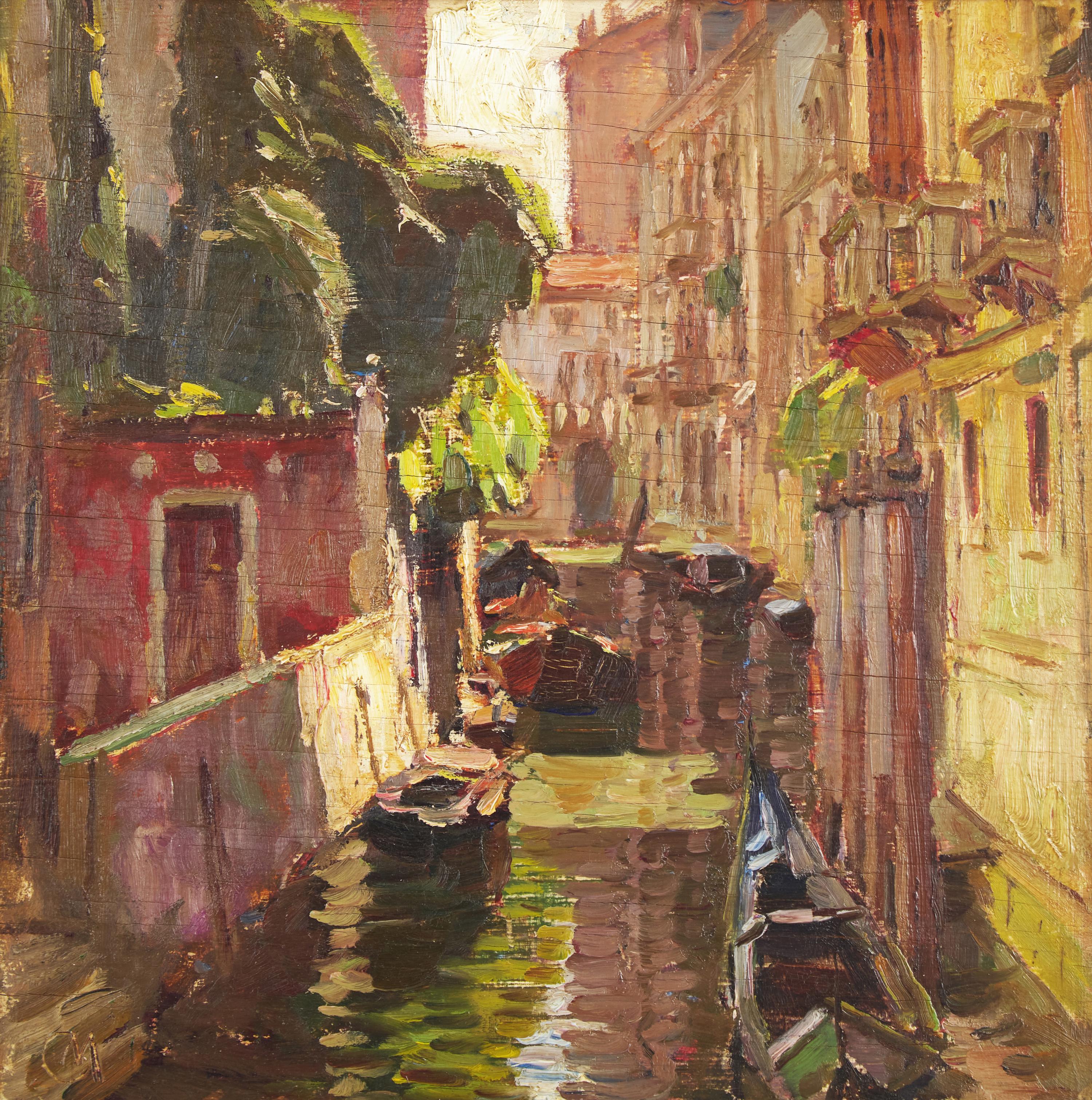
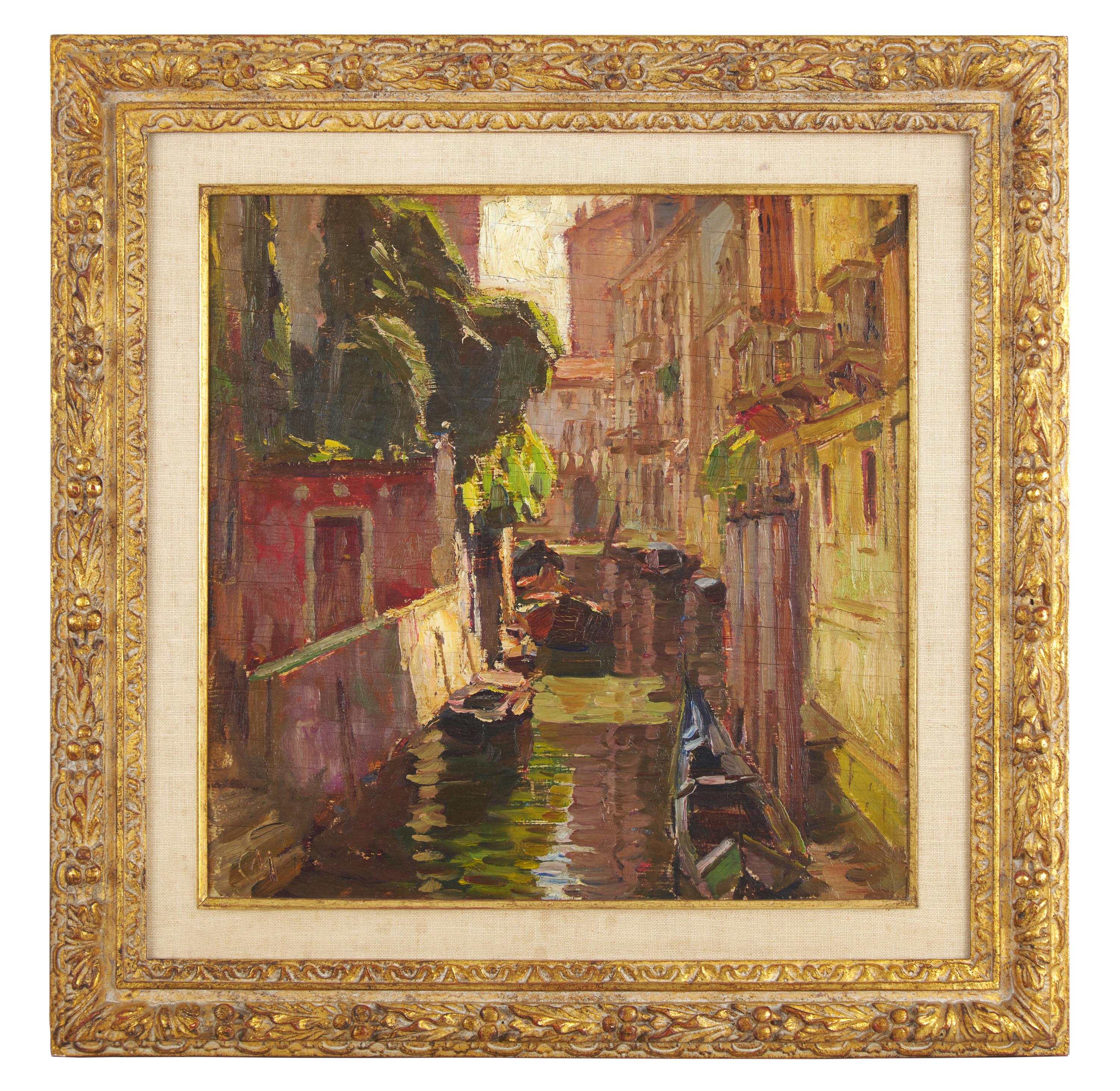
Executed circa 1924, Das rote Haus in Venedig dates from a time when Moll and his wife Anna travelled extensively to Italy and France in the winter, especially to cities and villages near the sea, such as Venice. Venice had a particular appeal, as Anna’s daughter and Carl’s stepdaughter, Alma Mahler, had purchased a house there in 1922, which she named Casa Mahler. Alma had been married to the Romantic composer and noted conductor Gustav Mahler from 1902 until his death in 1911. Born in Vienna in 1897, Alma was the daughter of landscape painter Emil Jakob Schindler and Hamburg singer Anna Sofie Bergen. After the death of Schindler in 1892, her mother married Moll, who had been mentored by her husband. As a founder of the Vienna Secession, Moll’s house was a meeting place for its members, including Klimt, Hoffman, Kolomon ('Kolo') Moser, and Joseph Maria Olbrich, as well as literary figures, such as Max Burckhard (at that time director of the Burgtheater) and Hermann Bahr. Exposed to this wide artistic circle at a young age, Alma was to go on to become a recognized composer herself. In addition to her marriage to Mahler, Alma was romantically linked to the artist Oskar Kokoschka and married both the famed architect Walter Gropius (1915-1920) and the poet and author Franz Werfler (1929-1945).
The inscription to Julius Tandler on the reverse of the present painting further links it to another significant Viennese figure. Tandler was a noted anatomist whose main claim to fame was his ambition to introduce a comprehensive system of public health and social services in the Vienna municipality in the interwar years. Both Moll and Tandler were a part of the committee, which also included Anton Hanak, Josef Hoffmann, and Berta Zuckerkandl, that organized a large commemorative exhibition of Gustav Klimt’s work in 1928, ten years after the artist’s death.
Despite the Cubist and Abstract movements emerging at the beginning of the 20th Century, Moll remained a fervent proponent of figurative works, believing that the creative process always originated from a first-hand visual experience. As exemplified in this richly hued work, the artist adopted a freer style in his late career, made of spontaneous, very fluid, and dynamic brushstrokes, as well as a joyful color palette that dazzles the eye. As Cornelia Cabuk, author of the monograph of the artist's work has stated, "the experience of Spain and El Greco" in the early 1910s as well as "the music of Mahler" are responsible for this artistic shift, which "led to the gradual emergence of a rhythmically accentuated, free colorism in Moll’s work." This bold chromatic play, paired with the sense of immediacy that the work conveys, channel both the art of Cézanne and Matisse, whom Moll both revered and defended.
As often with Moll, the panel is square, a format he usually reserved for his landscapes. The square format was often used by artists of the Secession movement to achieve a harmonious effect of high artistic quality. The scintillating sunlight that bounces off the building walls, greenery, and canal water likewise reveals the artist’s unique fragmented touch in the treatment of light, which appears vibrating, iridescent, and pointillist. The composition is a masterful exploration of the myriad different tonalities, which capture the play of light on a variety of textures to optimum effect.
Framed: 19 1/4 x 19 1/4 inches.
In overall good condition, with minor deposits of surface dirt and dust. We notice horizontal hairline craquelures throughout the surface of the panel, which appear stable and very thin. Under UV light: no apparent inpainting is visible. Additional images available upon request.
The physical condition of lots in our auctions can vary due to age, normal wear and tear, previous damage, and restoration/repair. All lots are sold "AS IS," in the condition they are in at the time of the auction, and we and the seller make no representation or warranty and assume no liability of any kind as to a lot's condition. Any reference to condition in a catalogue description or a condition report shall not amount to a full accounting of condition. Condition reports prepared by Freeman's staff are provided as a convenience and may be requested from the Department prior to bidding.
The absence of a posted condition report on the Freeman's website or in our catalogues should not be interpreted as commentary on an item's condition. Prospective buyers are responsible for inspecting a lot or sending their agent or conservator to inspect the lot on their behalf, and for ensuring that they have requested, received and understood any condition report provided by Freeman's.
Please email awolkenberg@freemansauction.com for any additional information or questions you may have regarding this lot.