To request further details about this lot, please email awolkenberg@freemansauction.com

Raphaël Chatroux
VP, Head of Department, Impressionist & Modern Art
Sale 6342
| Philadelphia
| Philadelphia
To request further details about this lot, please email awolkenberg@freemansauction.com
Raphaël Chatroux
VP, Head of Department, Impressionist & Modern Art
Estimate$150,000 – $250,000
We wish to thank Mr. Xavier Tricot for confirming the authenticity of the present lot, and for his kind assistance in its cataloguing.
Provenance:
Sam Salz, Paris & New York.
Leicester Galleries, London, United Kingdom.
Private Estate, Houston, Texas.
Sandy Perkoff, New Orleans, Louisiana.
Acquired directly from the above in 1972.
Exhibited:
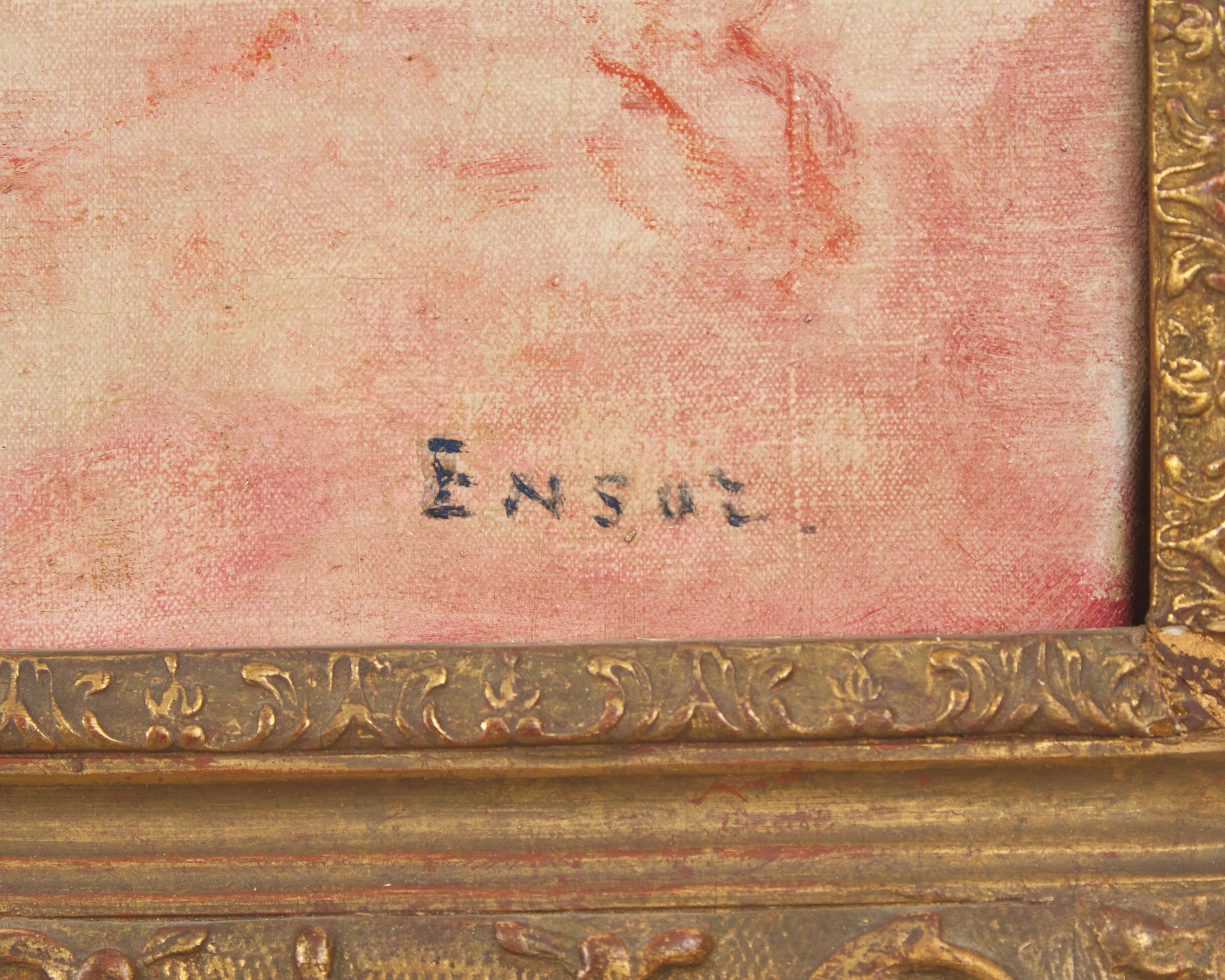
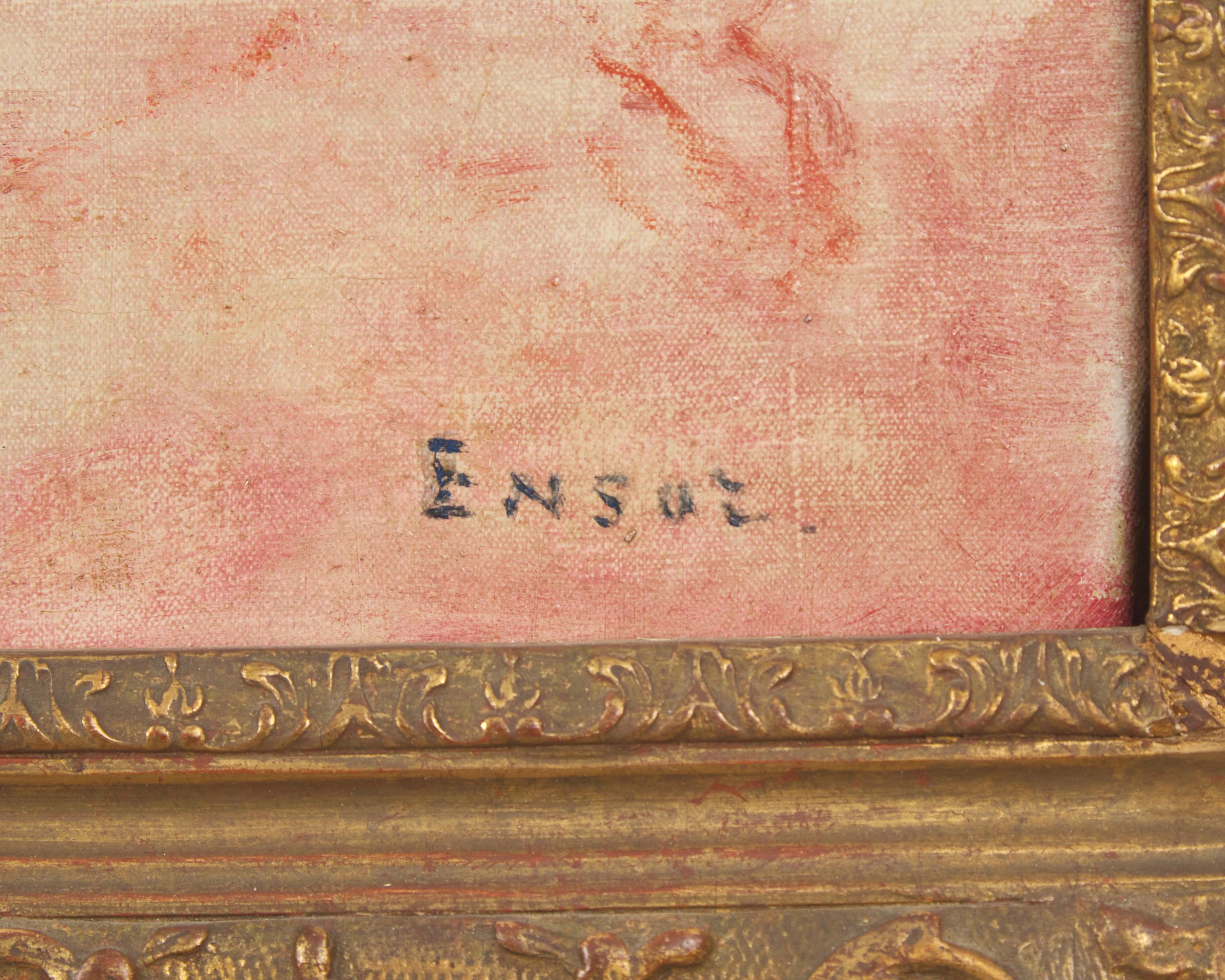
London, Leicester Galleries, Paintings, Drawings and Etchings by Baron James Ensor, June-July 1936, no. 86 (as dated to 1930).
Literature:
James Ensor, Liber Veritas, 1929-1941, f. 26r.
Xavier Tricot, James Ensor 1860-1949 (The Complete Paintings), Ostfildern, 2009, p. 390, no. 676 (the preparatory sketch illustrated).
Lot Essay:
While still life was far from the dominant genre in early 20th century Belgian painting, for James Ensor it offered a space of freedom—an open, uninhibited playground for experimentation, freed from the constraints of academic expectations or narrative obligations. Though he had little interest in still life during his student years in Brussels, favoring landscapes instead, it was upon returning to his family’s home and studio in Ostend that Ensor discovered the genre’s true potential.
In the curious, somewhat eerie souvenir shop run by his mother and aunt, Ensor was surrounded by an eclectic assortment of trinkets, seashells, masks, and exotic objects, which provided endless inspiration. His studio, perched just under the roof and bathed in soft, natural light, became the ideal setting for his creative exploration. There, Ensor staged and painted over 200 still lifes—nearly a quarter of his total output. These works are more than mere arrangements of objects; they are quiet, profound reflections of the artist’s inner world. Above all, they became a means of studying light—how it caressed, transformed, and even distorted the objects it touched.
Ensor’s earliest still lifes, inspired by the theatrical grandeur of Dutch Golden Age painting, were large, dark, and composed of familiar household elements—many drawn straight from the kitchen. Over time, however, his compositions grew luminous and more adventurous, featuring bold flowers and unexpected props from the Far East: porcelain vases, silk fans, and richly patterned fabrics. These chinoiseries were fashionable in bourgeois interiors at the time and readily available in the family shop. Ensor’s deep affinity for these exotic objects was both personal and aesthetic. He once recalled: "I spent much of my childhood in the parental shop surrounded by the wonders of the sea, the beautiful mother-of-pearl shells with a thousand shades of the rainbow and the bizarre skeletons of sea monsters and water plants. This environment full of colors, the abundance of reflections and rays of light have certainly contributed to making me a painter who loves color and is sensitive to the different plays of light."
This preoccupation with color and light profoundly shaped Ensor’s technique. With rapid brushstrokes and a bold, expressive palette, he created hazy, almost abstract compositions that gave his works a sense of spontaneity and atmospheric depth. To some, the imprecision of his forms suggested an unfinished quality, prompting comparisons to Impressionism—though Ensor was no plein air painter. Instead, his interiors were shaped as much by mood as by reality. Color, especially, became the carrier of emotion, and after encountering the visionary work of Odilon Redon in 1886, Ensor embraced a path that blurred the line between the real and the unreal.
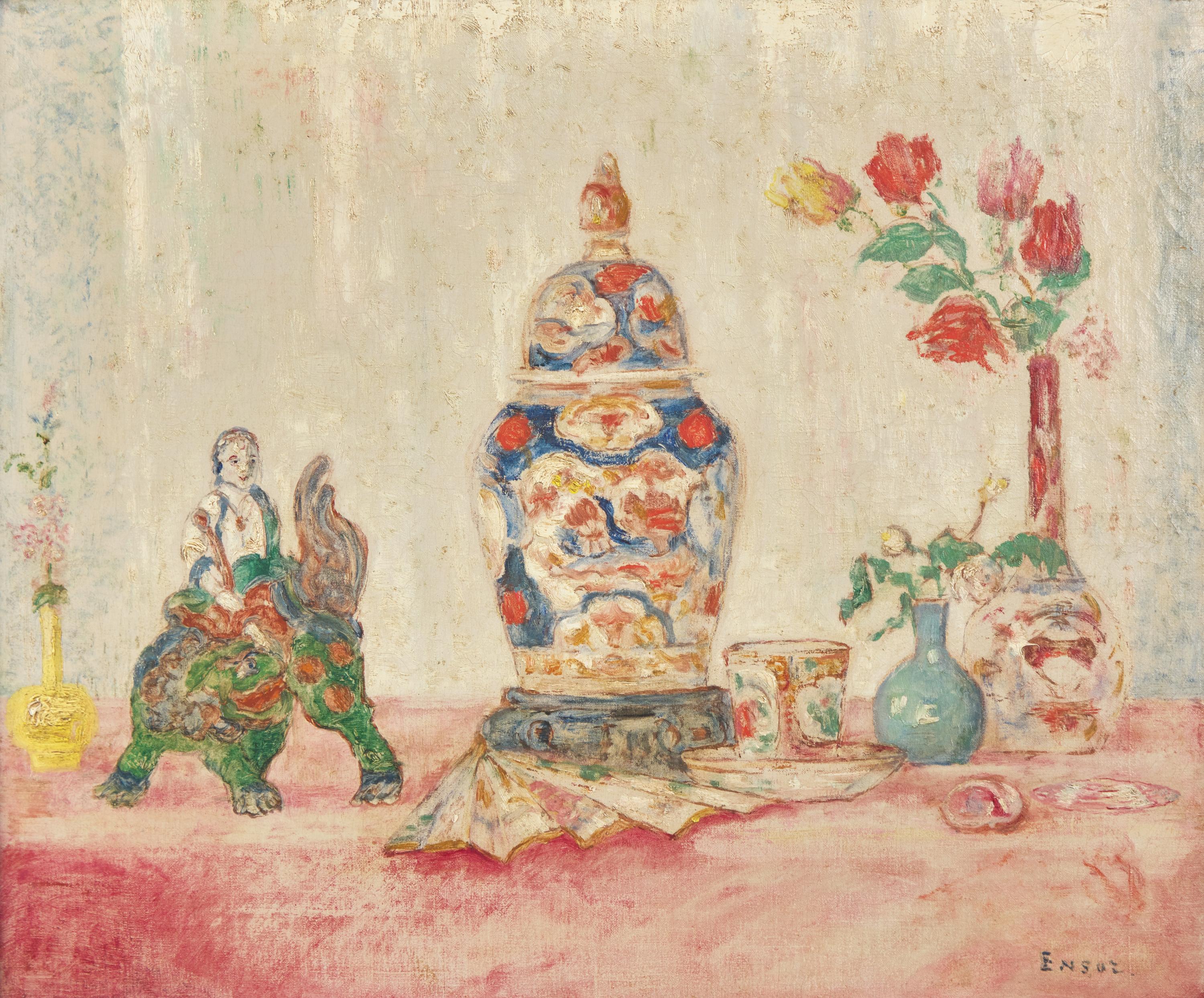
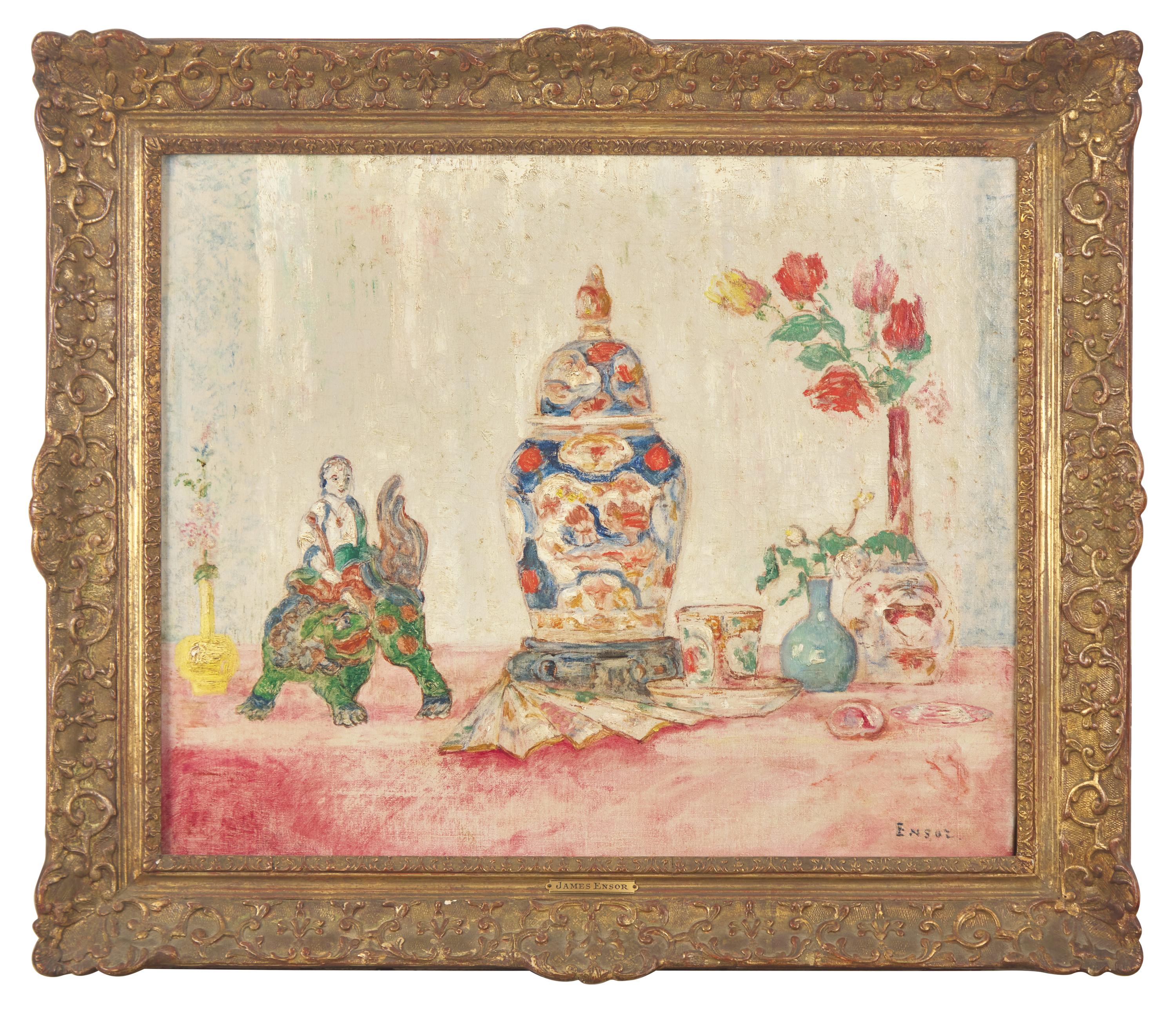
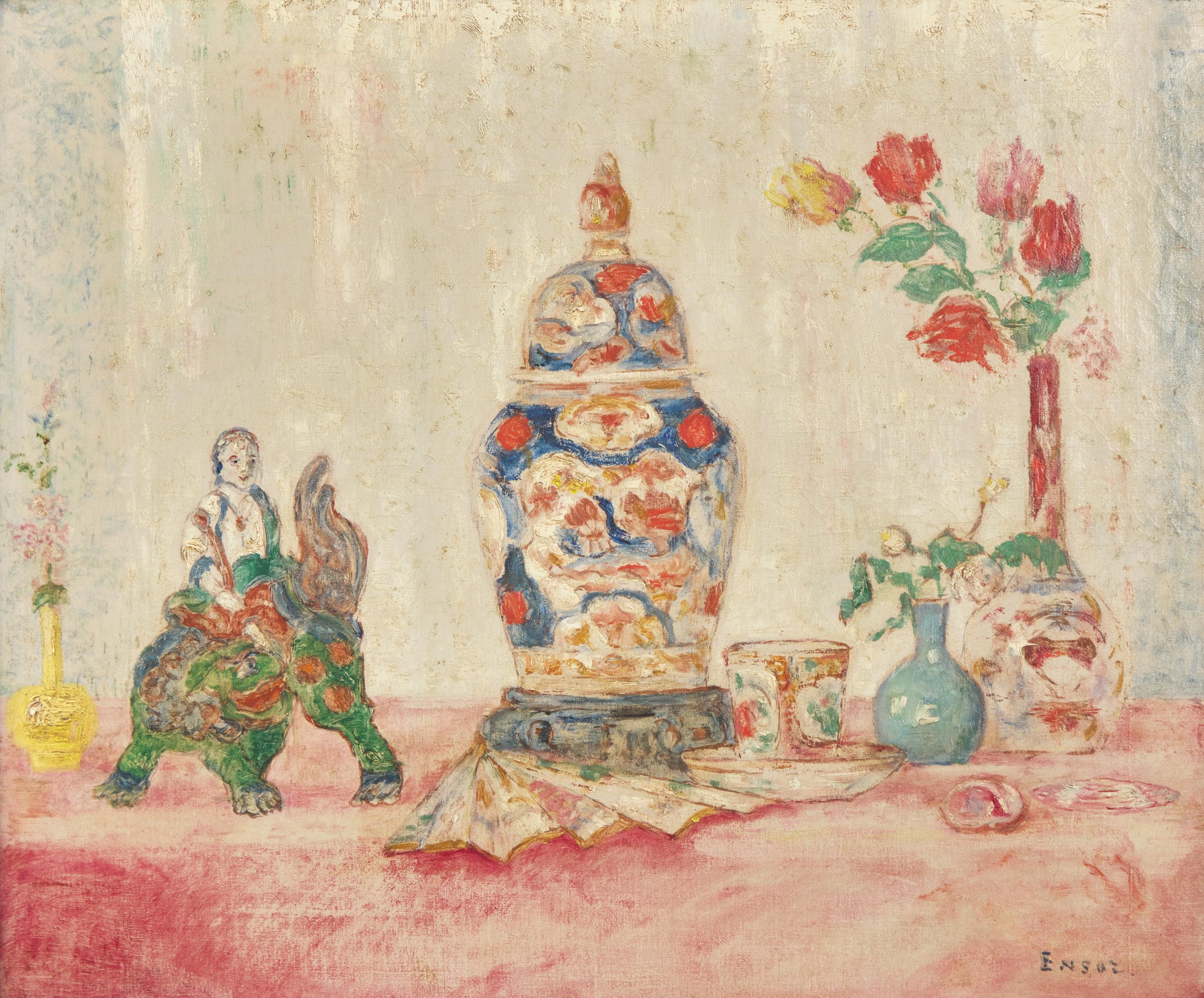
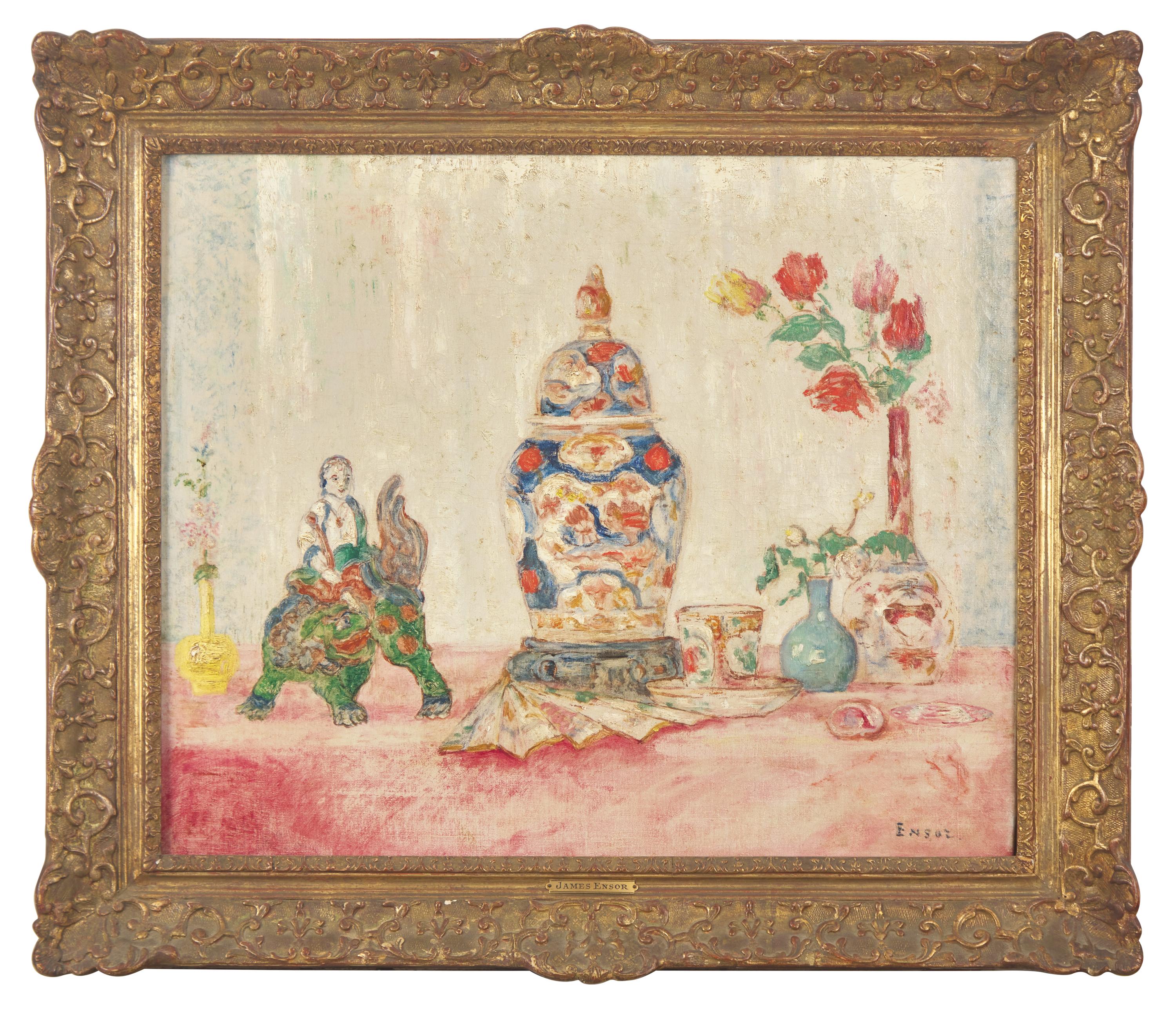
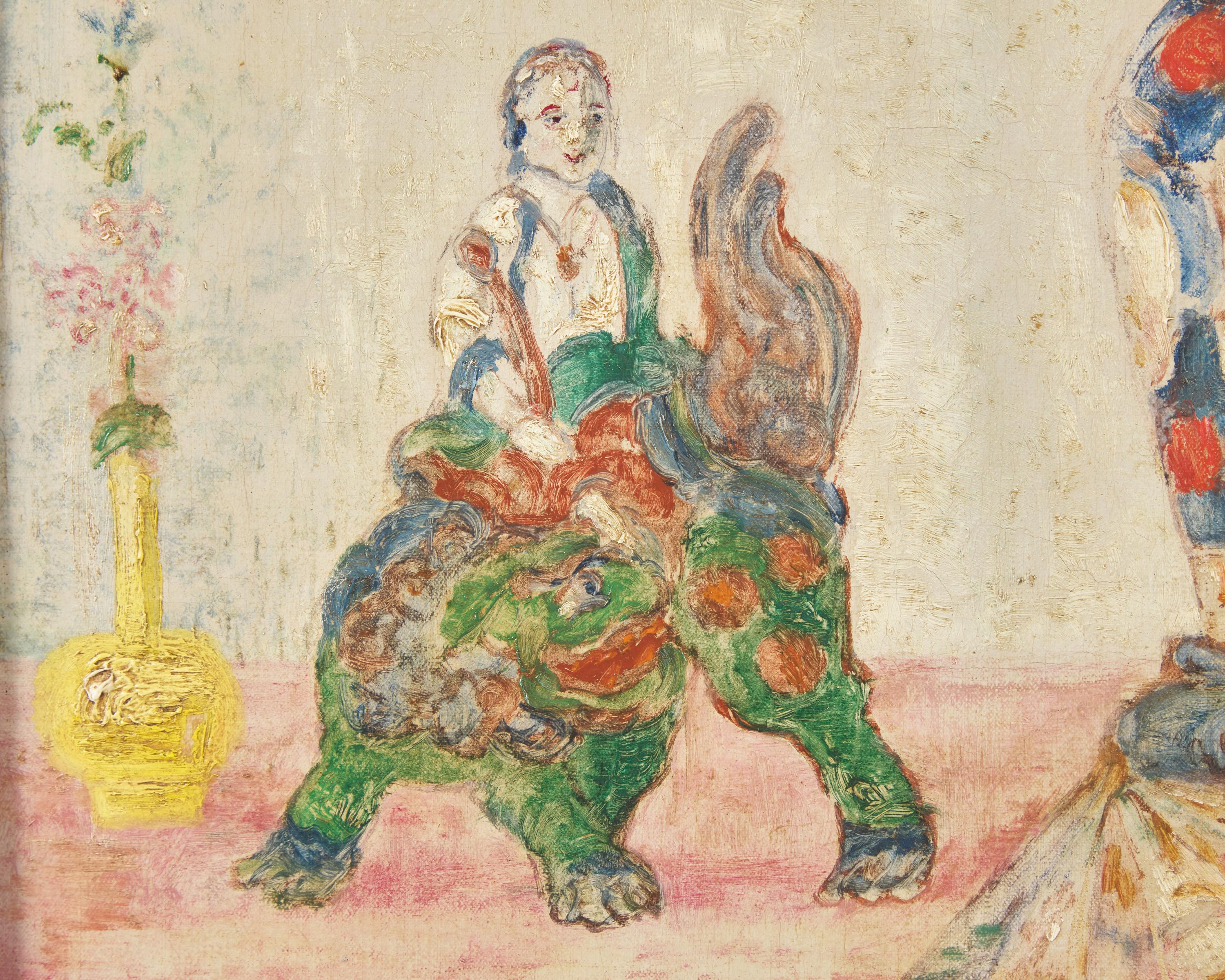
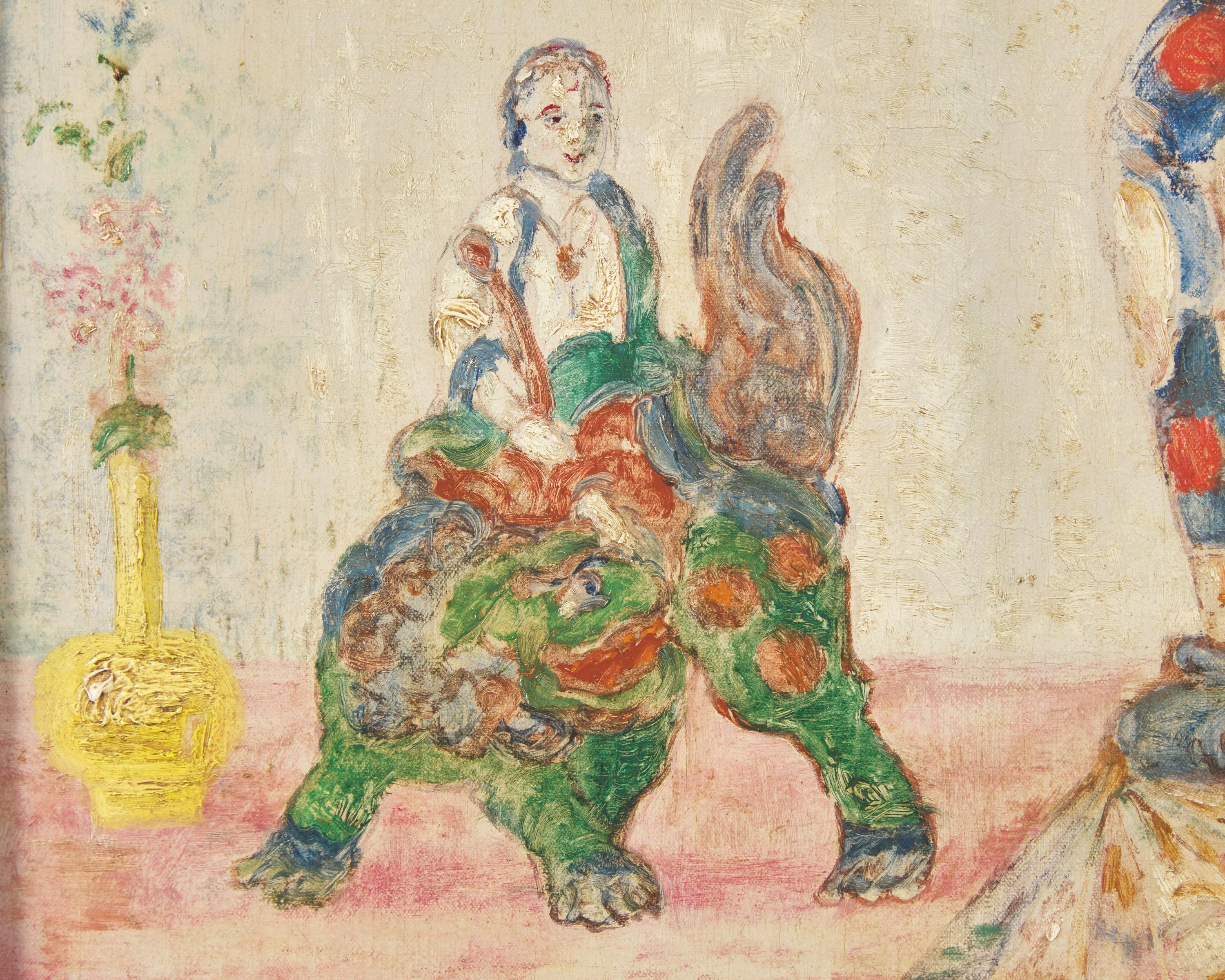
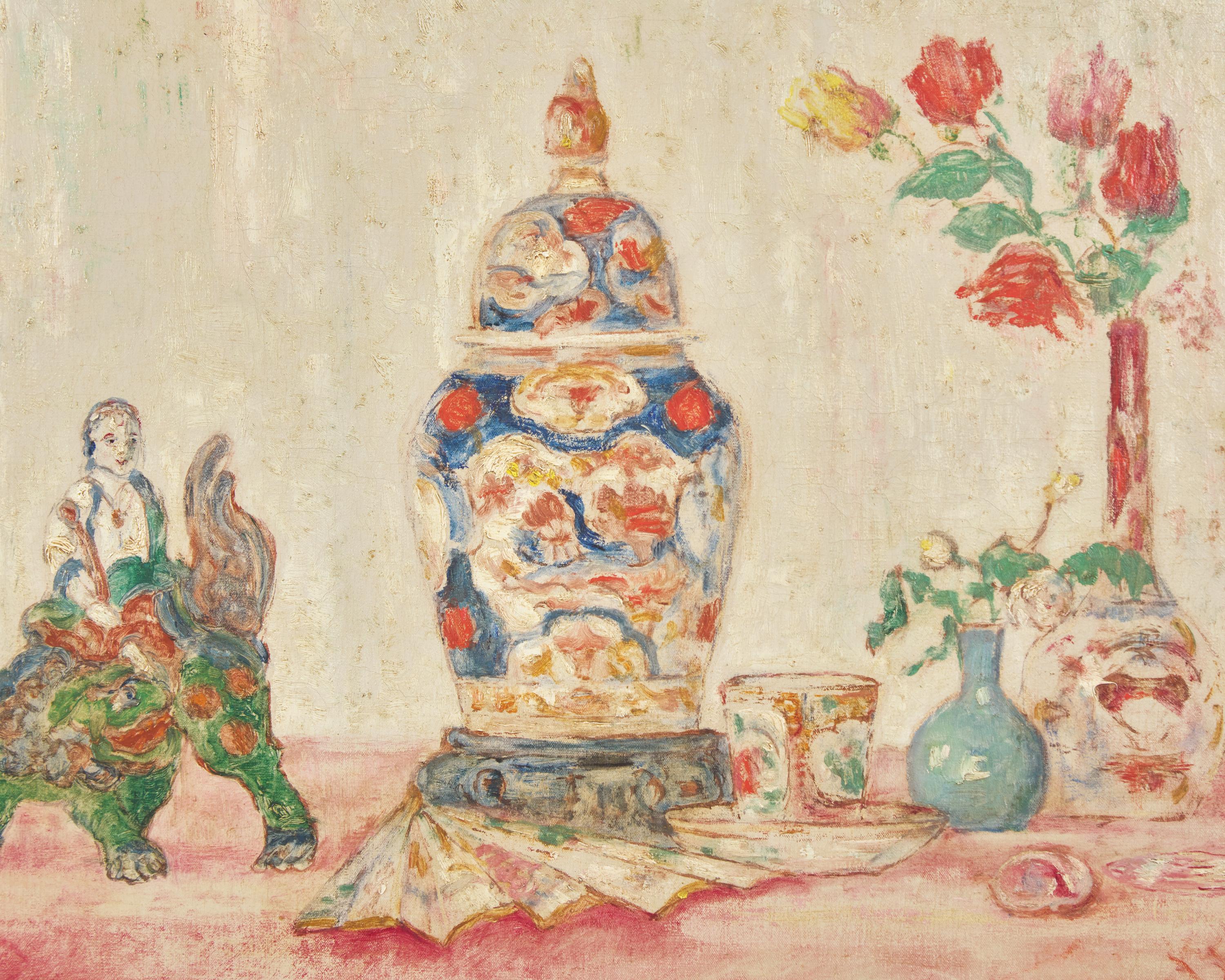
The present work, Chinoiseries Fleuries, is among the few paintings in Ensor’s oeuvre entirely devoted to chinoiserie. Executed in 1936, when the artist was in his seventies, it showcases the hallmarks of his mature style. At first glance, it appears to be an exotic bric-à-brac composition—porcelain vases, teacup, saucers, fantastical figurines, flowers, and fans scattered across a pink-draped table. But in truth, it is a carefully orchestrated scene. Unlike his earlier still lifes, which brimmed with abundance, this composition is pared down: each object is given space to breathe, aligned in a loose row like actors poised on a theater stage. Ensor emphasizes the sensuality of form—simple, irregular, yet captivating shapes modeled entirely by color. Against a luminous, almost ethereal white background, the objects emerge as if from a dream. Using zinc white, a semi-transparent pigment, Ensor achieves a shimmering effect that mimics the reflective surfaces of porcelain and the iridescence of silk. The backdrop, pearlescent and airy, evokes not only the sea mist of Ostend but also the glinting insides of the shells that so enchanted the artist in his youth.
Chinoiseries Fleuries is a symphony in pink, red, and white—a celebration of color as the true subject of painting. Rendered in rich, expressive strokes, it radiates the sense of artistic freedom and physical pleasure that defined Ensor’s approach to still life in the final chapter of his career. More than a collection of beautiful objects, this painting is a lyrical meditation on light, texture, and memory. It is at once soothing and mysterious, a visual poem that awes as much as it intrigues.
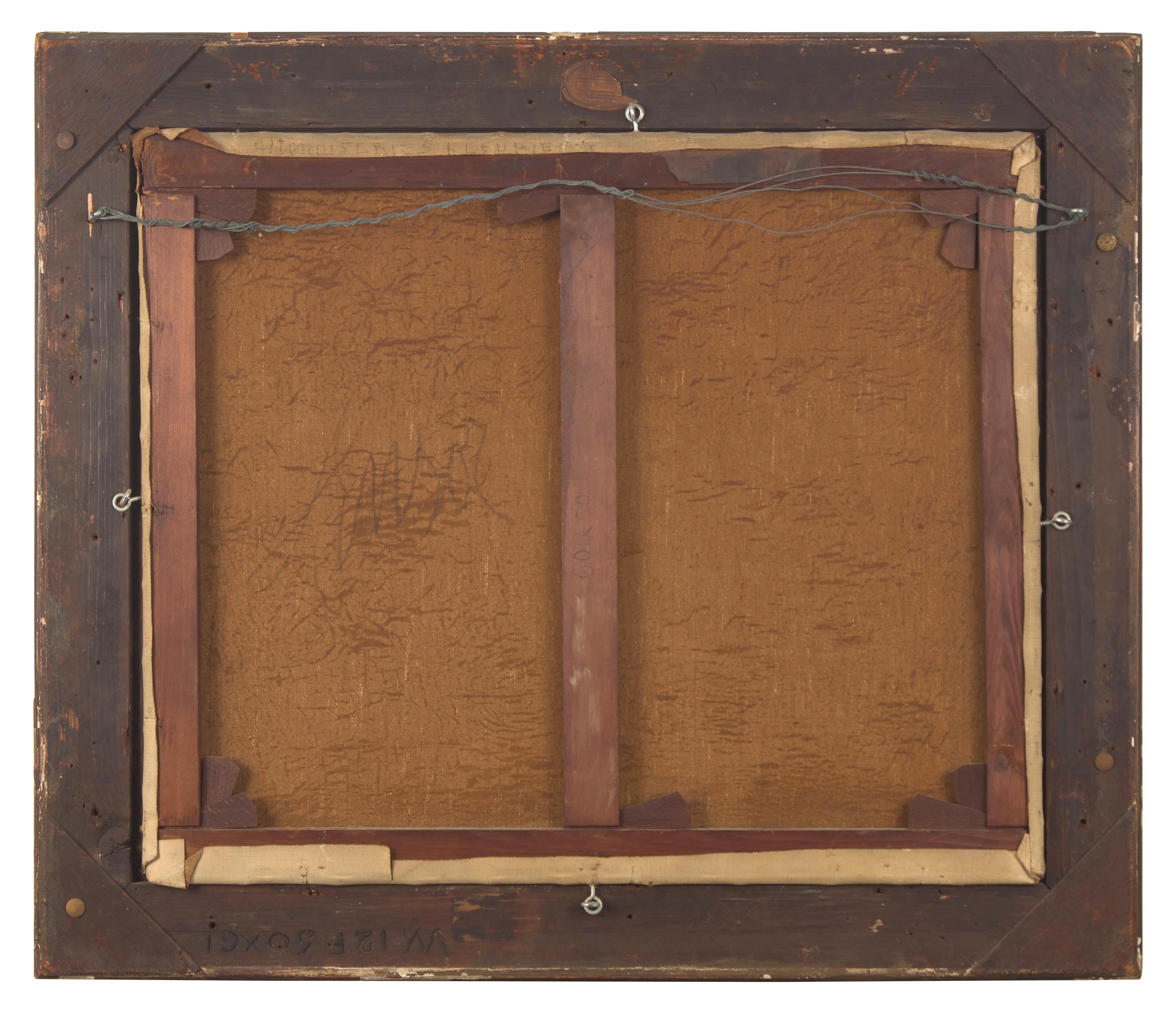
The unlined canvas in overall very good condition. With light craquelure, particularly in the background at top and in the heavily painted areas. An area of white paint, approx. 1 1/2 in. square at the top right shows craquelure. The painting also shows some light soiling, yellowed varnish, and may benefit from a light cleaning. There is no evidence of inpainting under UV light. Additional images available upon request.
The physical condition of lots in our auctions can vary due to age, normal wear and tear, previous damage, and restoration/repair. All lots are sold "AS IS," in the condition they are in at the time of the auction, and we and the seller make no representation or warranty and assume no liability of any kind as to a lot's condition. Any reference to condition in a catalogue description or a condition report shall not amount to a full accounting of condition. Condition reports prepared by Freeman's staff are provided as a convenience and may be requested from the Department prior to bidding.
The absence of a posted condition report on the Freeman's website or in our catalogues should not be interpreted as commentary on an item's condition. Prospective buyers are responsible for inspecting a lot or sending their agent or conservator to inspect the lot on their behalf, and for ensuring that they have requested, received and understood any condition report provided by Freeman's.
Please email awolkenberg@freemansauction.com for any additional information or questions you may have regarding this lot.