To request further details about this lot, please email awolkenberg@freemansauction.com

Raphaël Chatroux
VP, Head of Department, Impressionist & Modern Art
Sale 6342
| Philadelphia
| Philadelphia
To request further details about this lot, please email awolkenberg@freemansauction.com
Raphaël Chatroux
VP, Head of Department, Impressionist & Modern Art
Estimate$25,000 – $40,000
We wish to thank the Comité Anquetin at Brame & Lorenceau, Paris for kindly confirming the authenticity of the present Lot, which will be accompanied by a Certificate of Authenticity.
Provenance:
Christie's London, sale of June 26, 1995, lot 1.
Hazlitt, Gooden & Fox, Ltd., London, United Kingdom.
Acquired directly from the above by the present owner.
Exhibited:
London, Hazlitt, Gooden & Fox, Nineteenth Century French Drawings and some sculptures, June 13 - July 12, 1996, no. 31 (illustrated).
Lot Essay:
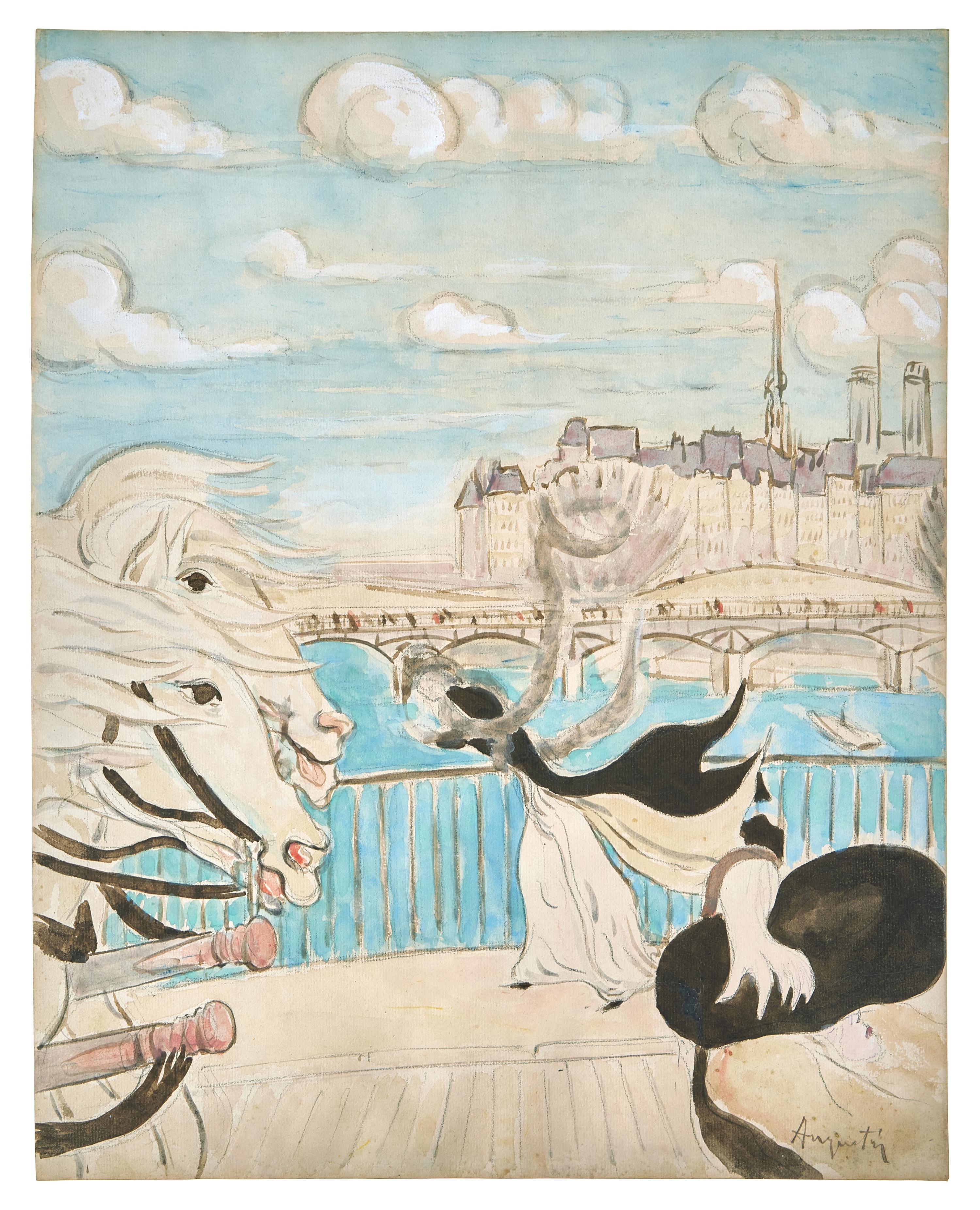
This watercolor is one of several key preparatory studies for Coup de Vent, Pont des Saints-Pères, Anquetin’s celebrated painting now housed in the Kunsthalle Bremen. When first exhibited at the 1891 Salon des Indépendants, the oil version caused quite a stir, critics calling the work disproportioned and fantastical. Yet, Émile Bernard praised it in a letter to Belgian painter Eugène Boch, calling it “very successful, very delicate,” and noting it had “the most perfect coloration” he had ever seen in Anquetin’s work. Today, this painting is recognized as a pivotal moment in Anquetin's career—one that earned him the moniker “painter of modern life,” much like Manet before him.
Anquetin draws on the compositional influence of Japanese woodcuts, capturing the restless motion of horse manes as they pull an omnibus across the Pont des Saints-Pères—a bridge now called Pont du Carrousel that connects the Louvre to the Musée d'Orsay. In the background, we glimpse the Île de la Cité and the towers of Notre Dame, yet the cityscape remains secondary. Anquetin’s true focus lies in the fleeting drama of everyday life. A strong wind animates the scene: one woman clutches her hat while another’s coat and flamboyant boa lift dramatically into the air, swirling like the wings of an exotic bird. The cool blue tones evoke the crispness of an autumn day, while bold outlines and flat areas of color—a style later embraced by Émile Bernard, Paul Gauguin, and the Nabis—prompted poet Édouard Dujardin to describe this technique as “Cloisonnism.”
Highly stylized, the image blends flattened patterns, asymmetrical composition, and a restrained color palette: elements that anticipate the elongated forms and decorative flair that would soon define the Art Nouveau posters of Toulouse-Lautrec.
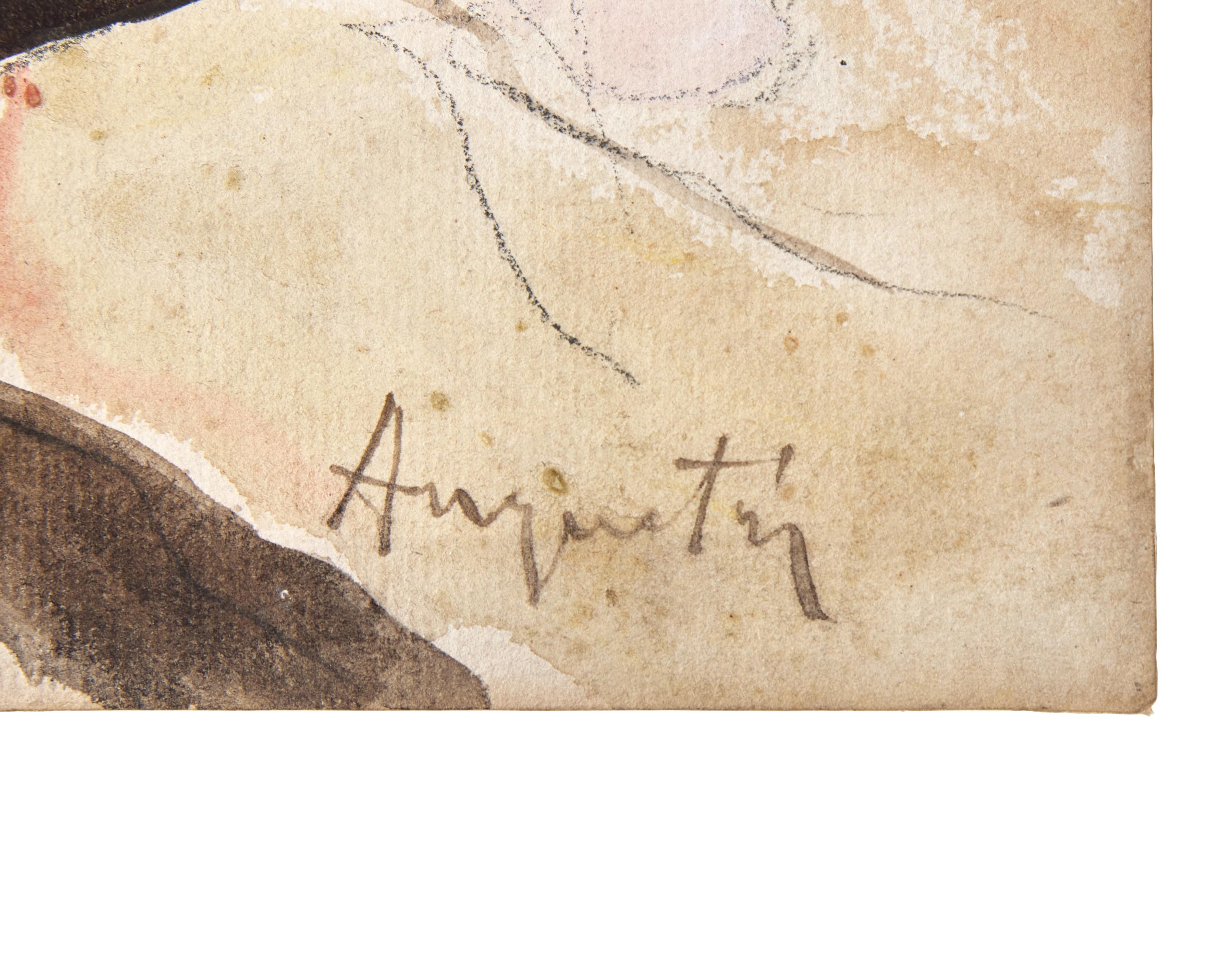
The paper is toned and shows some mat staining along the extreme edges. There are light fox marks visible in the lighter areas of the paper, for instance at the bottom center, bottom right and in the figure's cape; there is also foxing apparent on the sheet verso. There appears to be some restoration at bottom right in the large hat in foreground, with corresponding ink verso. There is a stray yellow horizontal line in the bridge walkway, approx. 1 in. long. Additional images available upon request.
The physical condition of lots in our auctions can vary due to age, normal wear and tear, previous damage, and restoration/repair. All lots are sold "AS IS," in the condition they are in at the time of the auction, and we and the seller make no representation or warranty and assume no liability of any kind as to a lot's condition. Any reference to condition in a catalogue description or a condition report shall not amount to a full accounting of condition. Condition reports prepared by Freeman's staff are provided as a convenience and may be requested from the Department prior to bidding.
The absence of a posted condition report on the Freeman's website or in our catalogues should not be interpreted as commentary on an item's condition. Prospective buyers are responsible for inspecting a lot or sending their agent or conservator to inspect the lot on their behalf, and for ensuring that they have requested, received and understood any condition report provided by Freeman's.
Please email awolkenberg@freemansauction.com for any additional information or questions you may have regarding this lot.