Back
American and European Art
|
- Sale 408
Live
| Chicago
Dec 14 | 6:00 AM CST
Live
| Chicago
Sale 408
| Chicago
| Chicago
Estimate$25,000 – $35,000
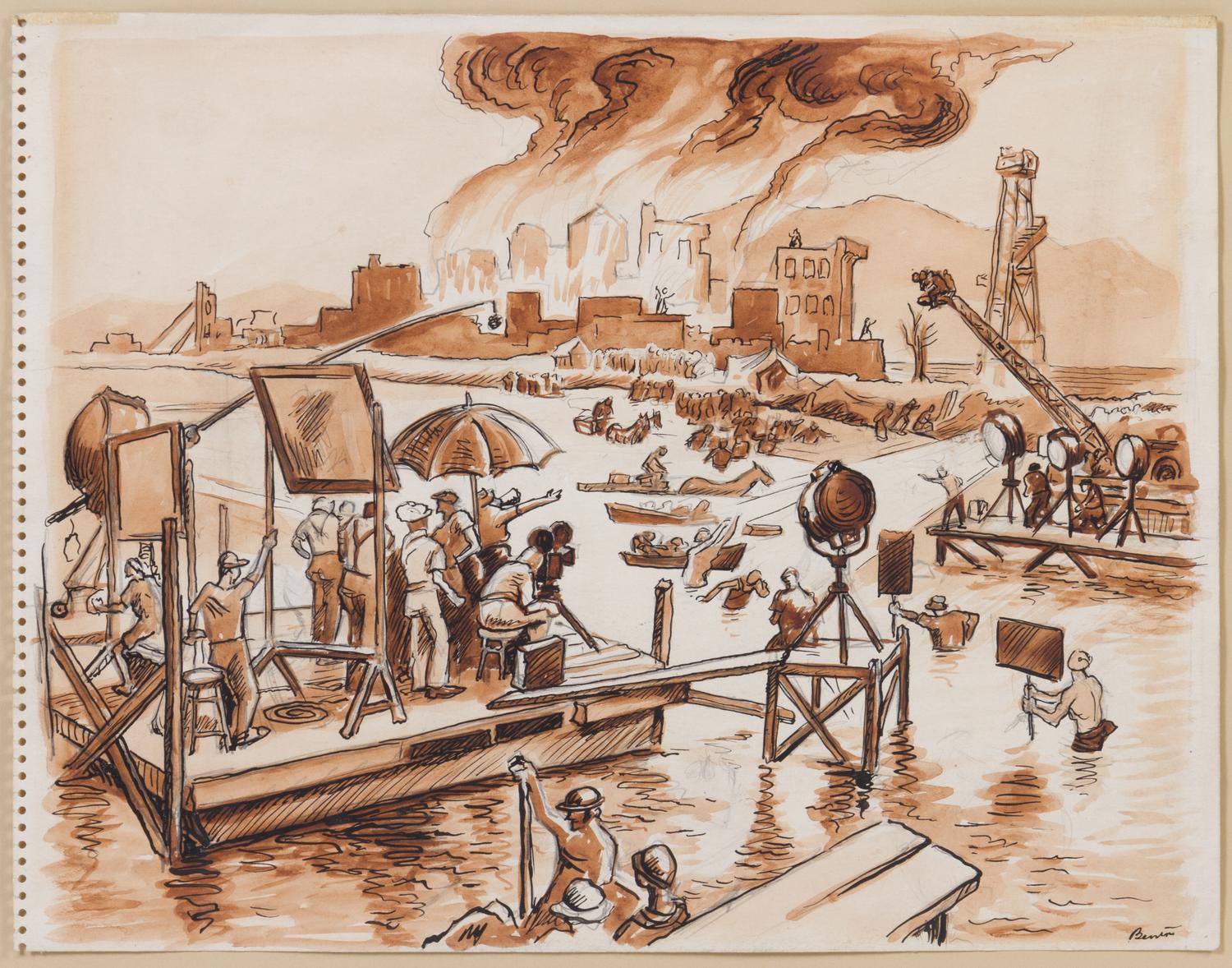
Property from the Collection of the Anne P. Foster Trust, Kansas City, Missouri Provenance: Collection of the artist Purchased from the above by the present owner Literature: Thomas Hart Benton, Benton Drawings: A Collection of Drawings by Thomas Hart Benton, Columbia, 1968, p. 99, illus. Lot note: Best known for his bold, sculptural depictions of Midwestern life, Thomas Hart Benton's art embodies the energy of America during a time of great change. No mere observer, however, in his documentation of this evolving cultural landscape-he was also a participant. After moving to New York in 1911, in 1913 the artist began painting sets for silent motion pictures in Fort Lee, New Jersey, the "first Hollywood." He embraced the dramatic poses and theatrical lighting of the film industry, incorporating these techniques into works that moved cinematically, scene-by-scene, in multi-panel compositions. Benton would even build clay models, miniature sets, so he could study the play of light and shadow on three-dimensional shapes aiding him in creating a sense of "deep space" in his canvases. Perhaps because his paintings visually echoed motion pictures, in 1937 Life magazine commissioned Benton to go to Hollywood to paint a mural that would unveil the mysteries of the film industry to its readers. The artist spent a month sketching in Hollywood, mostly at 20th Century Fox Studios. Several movies were being filmed at the time on the lot, including In Old Chicago, a big budget musical about the fire of 1871. Benton produced over four hundred sketches and forty ink-wash drawings during his sojourn, including Burning of Chicago and Movie Set, which served as studies for the painting Hollywood (1937-38; Kansas City's Nelson-Atkins Museum of Art, Kansas City, MO), a dynamic mural filled with actors, technicians and directors. Burning of Chicago (lot 152) depicts a scene from the movie In Old Chicago and served as the basis for the central section of Hollywood. At the time of its release, In Old Chicago was one of the most expensive movies ever made, and the drawing captures the choreographed chaos of an epic movie set of the 1930s. Members of the film crew float on barges or stand hip-deep in water in the foreground, aiming mirrors, microphones and lights toward the mass of actors and horses attempting to flee the fiery faux-Chicago as it burns in the background. The director is seen on the foremost raft under an umbrella, shouting through a megaphone and dramatically gesturing towards the action. Movie Set (lot 151) likewise reveals the complexity involved with filming even the most unassuming of scenes, and relates to the left panel of Hollywood. Depicted in the drawing is an elegantly coiffed starlet speaking to an older woman seated at a café table. In front of them and claiming the majority of the pictorial space is the film crew and all its paraphernalia. Men crowd the compact scene, whispering to each other, idly watching the dialogue, or handling the equipment. The strong vertical bases of the boom and light frame what are presumably the director and an assistant, and the boom arm hangs above the two actresses, the loci of the action. Both the Burning of Chicago and Movie Set are integral elements to the larger enterprise of the painting Hollywood. They also reveal an artist intensely interested in the process and mechanics of making movie magic, for both his own art and the big picture of American culture.
To request further details about this lot, please email [email protected]
Please email [email protected] for any additional information or questions you may have
Please contact us directly for a complete condition report.
The physical condition of lots in our auctions can vary due to age, normal wear and tear, previous damage, and restoration/repair. All lots are sold "AS IS," in the condition they are in at the time of the auction, and we and the seller make no representation or warranty and assume no liability of any kind as to a lot's condition. Any reference to condition in a catalogue description or a condition report shall not amount to a full accounting of condition. Condition reports prepared by Freeman's staff are provided as a convenience and may be requested from the Department prior to bidding.
The absence of a posted condition report on the Freeman's website or in our catalogues should not be interpreted as commentary on an item's condition. Prospective buyers are responsible for inspecting a lot or sending their agent or conservator to inspect the lot on their behalf, and for ensuring that they have requested, received and understood any condition report provided by Freeman's.
Please email for any additional information or questions you may have regarding this lot.