To request further details about this lot, please email aveil@freemansauction.com

Adam Veil
VP, Head of Department, American Art and Pennsylvania Impressionists
Sale 2105
| Philadelphia
| Philadelphia
To request further details about this lot, please email aveil@freemansauction.com
Adam Veil
VP, Head of Department, American Art and Pennsylvania Impressionists
Estimate$100,000 – $150,000
This lot is accompanied by a letter of opinion from The Milton and Sally Avery Arts Foundation.
Exhibited:
Naples, Florida, Harmon-Meek Gallery, Milton Avery's "Birds & Beasts," 1931-1936, March 24 - April 15, 1986 (and traveling).
Literature:
Frank Getlein, Milton Avery's "Birds & Beasts," 1931-1936, Harmon-Meek Gallery, Naples Florida, 1986, illustrated p. 4.
Lot Essay:
One of the distinctive features of modernism is the emphasis on an artwork’s physicality, from support and medium to technique. This tenet was core to Milton Avery’s aesthetic, who viewed the composition of his paintings as an effort in organizing forms, lines, and colors. On the surface of the canvas, which strictly delineates spatial borders, the image becomes an impeccable assemblage, where visual and textural elements tie the artist’s vision together.
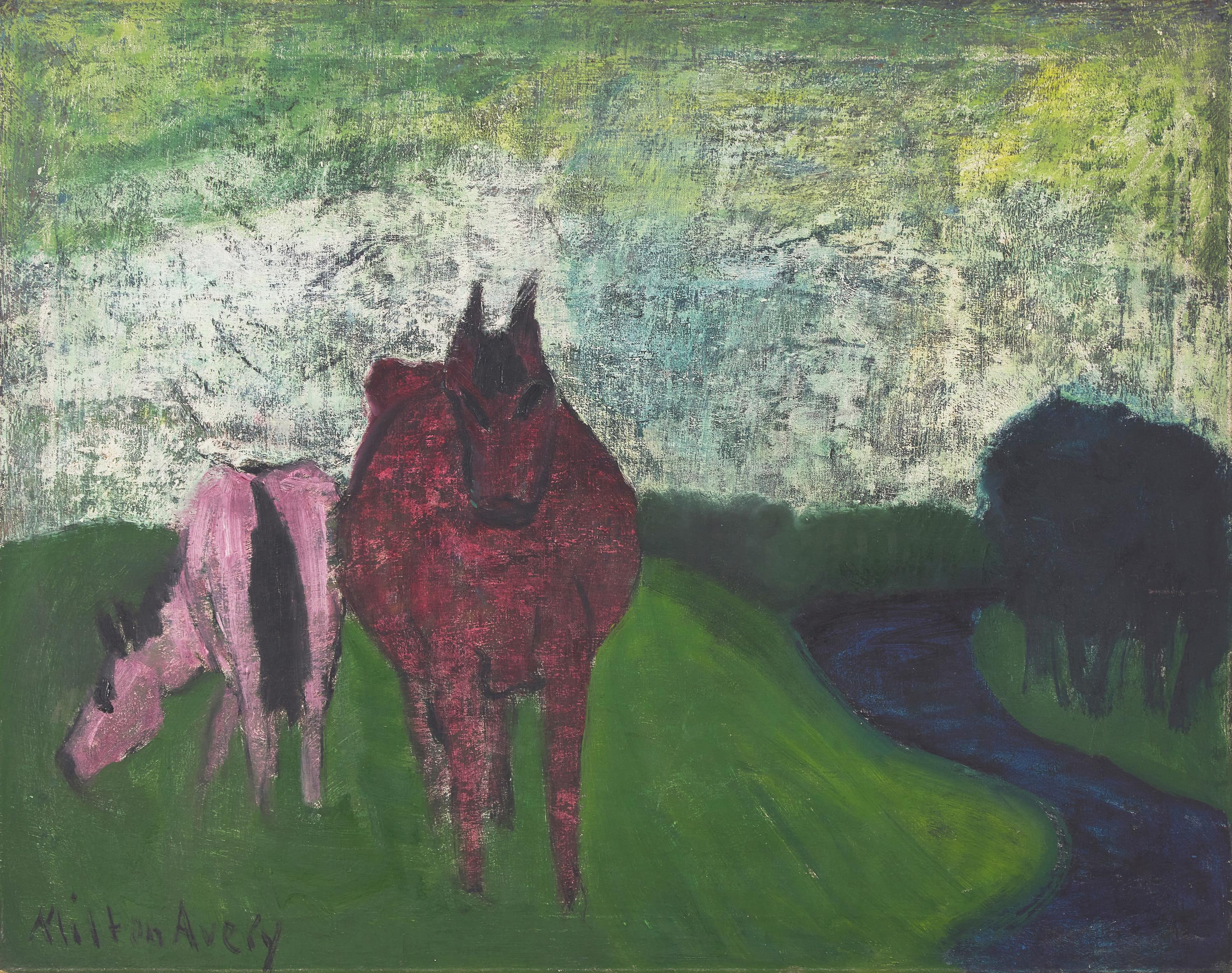
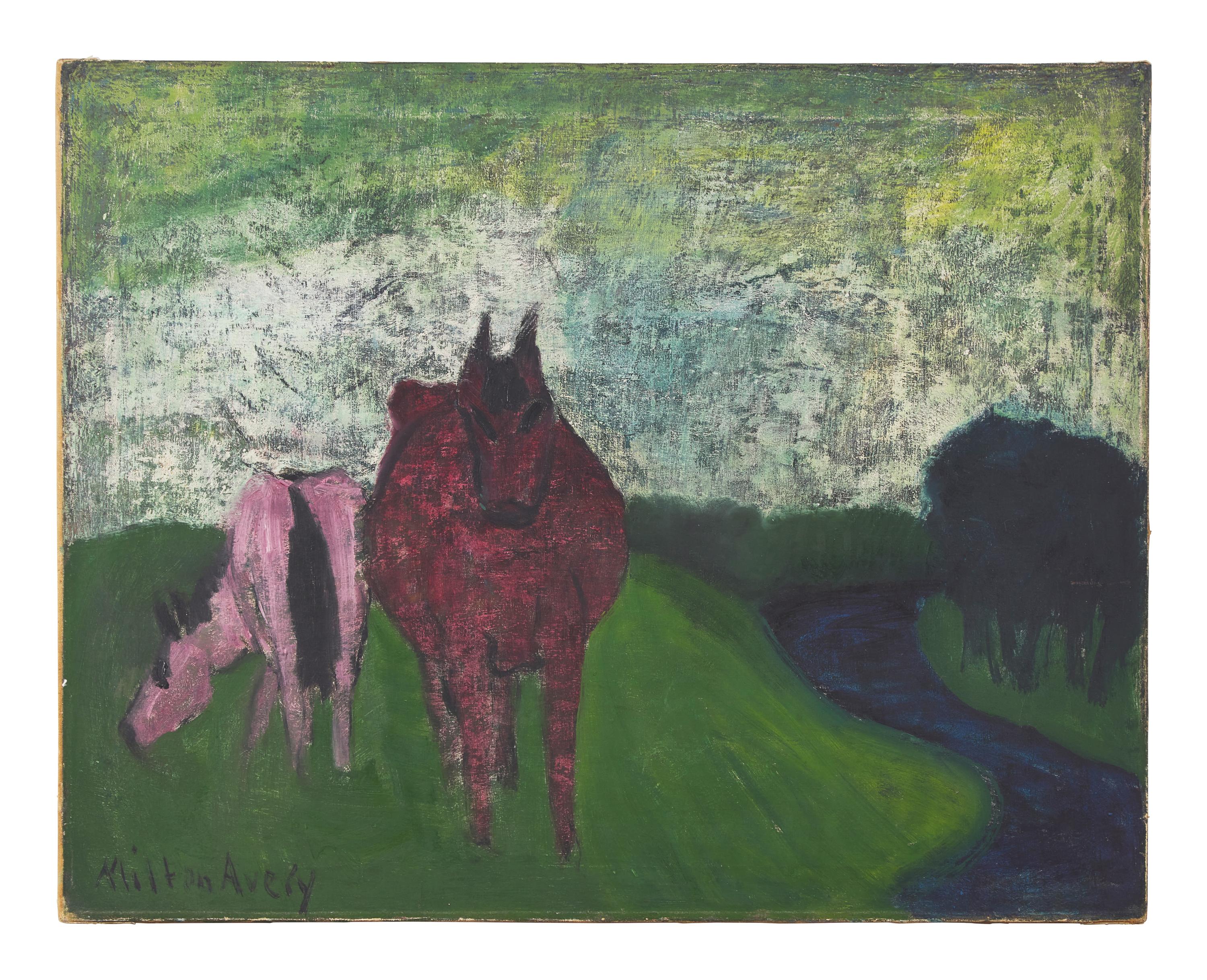
This calculated structuring implies that the objects represented in the painting are modified, even simplified and nearly abstracted, to fit into the intended design. This visual economy typically favors patches of color, interlocking shapes, and marked spatial delimitation of objects. Roger Fry, in his seminal book Transformations (1927), speaks of “integral plastic expression,” referring precisely to this subjugation of meaning to the physical elements of the painting—the palette, the contours—whereby the work as object becomes its own subject. In Horses in Spring, the surface is quite visibly uneven; physicality is manifested through the rather soft, though unmistakable, separation between forms and their corresponding colors as well as the conspicuous brushwork and the rugged patterns it produces.
Yet Avery’s aesthetic is not as straightforward as it seems. In addition to the material foundation that defines Horses in Spring, the painting’s very physicality is ironically what points to its other, more loosely defined, less tangible, dimension. The color irregularities as well as the subtle blending of hues, especially noticeable in the background and sky, drape the composition in a mesmerizing haze. It is this rather fussy appearance that signals the poetic element inherent to Avery’s practice. While the painting’s physicality is overwhelming, from it radiates an airier plenitude, which renders the solid surface of the canvas pervious to a profound affinity with the natural world.
The process of simplification described above leads to the capture of a moment or vision, an essential gesture in which the artist’s, and in turn the viewer’s, piercing eye meets the direct gaze of the horse, as if engaging in a dialogue with nature. As Clement Greenberg stated in 1957, “one does not manipulate a subject, one meets it.” When Avery simplifies the natural world around him, he does not merely manipulate it to make it readily accessible; he distills its potential depth. He provides an invitation to look and feel, not an explicit and all-encompassing account. In his final tribute to Avery, Mark Rothko aptly summed up this core dimension of Avery’s aesthetic—where the physical is tightly intertwined with the metaphysical—as “that inevitability where the poetry penetrated every pore of the canvas to the very last touch of the brush.”
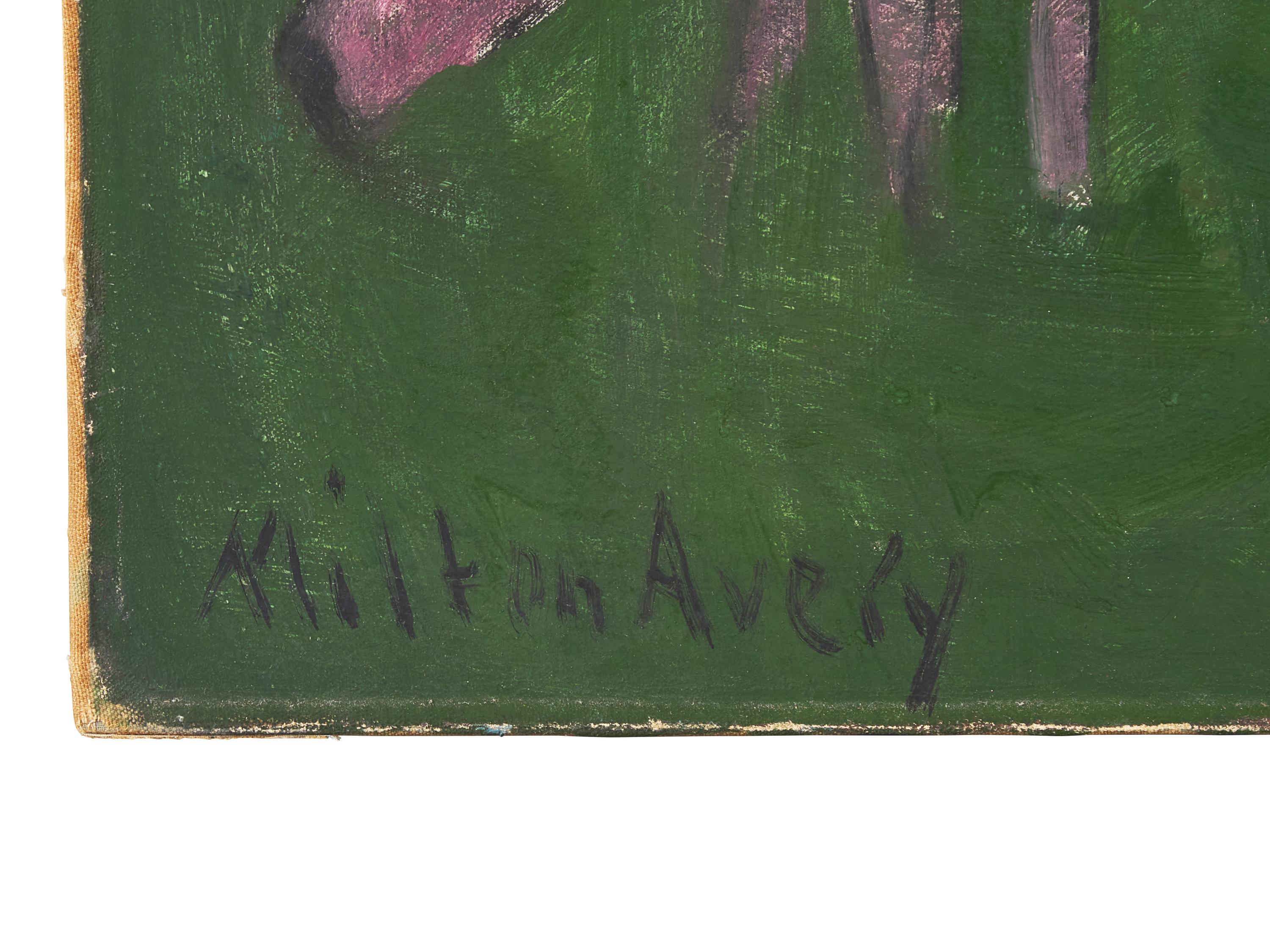
The relined canvas in overall good to very good condition. With faint stretcher bar marks around the composition (on four sides, very subtle). We notice a minor ripple in the canvas at upper right quadrant (air bubble of sorts). With a faint diagonal scratch at upper right, about 4 in. long (unobtrusive). Minor splashes of white at upper left corner, which appear consistent with the artist's technique. Minimal scuff marks (white) in the grass at bottom center right. Examination under UV light does not reveal any sign of inpainting. Additional images available upon request.
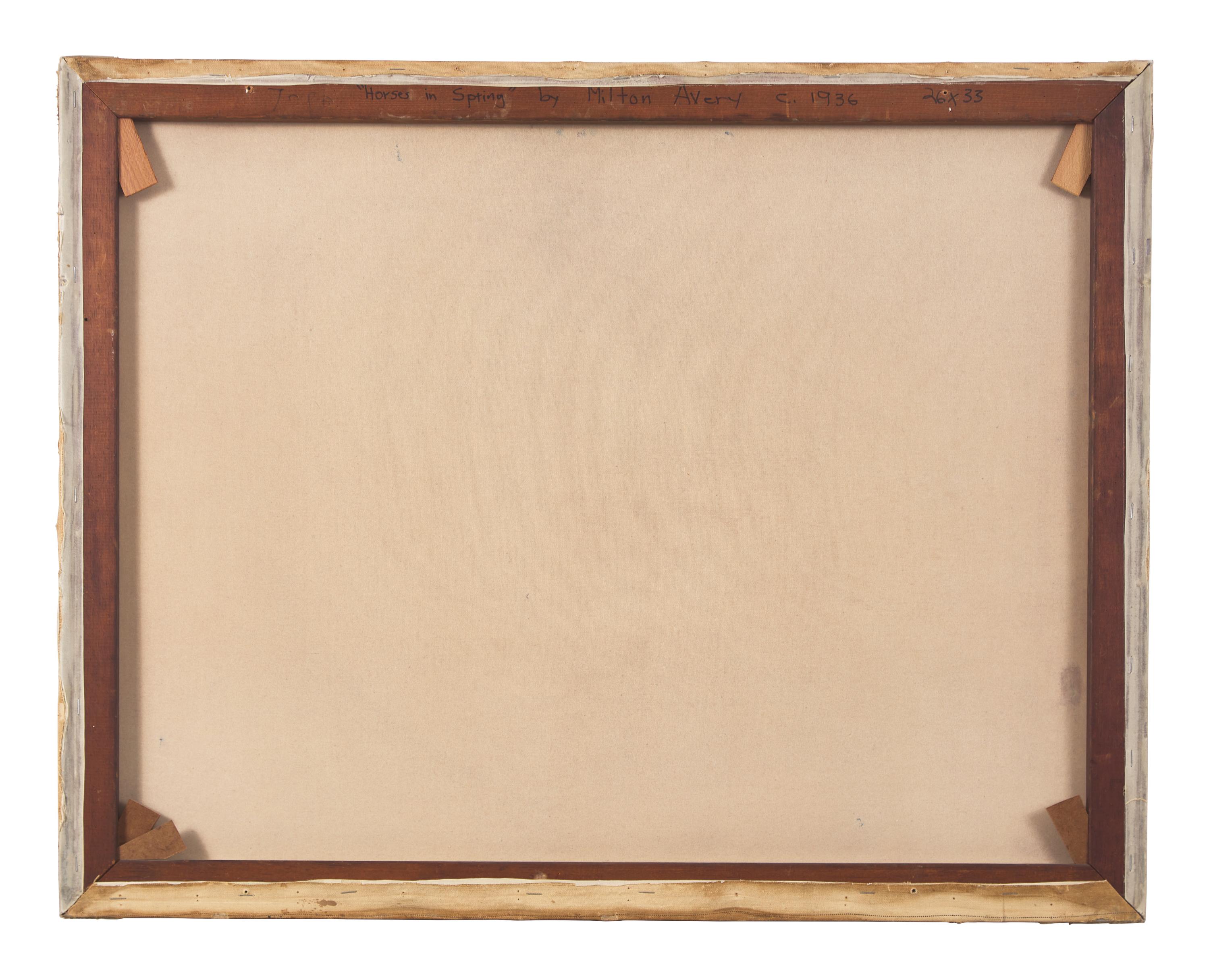
Framed: 32 x 29 x 1 1/2 in.
The physical condition of lots in our auctions can vary due to age, normal wear and tear, previous damage, and restoration/repair. All lots are sold "AS IS," in the condition they are in at the time of the auction, and we and the seller make no representation or warranty and assume no liability of any kind as to a lot's condition. Any reference to condition in a catalogue description or a condition report shall not amount to a full accounting of condition. Condition reports prepared by Freeman's staff are provided as a convenience and may be requested from the Department prior to bidding.
The absence of a posted condition report on the Freeman's website or in our catalogues should not be interpreted as commentary on an item's condition. Prospective buyers are responsible for inspecting a lot or sending their agent or conservator to inspect the lot on their behalf, and for ensuring that they have requested, received and understood any condition report provided by Freeman's.
Please email aveil@freemansauction.com for any additional information or questions you may have regarding this lot.