To request further details about this lot, please email rchatroux@freemansauction.com

Raphaël Chatroux
VP, Head of Department, Impressionist & Modern Art
Sale 2087
| Philadelphia
| Philadelphia
To request further details about this lot, please email rchatroux@freemansauction.com
Raphaël Chatroux
VP, Head of Department, Impressionist & Modern Art
Estimate$80,000 – $120,000
We wish to thank Mr. Didier Imbert for confirming the authenticity of the present Lot, which will be accompanied by a Certificate of Authenticity. The work will also be accompanied by an original letter dated June 9, 1992 signed by Valérie Roncari from Didier Imbert Fine Art (Paris), in which the authenticity of the work was already established.
Provenance:
Archives Durand-Ruel (#5956).
Wally Findlay Galleries, Chicago, Illinois.
Acquired directly from the above in 1979.
Lot Essay:
Although Gustave Loiseau was born in Paris and depicted the French capital city several times throughout his career, he spent most of his life far from it, exploring towns and regions long-associated with Impressionism, such as Pont-Aven, Auvers-sur-Oise, or Pontoise, a provincial town north of Paris made famous by Camille Pissarro’s early 1870s paintings, and where he settled from 1904 until his death in 1935.
Unlike many of his contemporaries (such as Henry Moret or Maxime Maufra, both represented in this sale), Loiseau resisted the influence of Paul Gauguin, and instead remained faithful to the Impressionist principles throughout his life. In 1897, he signed an exclusive contract with the famous dealer and long-time supporter of the Impressionist cause, Paul Durand-Ruel, who started exhibiting his work in New York and gave him his first solo show in 1904. At that time, Loiseau began a series of travels across the country, especially in the west of France. In 1907 specifically, the year the present work was executed, Loiseau marched in the footsteps of the early Impressionists, such as Claude Monet (whom het met in 1895), and explored the rugged cliffs of Normandy, stopping in villages such as Yport, Fécamp, Dieppe, Étretat, and Saint-Jouin, the site depicted in the present work.
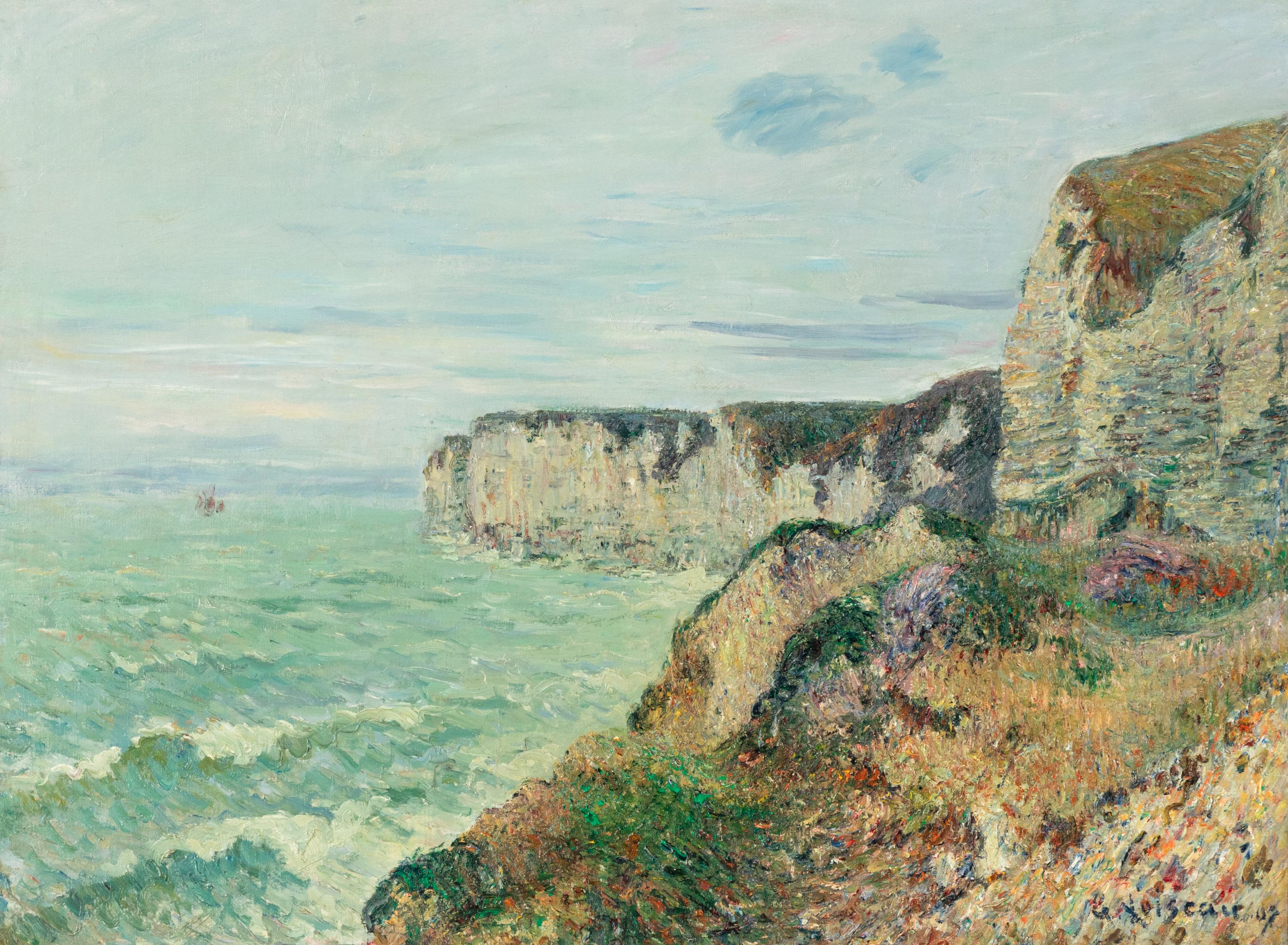
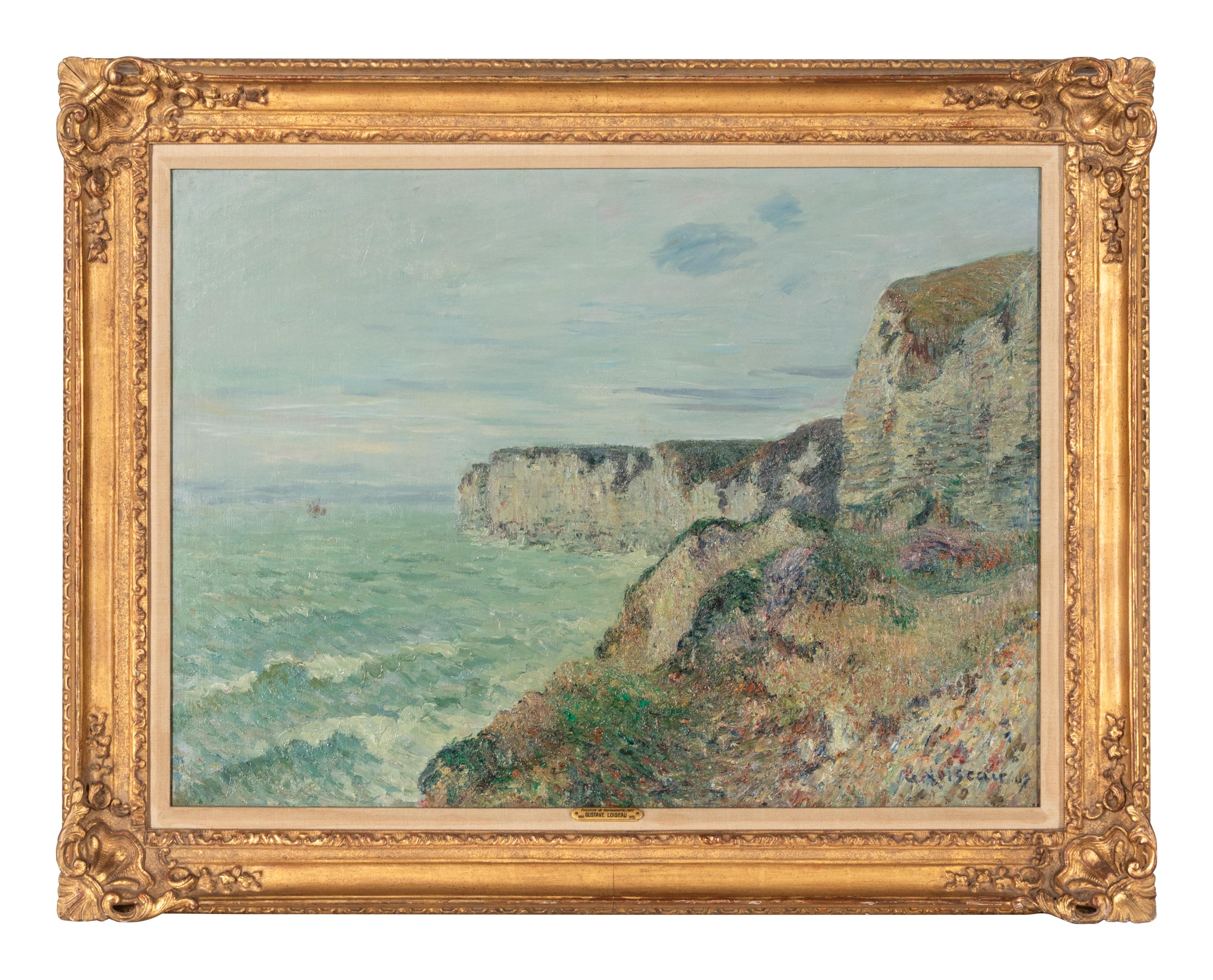
In Falaises de Normandie, Loiseau fully embraces his Impressionist style, and pays tribute to his predecessors by depicting a site many before him captured. Here, he focuses almost exclusively on Nature, and eliminates all sign of human presence, save for the small sailing boats faraway on the horizon. The composition is anchored by the dramatic and majestic limestone cliffs, framed by the clear lavender sky up top and the emerald green see at bottom.
Located between Étretat and Le Havre, the village of Saint-Jouin-sur-mer became a summer refuge for the upper middle class, who fled the city and built villas along the coast to enjoy a more purified air. However, and unlike other canvases Loiseau executed around the same period, the present work does not hint at the popularity of the place, or at its easy accessibility. The below beach is not visible, the sea seems agitated, and the cliff itself, captured in thick, vigorous impasto, appears almost impracticable, thus transforming the landscape into a pristine, raw piece of land untouched by mankind.
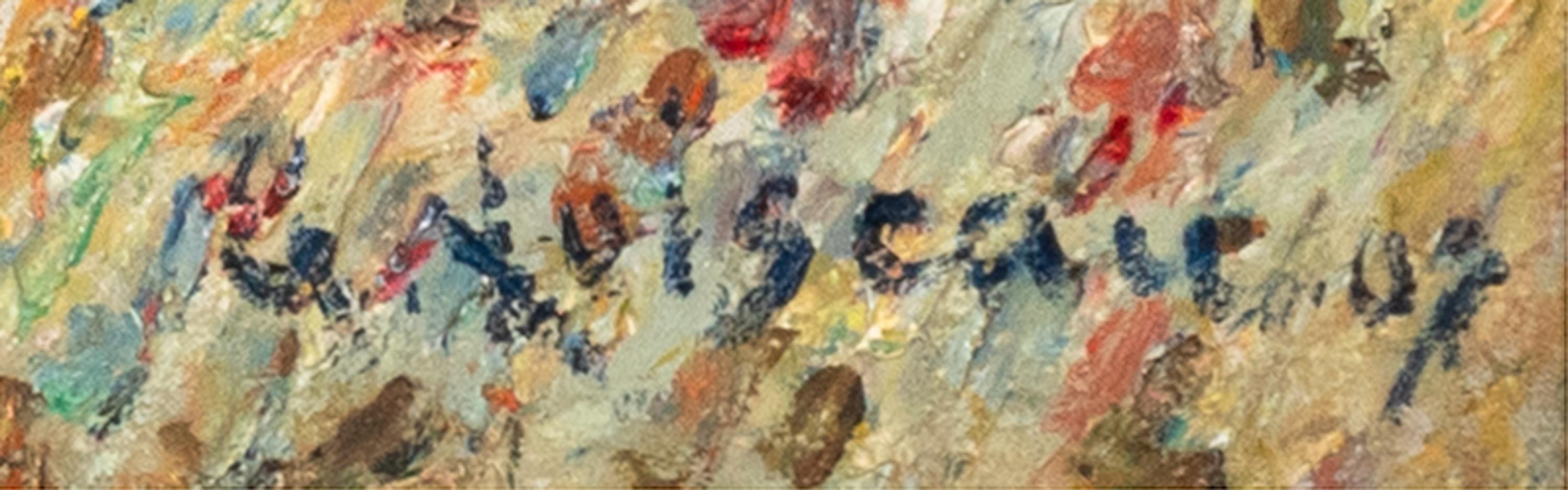
Just like the Impressionists before him, Loiseau shaped his style through close observation of nature and careful scrutiny. Like them, he was a champion of painting en plein air. Yet, he developed his own artistic technique that used a distinct cross-hatched brushstroke, called en treillis, which is on full display here. This method created an atmospheric quality and introduced movement in his compositions. In the present work, the heavy cliff seems as shimmering and evanescent as the dancing sea, or the moving sky, thus creating a vibrating, almost pulsating, canvas which echoes the strength, and raw beauty of Normandy.
Framed: 30 3/4 x 38 inches.
The physical condition of lots in our auctions can vary due to age, normal wear and tear, previous damage, and restoration/repair. All lots are sold "AS IS," in the condition they are in at the time of the auction, and we and the seller make no representation or warranty and assume no liability of any kind as to a lot's condition. Any reference to condition in a catalogue description or a condition report shall not amount to a full accounting of condition. Condition reports prepared by Freeman's staff are provided as a convenience and may be requested from the Department prior to bidding.
The absence of a posted condition report on the Freeman's website or in our catalogues should not be interpreted as commentary on an item's condition. Prospective buyers are responsible for inspecting a lot or sending their agent or conservator to inspect the lot on their behalf, and for ensuring that they have requested, received and understood any condition report provided by Freeman's.
Please email rchatroux@freemansauction.com for any additional information or questions you may have regarding this lot.