To request further details about this lot, please email madalinalazen@hindmanauctions.com

Madalina Lazen
VP Head of Department, Old Masters & 19th Century European Art
Sale 2084
| Philadelphia
| Philadelphia
To request further details about this lot, please email madalinalazen@hindmanauctions.com
Madalina Lazen
VP Head of Department, Old Masters & 19th Century European Art
Estimate$10,000 – $15,000
Provenance:
Aline Thorold (1869-1951) m. Ernest James Wythes (1868-1949) at Copped Hall, Essex, until 1917 and The Wood House, Essex, thereafter
By descent to Barbara Dorothy Wythes (1896-1984) m. (Francis) Guy Robert Elwes (1895-1966) at The Wood House, Essex until 1961 and Ham Spray House, Marlborough, thereafter
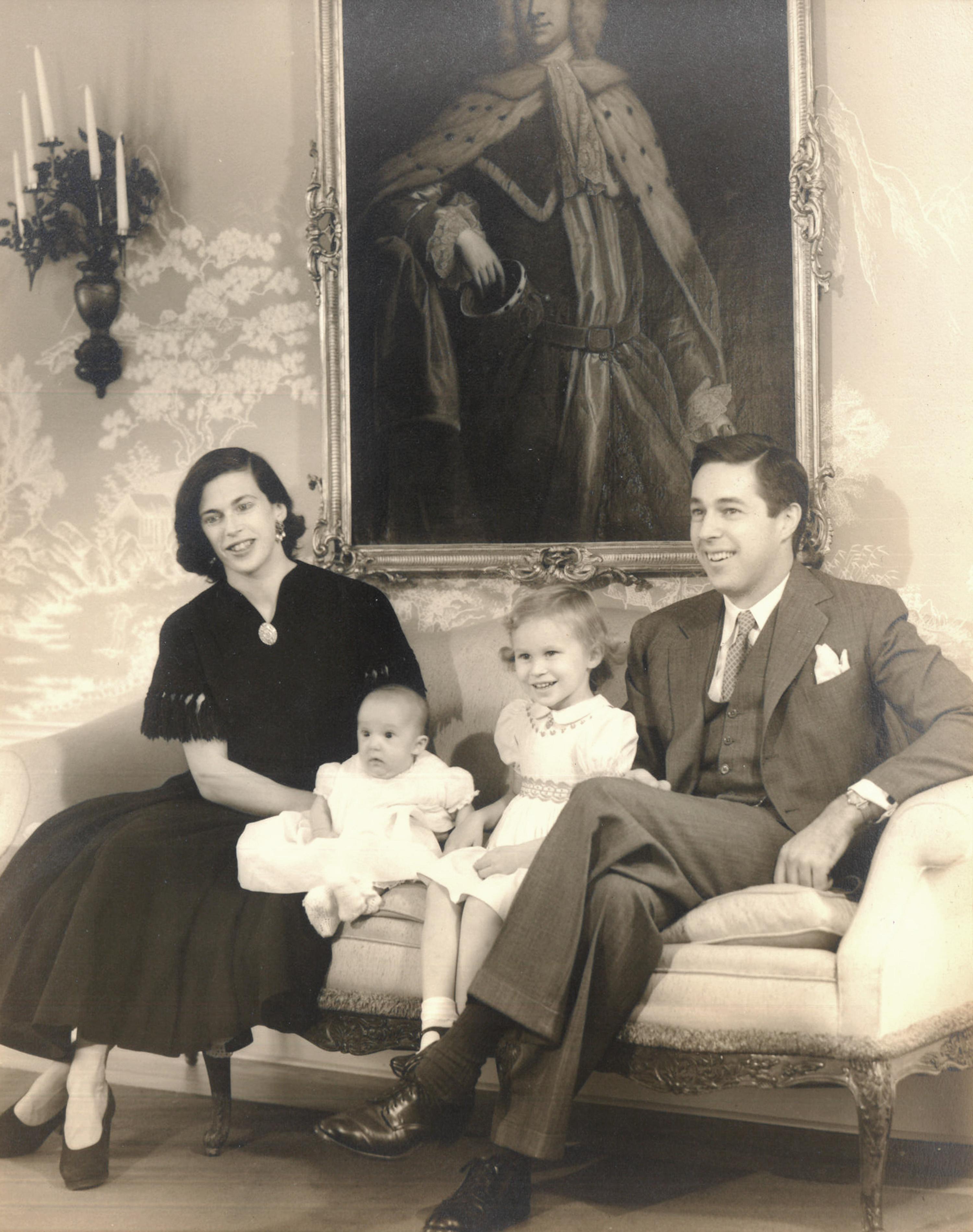
By descent to Aline Mary Margaret (Elwes) McDonnell (1923-2023) m. Hubert McDonnell Jr. (1919-2004), Greenwich, Connecticut, and thence by descent
Note:
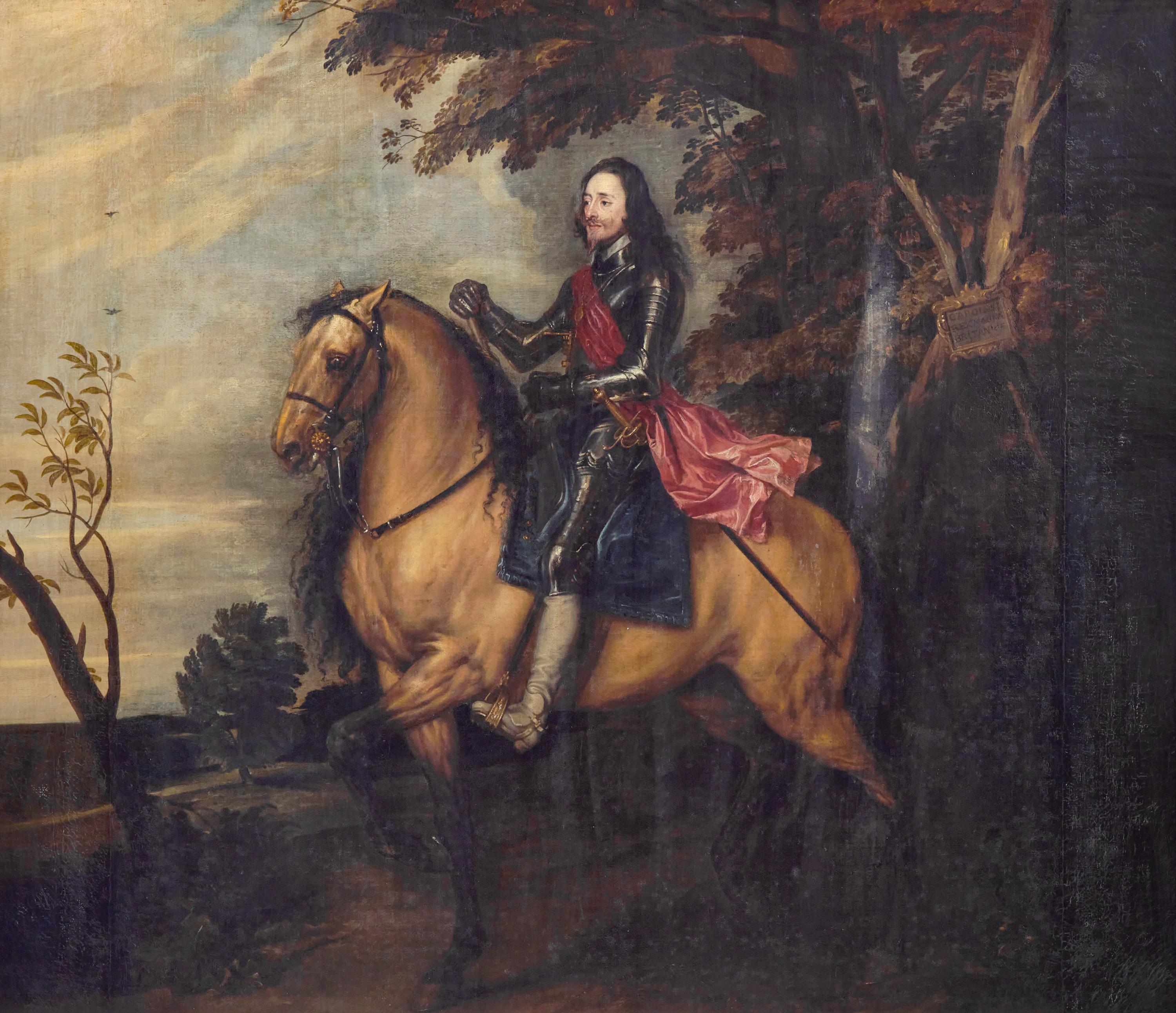
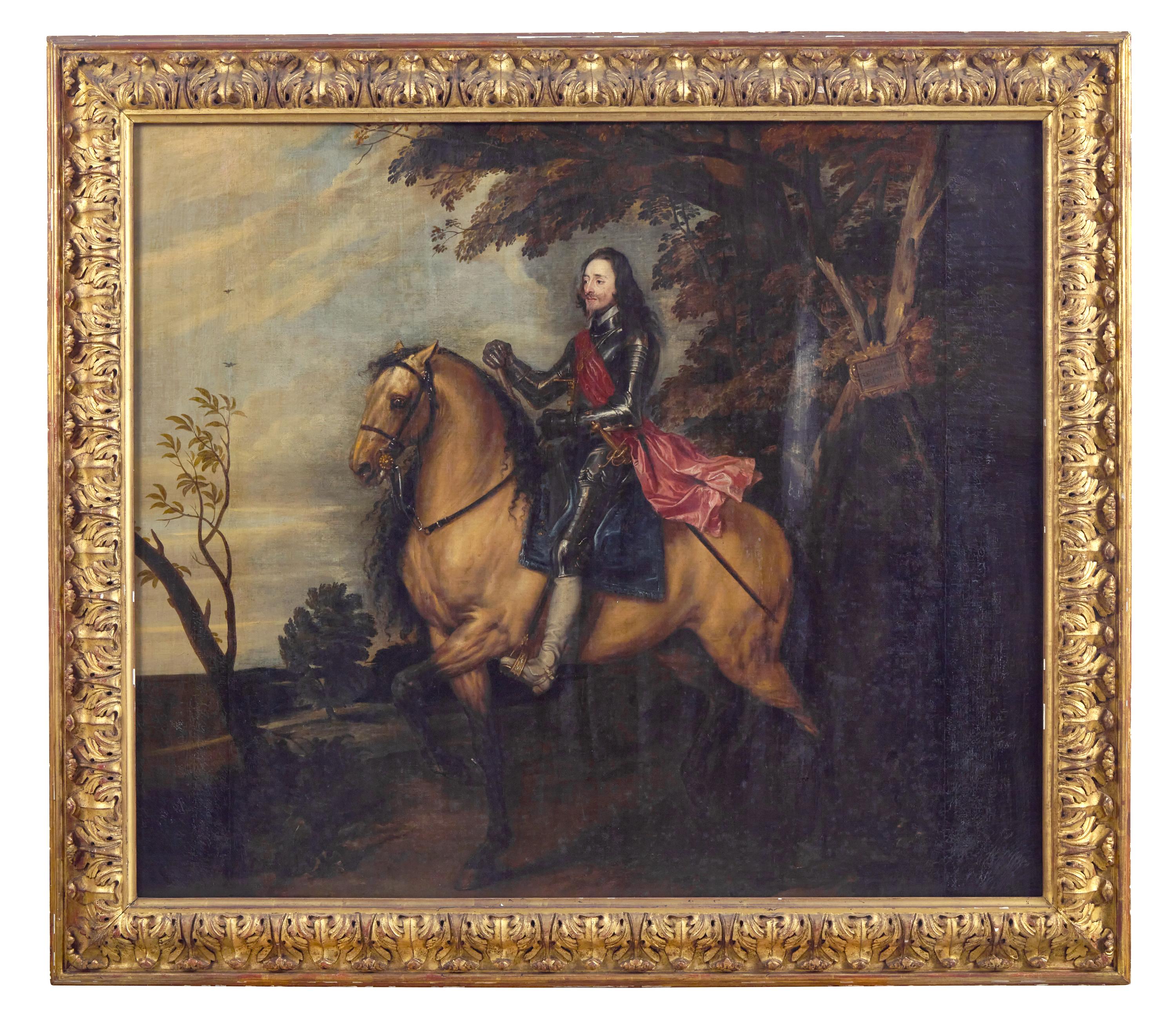
The present painting follows the composition of the full-scale equestrian portrait of King Charles I in the collection of the National Gallery, London, painted circa 1637-8, though with some notable compositional differences. In the National Gallery version, King Charles I is depicted wearing a single pearl drop earring in his left ear and is seated on a blue and red-toned velvet saddle. Further in the National Gallery version, King Charles is depicted holding his staff of command and to the rear of the horse, under the Carolus Regis carved plaque in the tree at right stands an equerry, proffering an armored helmet. In the present painting the pearl earring is absent, as is the figure of the equerry, and here Charles sits atop a blue velvet saddle.
Arguably the single most distinguishing compositional feature that separates the present work from the National Gallery version is the inclusion of a flowing red sash. Related paintings in which the sitter is depicted wearing a similar red sash include the famous portrait of Thomas Francis of Carignan, Duke of Savoy, in the collection of Galleria Sabauda, Turin, and in the Equestrian Portrait of the Brother of the King of Spain, the Cardinal-Infante Ferdinand of Austria in the Louvre. The latter is regarded as the most important derivation of van Dyck's original portrait of Charles I.
While the latter painting in the Louvre was, in the 19th century, ascribed to Gaspar de Crayer, in the current widely respected van Dyck monograph the painting is described as "Attributed to Van Thulden."
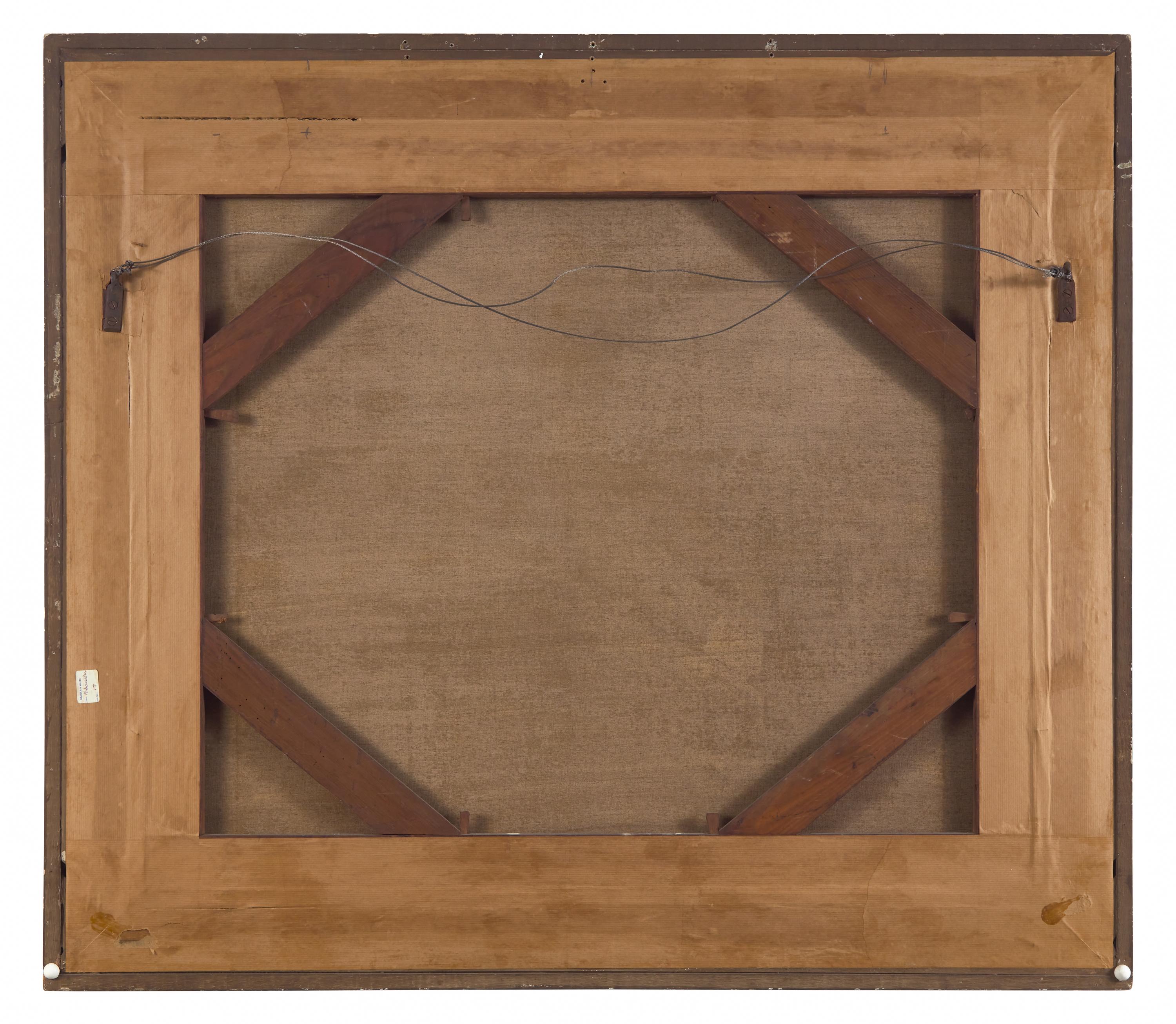
Of further note, the present canvas has a thick re-line and shows evidence of either folded or added sections to the canvas at left and right to fit the present Italian acanthus and stiff-leafed carved and gilded frame. The central canvas panel section is similar in dimension (91 x 83 cm) to the 'modello' of the final portrait composition in the National Gallery in the Royal Collection (96.0 x 86.3 cm) RCIN 400571.
As noted in the van Dyck monograph: 'Most copies of the original van Dyck composition are derived from the small version in the Royal Collection, which measures 96.9 x 61 cm (with an addition of circa 12.1 cm to the top). It is not possible precisely to trace the picture through the sale and recovery of the King's goods or, thereafter, with complete assurance to link it with either of the two versions of the subject in James II's collection (Susan Barnes, Nora de Poorter, Oliver Millar and Horst Vey, 'Van Dyck, A Complete Catalogue of the Paintings,' Yale, 2004, p. 470).
Per the van Dyck monograph 'Other known early copies are in the Pradines and (formerly) at Hitchin Priory. A copy (?eighteenth century) on a reduced scale, is at Hellens, Much Marcle. A small copy was at Ickworth (sale by Sotheby's in the house, 11, 12 June 1996 (432); another is in the Clarendon Collection.'
Provenance and the history of Copped Hall
Aline Elwes McDonnell’s lineage is traceable back as far as King George II of England (one branch of the family lays claim to having researched their ancestry yet further to the late 1400s and the reign of Edward IV) and Copped Hall in Essex was a site near the town of Epping that dates to medieval times – originally home to the FitzAucher family who held the office of Foresters. The meaning of ‘Copped’ has its roots in the old English term for peak and denotes the vantage point of the site upon which the 18th century version of the house was built. No fewer than three grand country houses graced the site until the demise of the Wyatt aggrandized version (now thankfully undergoing restoration by a local trust) in a devastating fire of 1917.
The story goes that the few household staff and gardeners that remained during the war years, armed with only a small handpump to quell the flames, dragged furniture, paintings and objects out onto the lawn to save them from destruction. Much was sold off or dispersed thereafter to offset the huge losses incurred at the time but what remained was rehoused at The Wood House (an 1898 confection in the high Tudor revivalist style on the estate grounds) where the family moved following the catastrophic event. A time capsule of 100 or so items made the transatlantic journey following Aline Mary Margaret Elwes marriage to the well-heeled New Yorker, Hubert McDonnell Jr. (1919-2004), in the Brompton Oratory in 1948. The pair settled in Connecticut and shipped the extant portion of the collection, bequeathed to Aline, by slow boat in the early 1950s, where they were lovingly preserved until the sale of the collection earlier this year. The present work is the last work to be offered from the collection at Freeman’s I Hindman.
When offering the greater part of the collection back in June, much earlier works (including a 17th century portrait of Chancellor John Conyers, parrt of Cromwell’s inner circle during the English Civil War) and tapestries from circa 1680 were offered. Whilst the provenance for the present work can only be traced with any certainty as far as 1898 when Edward Wythes purchased Copped Hall from the Conyers family, the possibility remains that residual contents from successive owners of the site may have been included with the sale of the house over several generations. Of specific interest, is the ownership of the Tudor Copped Hall, Lionel Cranfield, 1st Earl of Middlesex (1575-1645). According to a fragment on the website of the National Portrait Gallery detailing the history of frames at Knole Park, Cranfield commissioned master carver and gilder, George Geldorp, in 1636 to create frames for numerous works including Van Dycks and Van Dyck copies:
‘In about 1636 Geldorp drew up a bill to the Earl of Middlesex for seven pictures and seven frames, totalling £114.10s. By far the most expensive items were the royal portraits, that of Charles I and Henrietta Maria in royal robes with its rich gilt frame costing £45 while The Three Eldest Children of Charles I with its frame cost £17, both perhaps copies after Van Dyck. Also supplied was a flower piece for the Countess’s closet at £4, a frame for a Van Dyck, called ‘la bergeere’, and various family portraits including a copy after Van Dyck of the Countess’s portrait at £12 and a separate frame for Van Dyck’s original portrait at £6, two smaller framed copies at £4 each, a portrait of a dead infant at £10 and a rich picture frame for an original by Van Dyck at £6.10s (National Portrait Gallery, Archive MSS coll.; another version, Kent History and Library Centre, U269 A454/4, information from Edward Town).’
The above excerpt from ‘British Picture Frame Makers, 1600-1950’ specifically references numerous Van Dyck copies of Royal portraiture in the collection of the Earl of Middlesex. The tantalizing possibility exists that the present work was part of this group – the most important of which transferred to Knole Park in 1637 upon the marriage of Frances Cranfield to Richard Sackville, future 6th Earl of Dorset. Through this marriage, Copt Hall came into the possession of the Earls of Dorset following the death of the 3rd Earl of Middlesex in 1674. The same article references the financial difficulties of the 6th Earl:
‘Copt Hall became one of the chief Dorset residences, though the 6th Earl of Dorset was considering selling the house at least as early as 1693 to meet his mounting debts. Finally in June 1701 the estate was sold and the contents moved to Knole. At least six wagon loads, including 157 pictures and maps, made their way to Knole, with the great cartoons now in the Cartoon Gallery specially rolled for the occasion.’ (ibid, https://www.npg.org.uk/collections/research/programmes/the-art-of-the-picture-frame/guides-knole)
Whether traceable or not to the Cranfield commission, the present copy is a rare English Country House survival. We are grateful to Alan Cox of the Copped Hall Trust for his research, website and suggestions in the research of this rare and unusual Van Dyck copy with pentiments. We are equally grateful to Anna Reynolds and Cicely Robinson of the Royal Collection for checking the van der Doort inventory on our behalf.
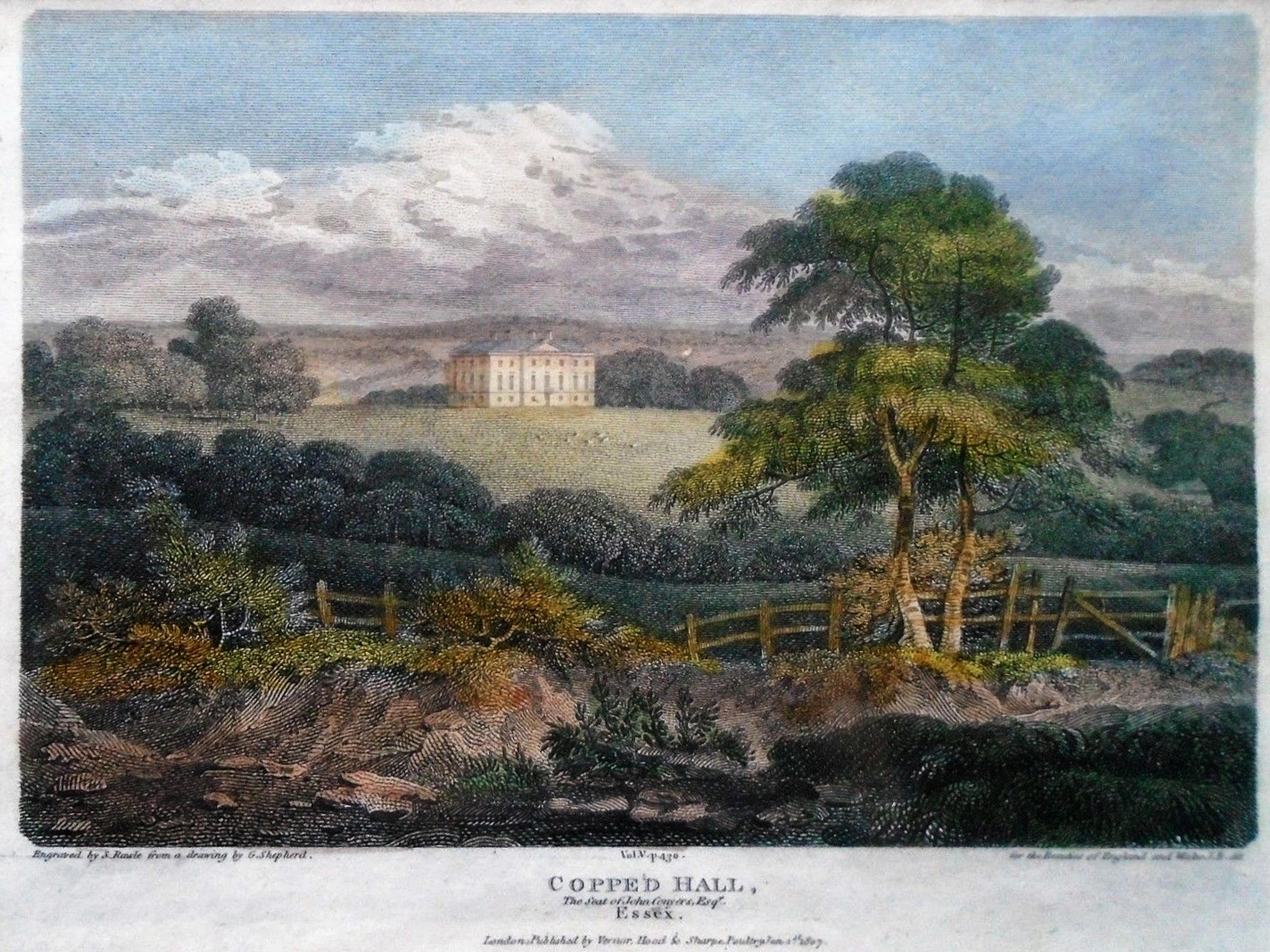
Pictured:
An 1807 engraving of Copped Hall, S. Rawle from a drawing by S. Shepherd.
Aline Elwes McDonnell and Family, circa 1954.
Framed: 43 5/8 x 49 5/8 in.
The relined canvas is in generally fair condition. Craquelure and surface soiling of varying degrees is present throughout the work . Two vertical creases present along left and right sides of work, as referenced in lot essay, presumably from previous folding or due to addition to canvas. Significant scuff present at right with associated discoloring and loss of varnish, measuring approximately 12 inches in length. Under UV evidence of cosmetic retouching present throughout most notable along creasing at left and right, in figures foot and hand, at lower left extreme corner and over apparent scuffing. Please see specialist photos for details.
The physical condition of lots in our auctions can vary due to age, normal wear and tear, previous damage, and restoration/repair. All lots are sold "AS IS," in the condition they are in at the time of the auction, and we and the seller make no representation or warranty and assume no liability of any kind as to a lot's condition. Any reference to condition in a catalogue description or a condition report shall not amount to a full accounting of condition. Condition reports prepared by Freeman's staff are provided as a convenience and may be requested from the Department prior to bidding.
The absence of a posted condition report on the Freeman's website or in our catalogues should not be interpreted as commentary on an item's condition. Prospective buyers are responsible for inspecting a lot or sending their agent or conservator to inspect the lot on their behalf, and for ensuring that they have requested, received and understood any condition report provided by Freeman's.
Please email madalinalazen@hindmanauctions.com for any additional information or questions you may have regarding this lot.