To request further details about this lot, please email antiquities@hindmanauctions.com
Please email antiquities@hindmanauctions.com for any additional information or questions you may have
Sale 2069
| Chicago
| Chicago
To request further details about this lot, please email antiquities@hindmanauctions.com
Please email antiquities@hindmanauctions.com for any additional information or questions you may have
Estimate$20,000 – $30,000
Provenance:
Private Collection, Spain, 19th-20th Century; thence by descent.
Setdart Auction House, Barcelona, Decorative Arts & Oriental Art, 28 November 2023, Lot 45. [where described as 16th Century]
Art Market, Belgium; where acquired by the present owner.
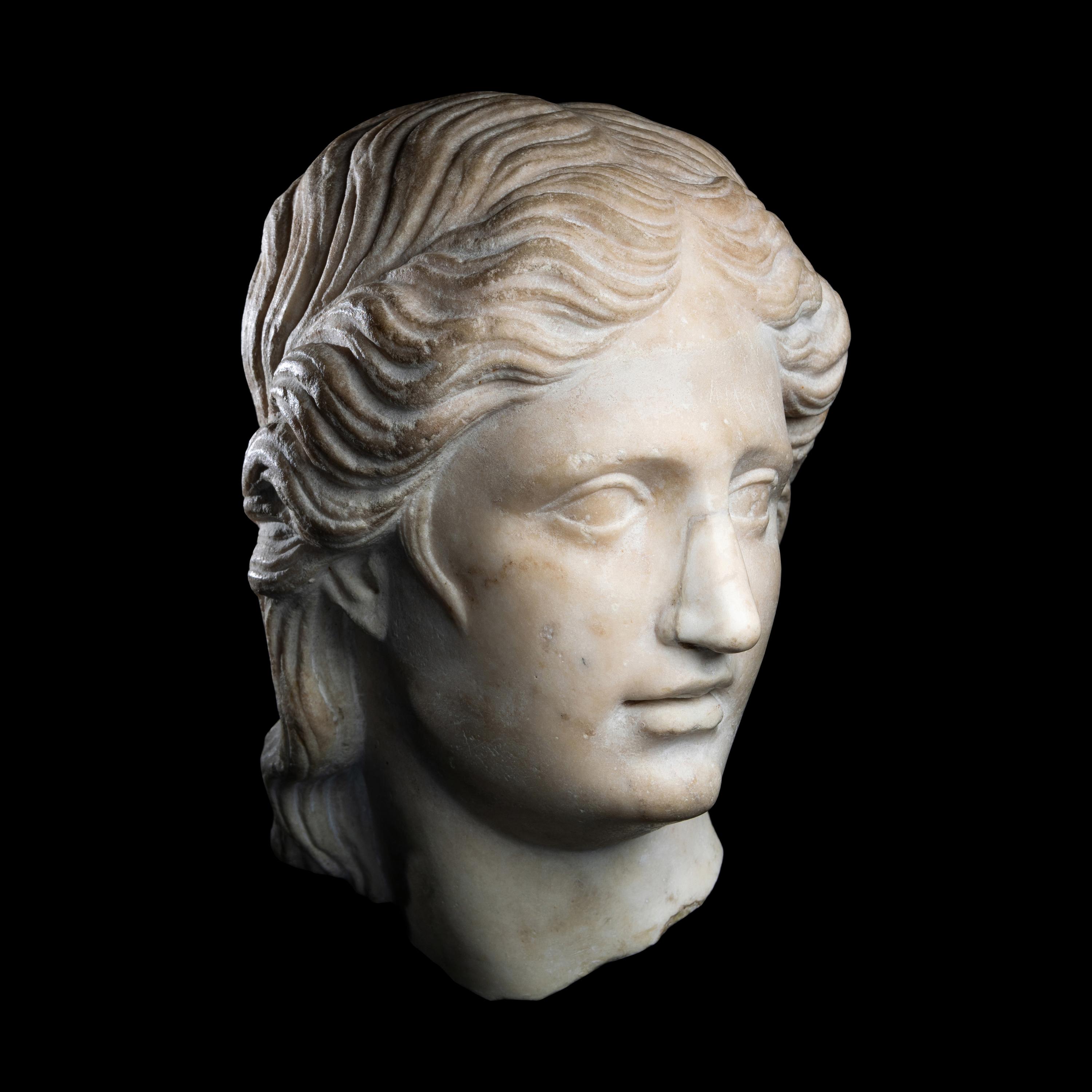
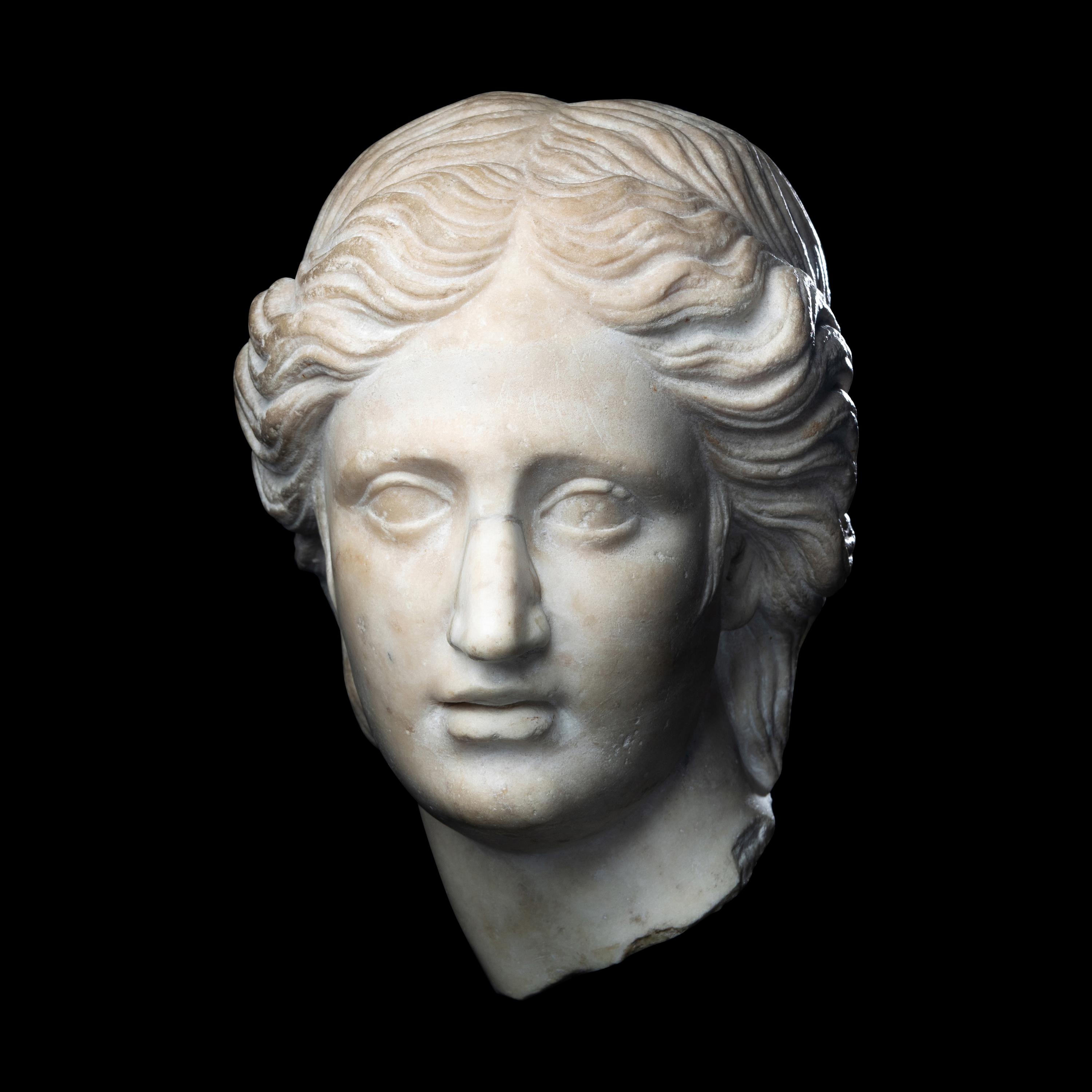
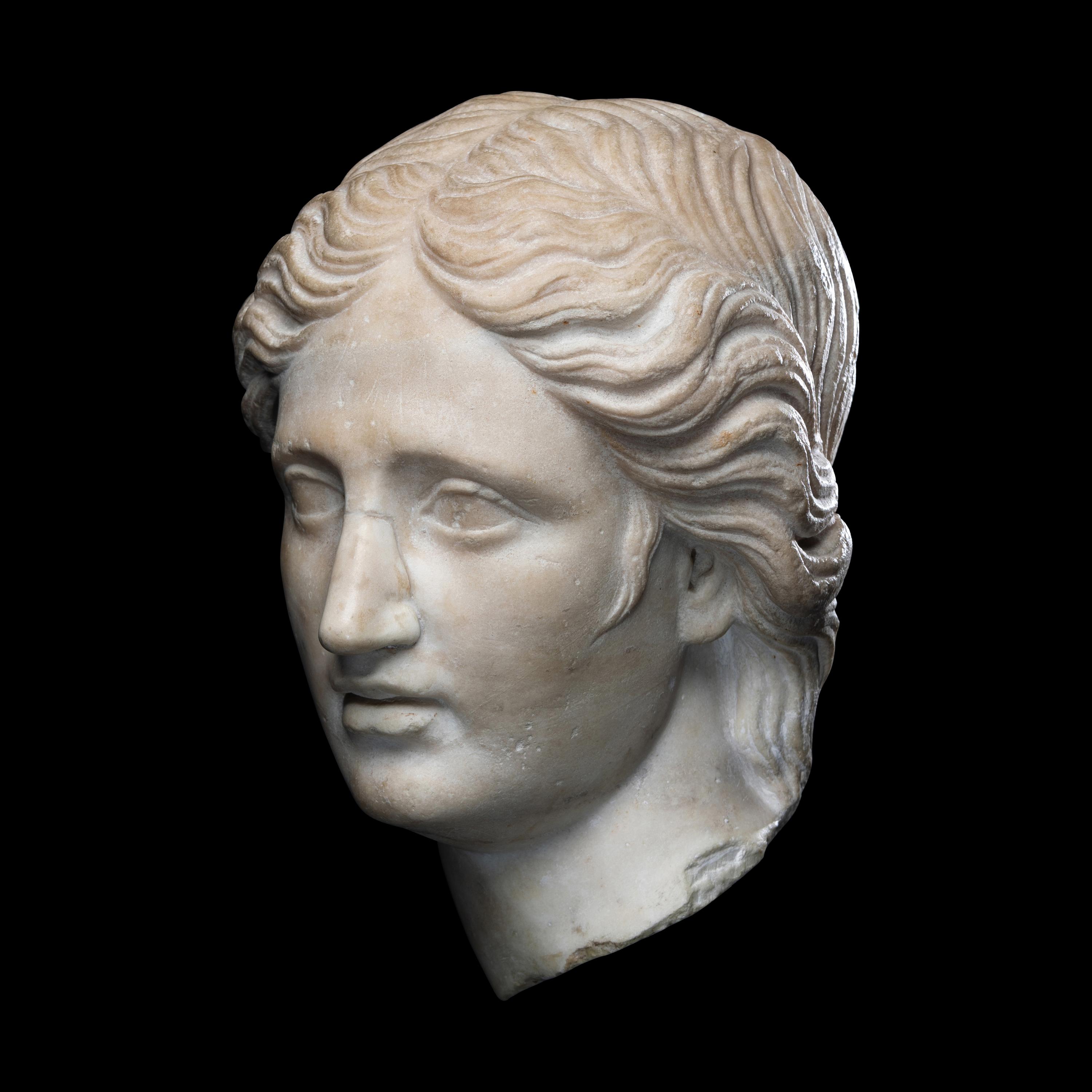
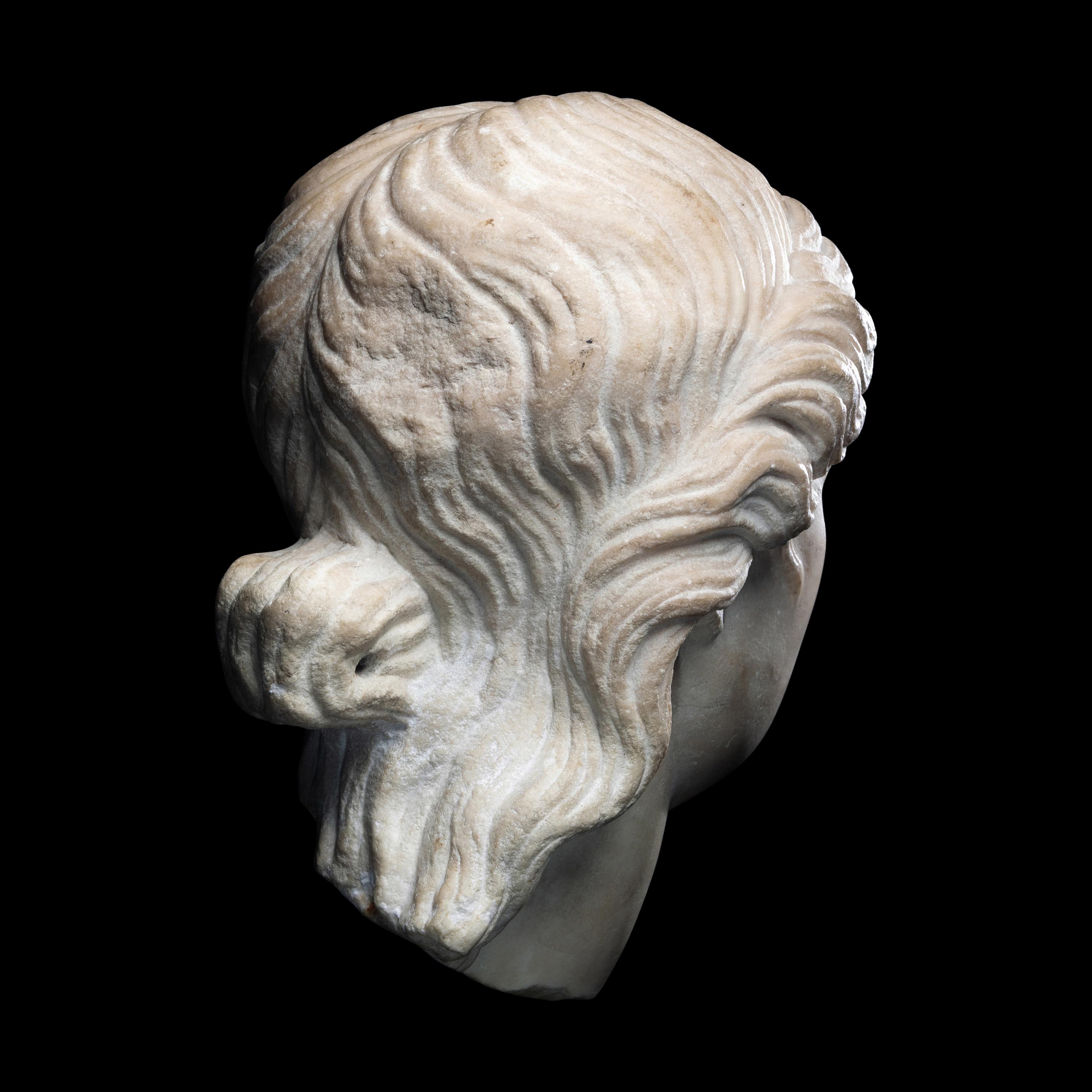
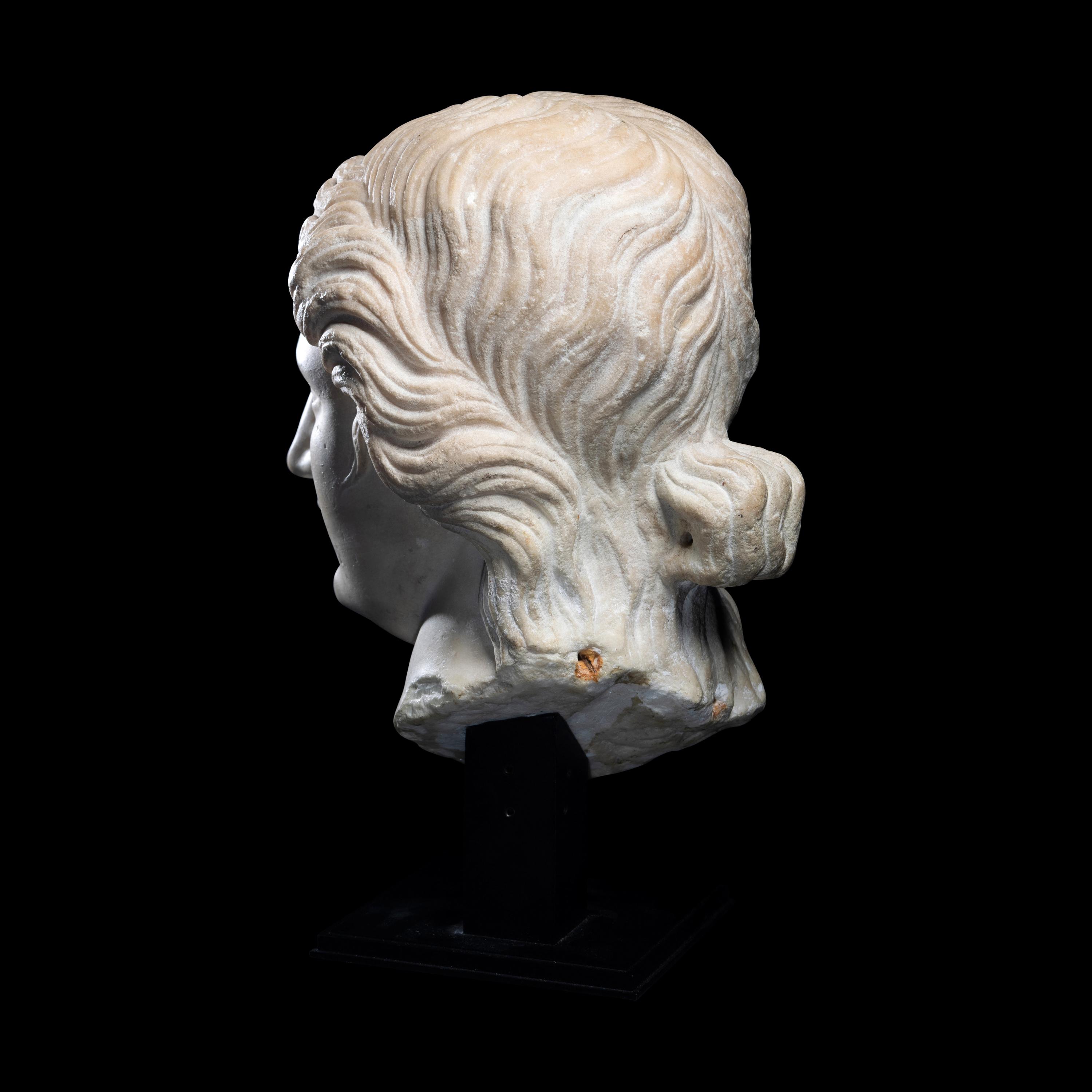
Turning to the left, this idealized head displays a soft physiognomy and inquisitive confidence equally suited to a goddess or a youthful god. Thick locks of hair are centrally parted above a high brow, brushed back from the face with tendrils escaping over each cheek, and gathered into a loose, squared chignon at the nape. The chignon is pierced through the center, and a channel above the roll of hair around the crown might have accommodated a ribbon or crown in metal (now lost). Sloping eyebrows are crisply delineated, with the proper left cocked slightly higher at the interior. Large almond-shaped eyes below are encased in thick lids, with the pupil and iris left uncarved but perhaps retaining traces of polychromy. The full lips are slightly parted and fleshy cheeks descend to a pert, slightly dimpled chin. The original nose has broken almost completely, restored in an 18th-century technique (for parallels, see the prolific work of the Italian master Bartolomeo Cavaceppi) with the original break smoothed and fitted with a carefully joining addition of matching marble.
The slight asymmetries of the facial features and the decided turn to the neck enliven this head and indicate it was originally part of a full-sized statue. Both hairstyle and smooth features draw from the Late Classical Greek prototypes, enthusiastically adapted and deployed by sculptors during the Roman period for an expanded range of subjects. Perhaps the best candidate for the deity shown is Aphrodite (Romanized to Venus), who was shown in a variety of formats and poses during the Imperial period. An especially popular motif showed the goddess – that regal coquette – emerging from the bath, turning toward her voyeuristic onlooker while partly covering her nudity (see most famously Capitoline Museum, Rome, Inv. no. 409). However, ambiguities regarding the subjects’ gender might never be resolved, as ever-youthful Apollo commonly received androgynous facial features and hairstyles (see surviving examples in Berlin, Staatliche Museen zu Berlin, Inv. no. Sk 52 and at Holkham Hall).
Notes:
On Cavaceppi and 18th-century restoration techniques, see M.G. Barberini and C. Gasparri, Bartolomeo Cavaceppi, scultore romano (1717-1799) [exhibition catalogue, Museo del Palazzo di Venezia], Rome, 1991; F. Haskell, and N. Penny, Taste and the Antique: The Lure of Classical Sculpture 1500-1900 (New Haven, 1981). For the Holkham Hall Apollo, see A. Michaelis, Ancient Marbles in Great Britain, Cambridge, 1882, p. 314, no. 37. On how Greek sculptural types were adopted and adapted to Roman audiences, see C.C. Vermeule, Greek Sculpture and Roman Taste: The Purpose and Setting of Graeco-Roman Art in Italy and the Greek Imperial East, Ann Arbor, 1977.
Inspected under UV light and 10x loupe. Broken at neck; light areas of surface wear and pitting; 18th Century restoration to the nose; two pin holes and oxidized traces of iron pins near the break at the rear, likely indicating post-antique use, perhaps to secure the head to a different body. Other weathering, gouges, and patina typical of age. Overall in fine and attractive condition. See additional images. Affixed to stand. Height with stand 13 3/4 inches (34.93 cm).
The physical condition of lots in our auctions can vary due to age, normal wear and tear, previous damage, and restoration/repair. All lots are sold "AS IS," in the condition they are in at the time of the auction, and we and the seller make no representation or warranty and assume no liability of any kind as to a lot's condition. Any reference to condition in a catalogue description or a condition report shall not amount to a full accounting of condition. Condition reports prepared by Freeman's staff are provided as a convenience and may be requested from the Department prior to bidding.
The absence of a posted condition report on the Freeman's website or in our catalogues should not be interpreted as commentary on an item's condition. Prospective buyers are responsible for inspecting a lot or sending their agent or conservator to inspect the lot on their behalf, and for ensuring that they have requested, received and understood any condition report provided by Freeman's.
Please email antiquities@hindmanauctions.com for any additional information or questions you may have regarding this lot.