To request further details about this lot, please email antiquities@hindmanauctions.com
Please email antiquities@hindmanauctions.com for any additional information or questions you may have
Sale 2069
| Chicago
| Chicago
To request further details about this lot, please email antiquities@hindmanauctions.com
Please email antiquities@hindmanauctions.com for any additional information or questions you may have
Estimate$80,000 – $100,000
Provenance:
with Phoenix Ancient Art, New York, 1990s.
Christie's, New York, Ancient Jewelry, 7 December 2006, Lot 256.
Private Collection, United States.
Christie's, New York, Ancient Jewelry, 9 December 2010, Lot 396.
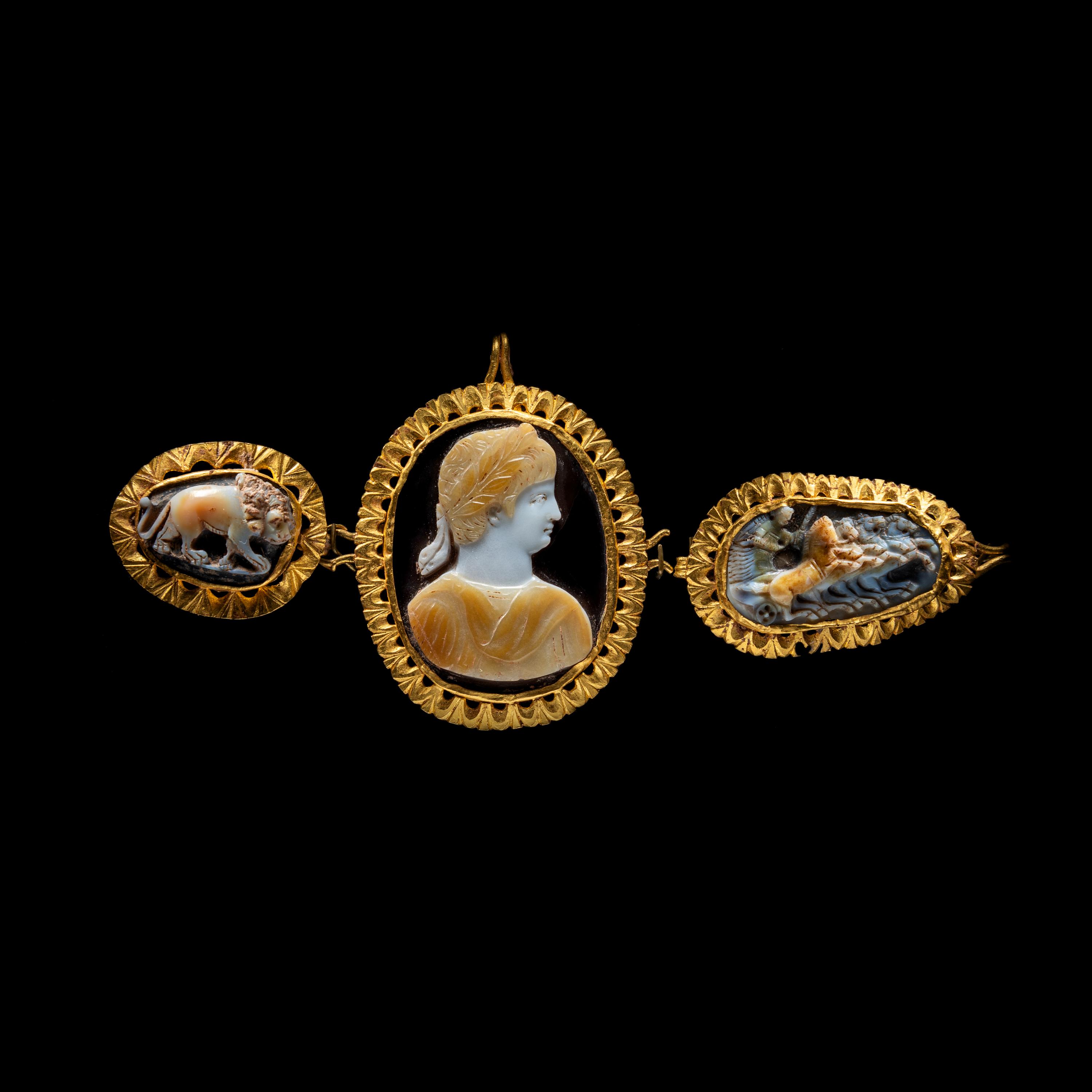
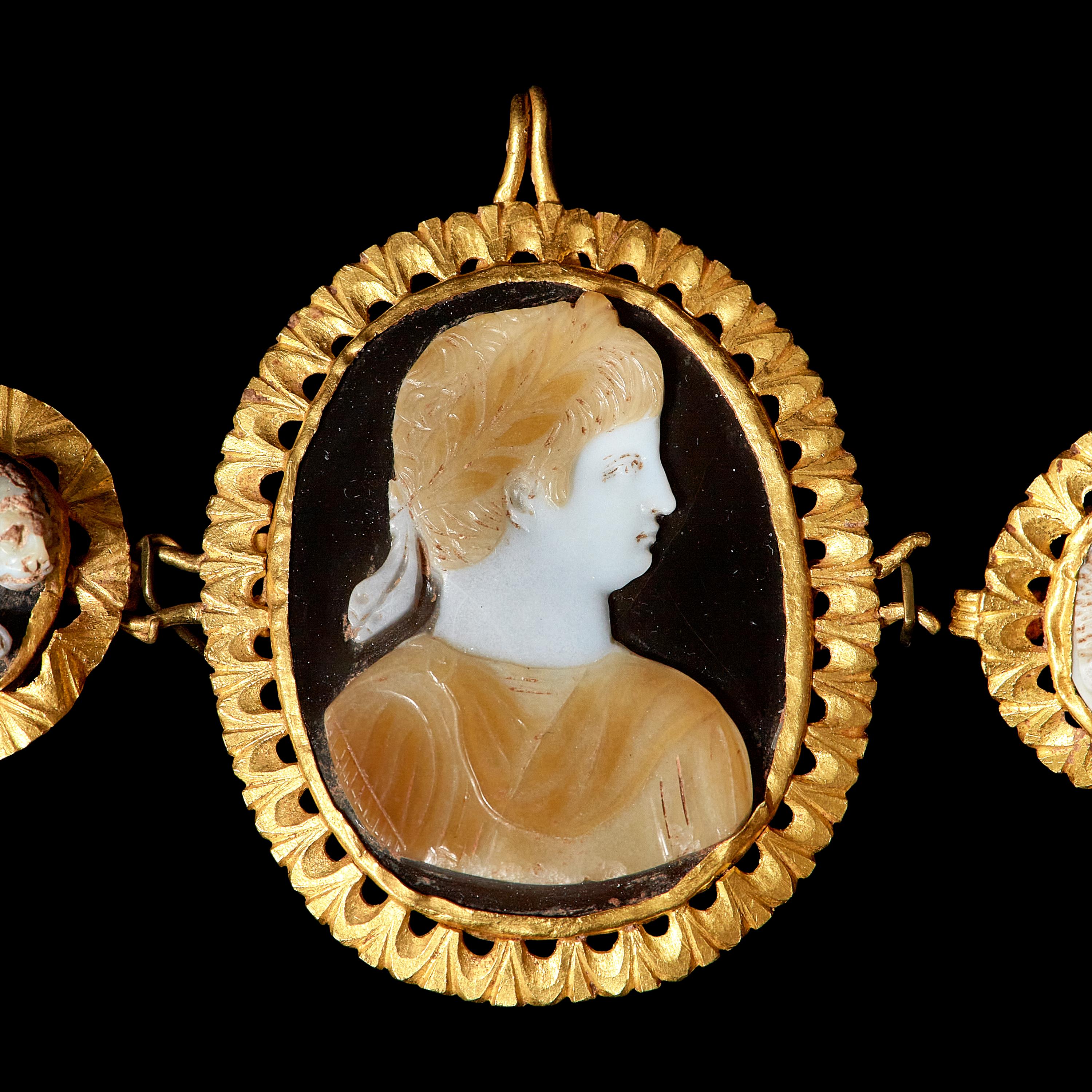
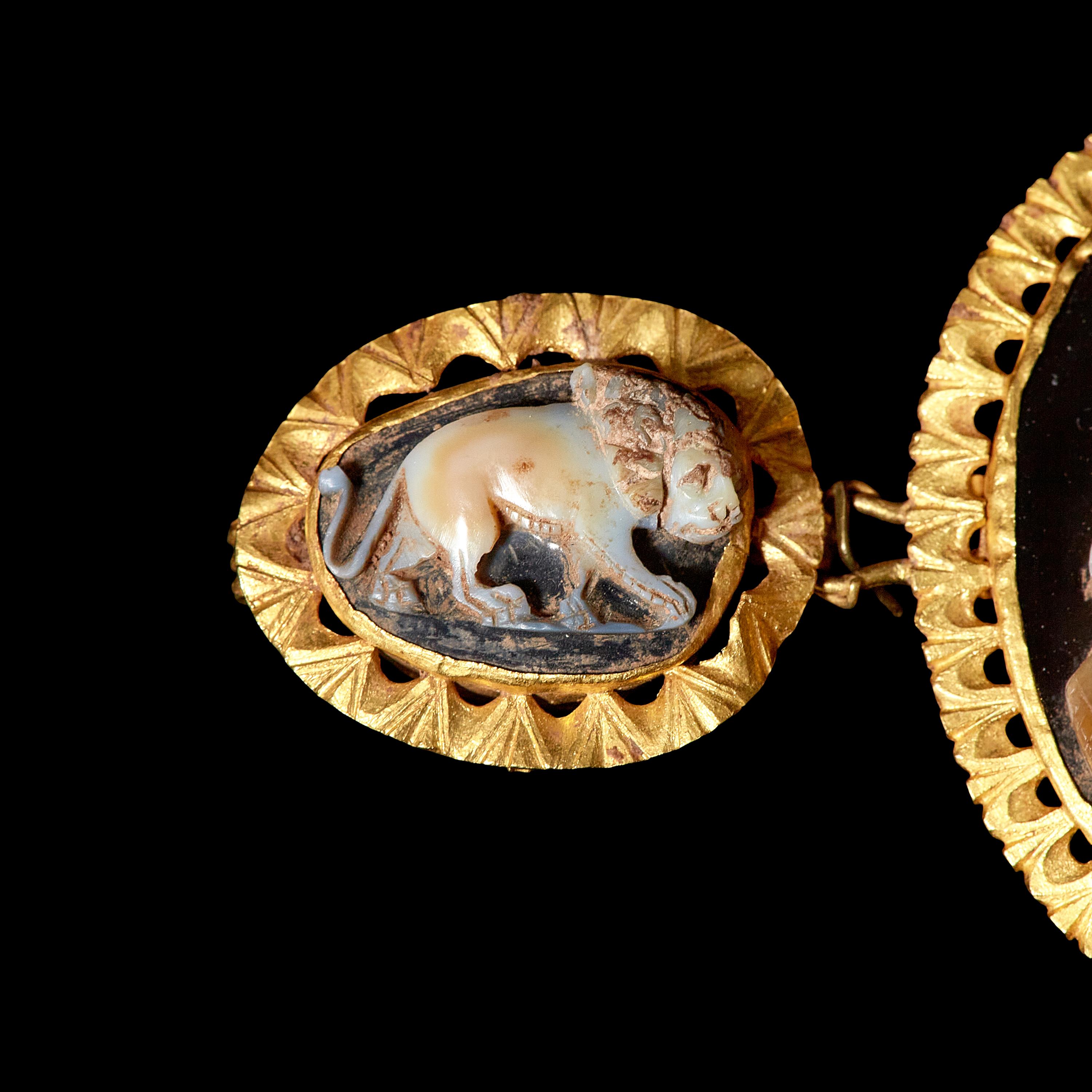
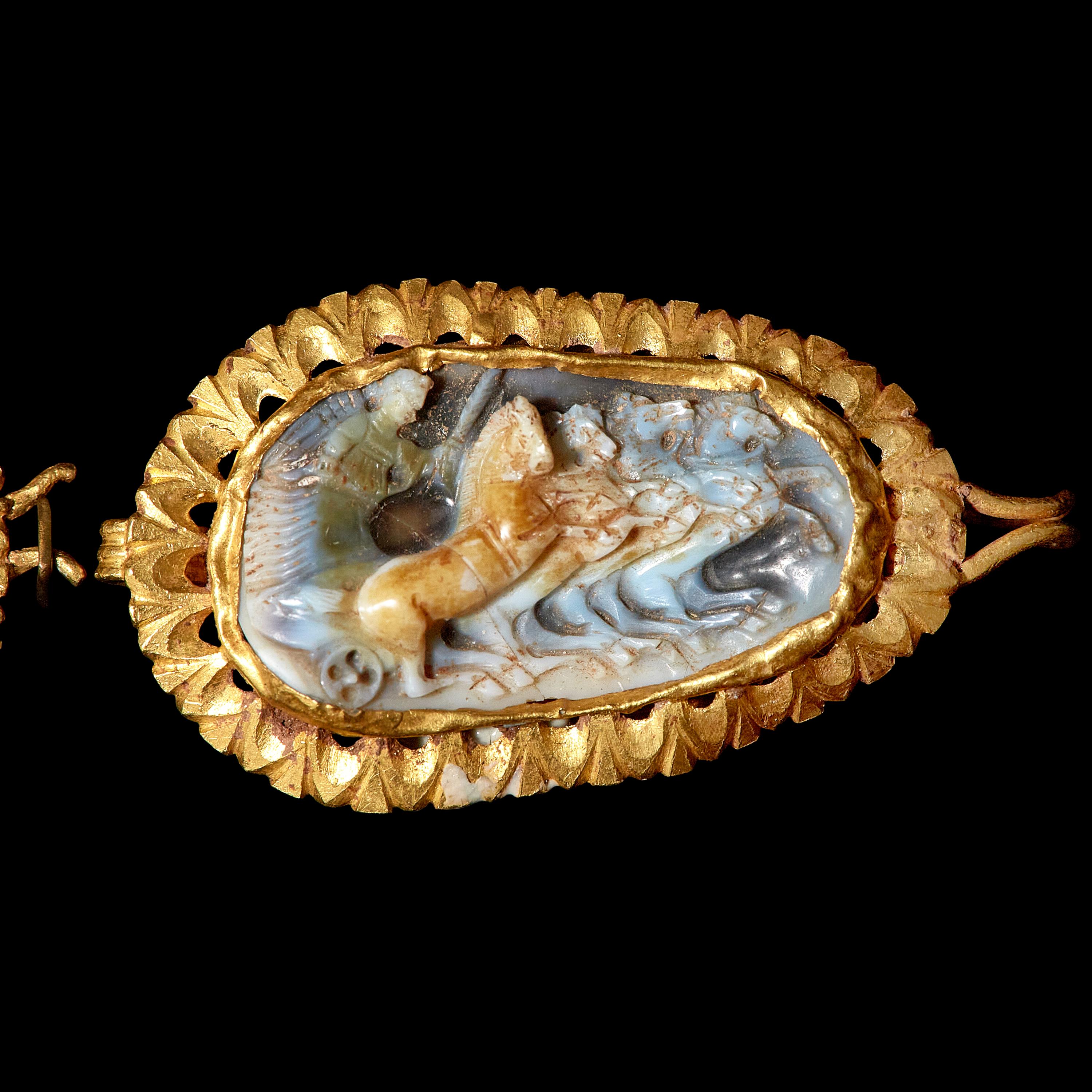
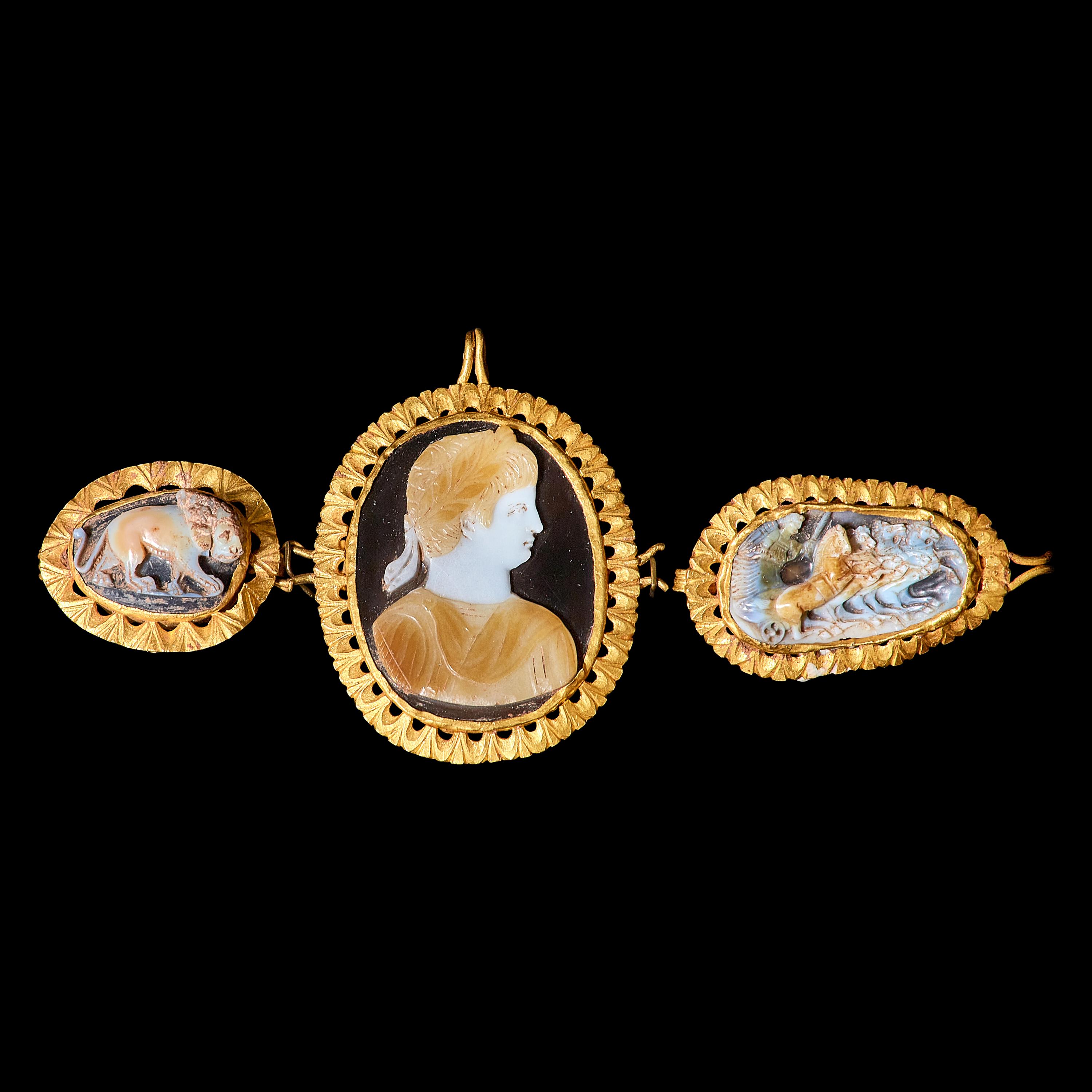
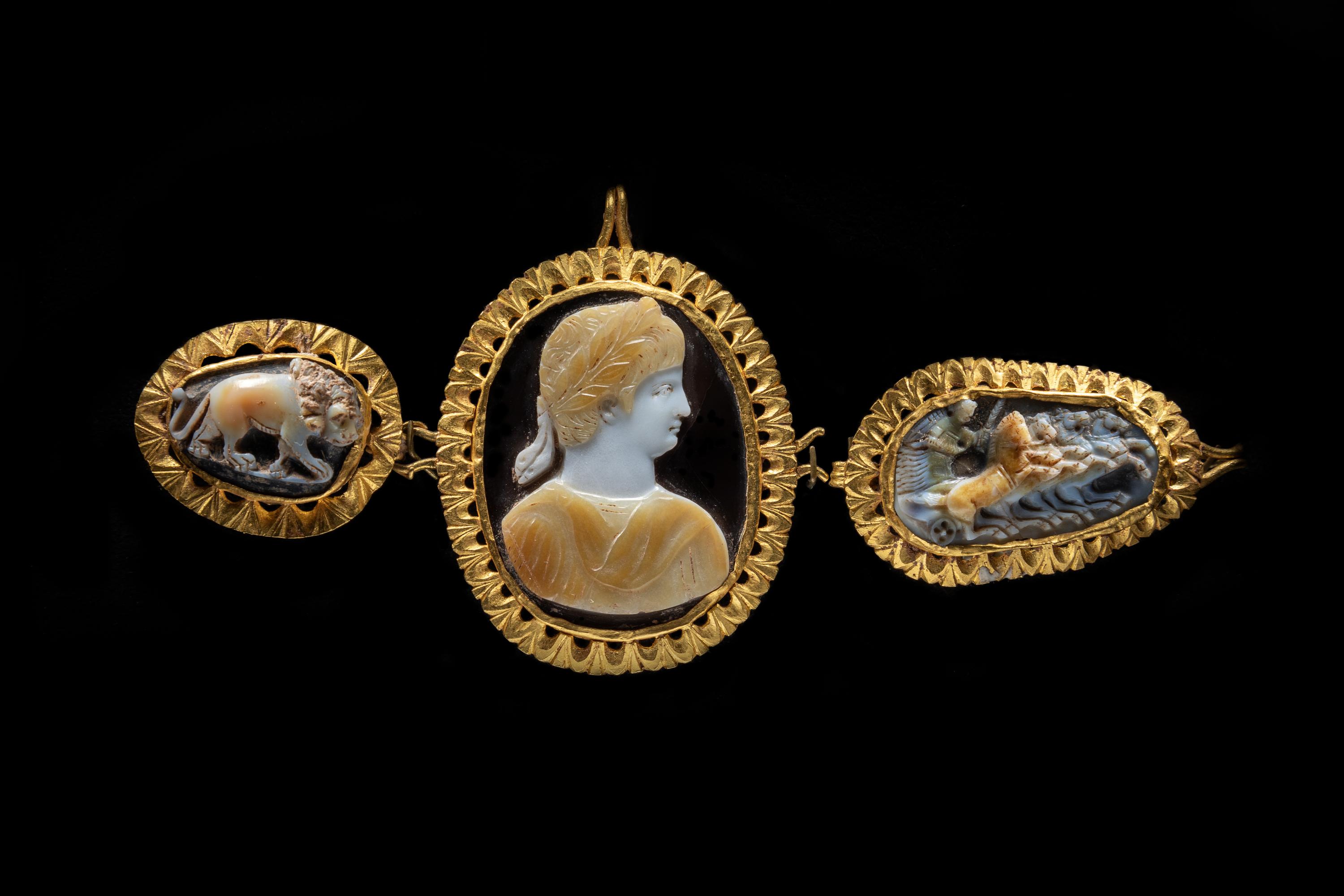
Set into individual frames of pierced-work gold and joined by hook and loop closures, three large sardonyx cameos form an impressive array that would have served as the centerpiece of a sumptuous necklace. The largest, central stone shows the bust of Nero (54-68 A.D.) facing right and wearing a cuirass and paludamentum, the carving exploiting naturally occurring layers of toffee, cream, and dark brown to great advantage for the emperor’s hair, laurel wreath, flesh, and garment. The portrait is related to his accession type (most famously preserved in the round in an example in Cagliari, Museo Nazionale, Inv. no. 35.533) inaugurated in 54 A.D. Comma-shaped locks are arranged into a thick fringe over the forehead but not yet transformed into the peculiar, terraced coiffure that marked Nero’s later portraiture. At the same time, a burgeoning double chin only hints at the pronounced fleshiness to come (see the portly examples now in the Worcester Art Museum, Inv. no. 1915.23 and Munich Glyptothek, Inv. no. 321). The flanking oblong cameos were carved at least a century after the central portrait, with details more summarily rendered and backgrounds tinged more blue than brown: to the left, a lion strides forward with head tilted ominously downward, and to the right a quadriga speeds forward with Victory as charioteer.
Much of what is known about Nero’s life stems from the writing of some of his most vicious detractors (most notably Suetonius and Cassius Dio) and his reign is now notorious for his lavish pleasure palaces, possible homicidal streak, and increasing megalomania. His fondness for public spectacle (gladiatorial munera and venationes with exotic animals, gruesome executions, staged displays of largesse, and pornographic theatre) enthused the Roman populace, while his penchant for participating in them horrified the upper classes. Chariot races became a personal obsession, and in addition to competing in the Circus Maximus, Nero famously took part in the Olympic Games of 67 A.D., significantly boosting his performance by competing with ten horses rather than four.
By 68 A.D., Nero’s increasingly erratic and autocratic rule had pushed the Senate to declare him a public enemy, forcing him to commit suicide. In his final moments, he famously cried, “What an artist the world is losing!” As was customary for condemned emperors, his memory was officially subjected to damnatio memoriae, erasing him from public record. While his image was publicly defaced and erased, private settings were a different matter, as shown by the survival of this cameo portrait—a reminder of the limits of the Senatorial decree. Hard-stone portrait cameos of emperors were often crafted as gifts within imperial circles, symbolizing dynastic loyalty and favor. Bestowed personally by the emperor, these honorific pieces were prized and seldom discarded, especially in households with enduring loyalty. The survival of this example, though rare, is not unique (see notes below). Re-set over a century after it was first carved, the cameo reemerged as an object of prestige—its costly and striking stone invoking imperial authority. The unusual pairing of the portrait with flanking lions and a chariot scene subtly highlights aspects of Nero’s unique tastes, suggesting that the 3rd-century owner was well aware of the emperor’s likeness they chose to wear.
For close parallels showing Nero’s early portraiture in preserved sardonyx cameos, see J. Boardman, D. Scarisbrick, C. Wagner, E. Zwierlein-Diehl. The Marlborough Gems. 2009, no. 374; M. Henig, The Content Cameos. 1990, p. 34 no. 59; and W.-R. Megow, Kameen von Augustus bis Alexander Severus. Berlin, 1987, pp. 211-12 nos. A93 and A94; On Nero’s ‘damnatio memoriae’, see E. Varner (ed). From Caligula to Constantine: tyranny and transformation in Roman portraiture. Atlanta, 2000, pp. 126-30; and for imperial portrait cameos as gifts, see R.R.R. Smith, “Maiestas Serena: Roman Court Cameos and Early Imperial Poetry and Panegyric,” The Journal of Roman Studies, vol. 111, p. 78.
Inspected under UV light and 10x loupe. Two cracks in Victory cameo. One across waist and through legs, and one through head and heads of horses. Some loss to face. Weathering and nicks to setting. Loss to proper left loop of setting for Nero cameo. Some encrustation, notably to lion cameo. Nero cameo set in open-backed mount. Flanking intaglios are set in a gold encapsulated mount. Gold with some encrustation and mild reddish patina in areas. Adhesive putty on back of Victory setting. Overall in very fine and attractive condition. See additional images. Height with stand 3 3/8 inches (8.57 cm).
The physical condition of lots in our auctions can vary due to age, normal wear and tear, previous damage, and restoration/repair. All lots are sold "AS IS," in the condition they are in at the time of the auction, and we and the seller make no representation or warranty and assume no liability of any kind as to a lot's condition. Any reference to condition in a catalogue description or a condition report shall not amount to a full accounting of condition. Condition reports prepared by Freeman's staff are provided as a convenience and may be requested from the Department prior to bidding.
The absence of a posted condition report on the Freeman's website or in our catalogues should not be interpreted as commentary on an item's condition. Prospective buyers are responsible for inspecting a lot or sending their agent or conservator to inspect the lot on their behalf, and for ensuring that they have requested, received and understood any condition report provided by Freeman's.
Please email antiquities@hindmanauctions.com for any additional information or questions you may have regarding this lot.