To request further details about this lot, please email antiquities@hindmanauctions.com
Please email antiquities@hindmanauctions.com for any additional information or questions you may have
Sale 2069
| Chicago
| Chicago
To request further details about this lot, please email antiquities@hindmanauctions.com
Please email antiquities@hindmanauctions.com for any additional information or questions you may have
Estimate$100,000 – $150,000
Provenance:
The Thétis Foundation, Geneva.
Sotheby's, London, Antiquities: The Property of the Thétis Foundation and Other Owners, 23 May 1991, Lot 72.
Private Collection, Switzerland.
Antiquarium, New York, 2005.
Mr. & Mrs. Charles Newhall, III, Maryland. Christie’s, New York, Antiquities, 9 December 2010, Lot 105.
Exhibited:
Switzerland, Geneva, Musée d’art et d’histoire, Collection de la Fondation Thétis, 1987.
Published:
J.-L. Zimmerman, Collection de La Fondation Théthis, Geneva, 1987, p. 58, no. 107.
N.E. Kephalidou, Eikonographiki meleti tou archaiou ellinikou athlitismou, Thessaloniki, 1996, pl. 23.G47 (I).
I.G. Rizzo, Inquieti “commerci” tra uomini e dei, Rome, 2002, pl. 3.3 (A).
Beazley Archive Database no. 41586.
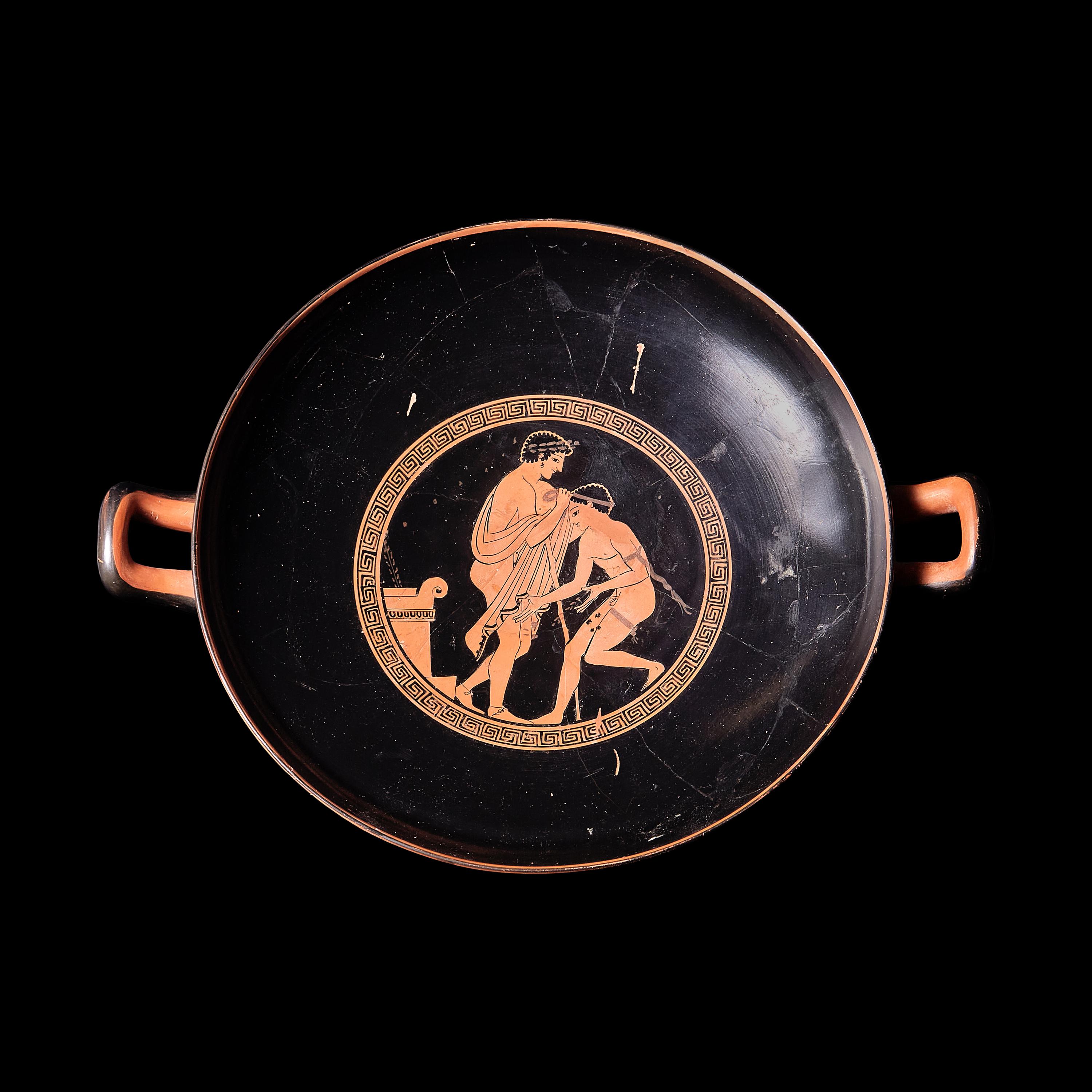
Mortal and mythological realms are combined to great effect on a drinking cup attributed to the Colmar Painter. Here, the canonical cup shape finds its most refined iteration (a kylix, ‘type B’) with the shallow bowl descending to the stem and foot in a continuous line, with horizontal handles upturned slightly to echo that elegant curve. Favored by the great masters of Late Archaic Attic vase painting, the shape provided three ideal zones in which to showcase their craft.
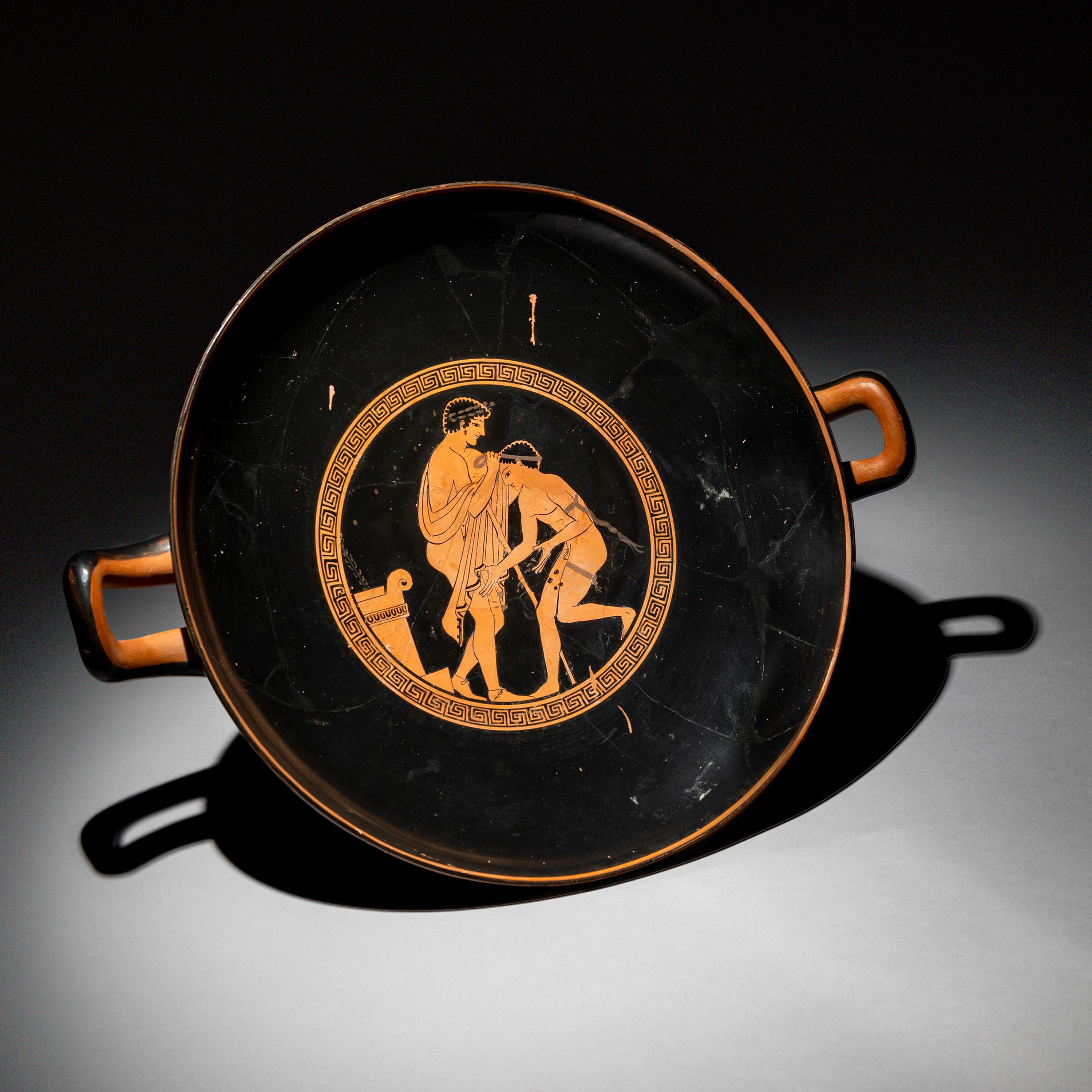
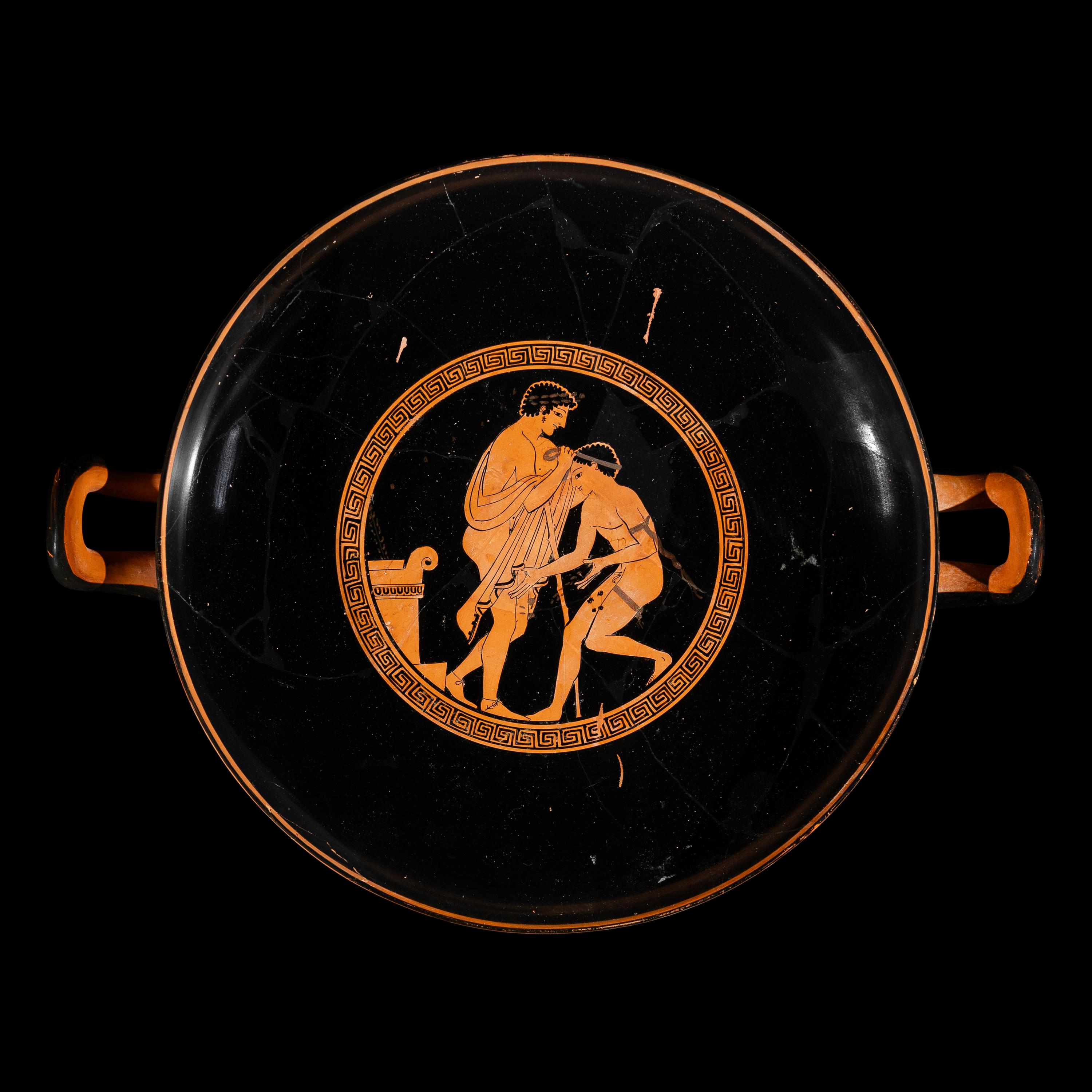
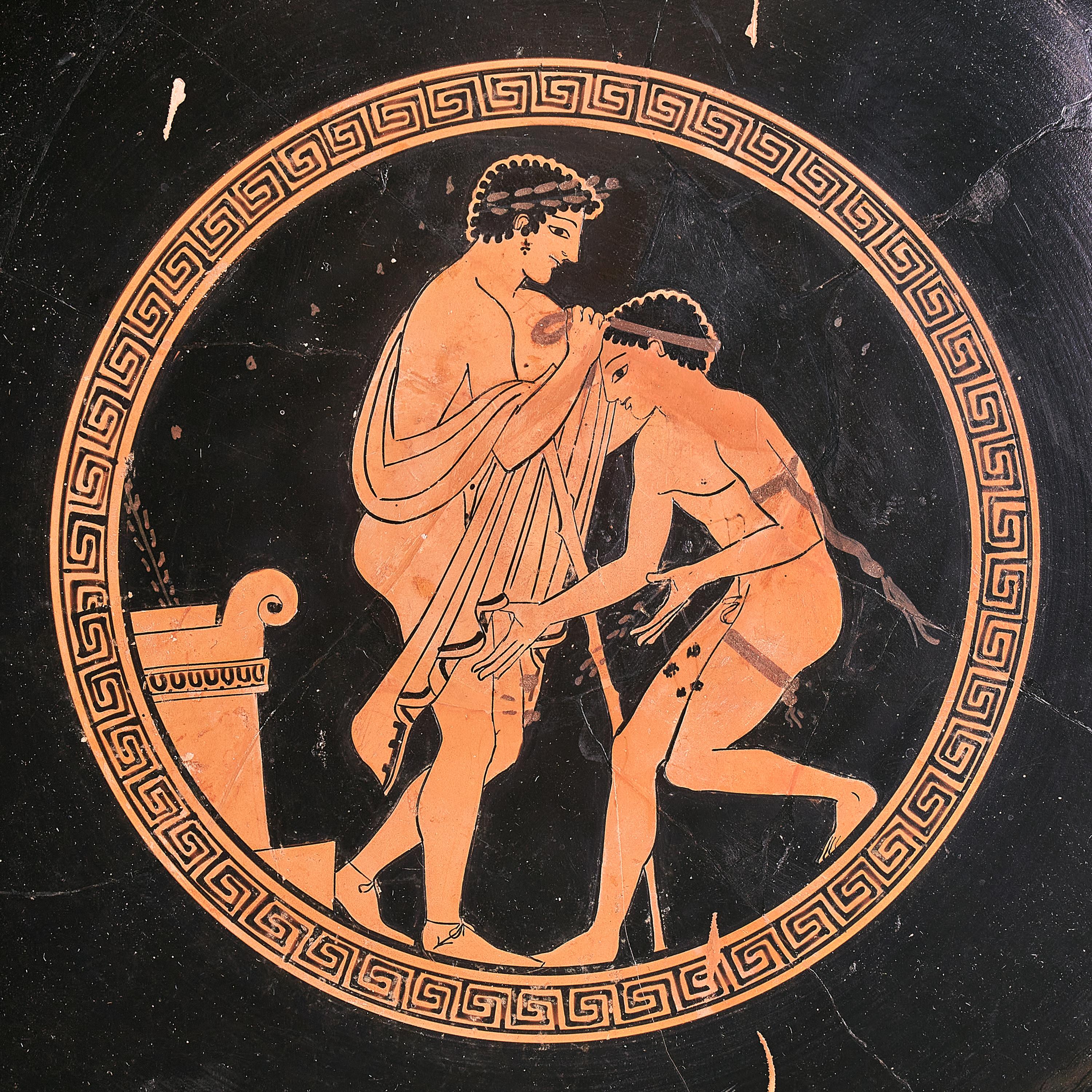
Within the interior, the tondo is bordered by a running meander and occupied by two youths before an altar. The more upright youth is slightly older (as evidenced by the downy puff of sideburn on his cheek) and wears a vegetal wreath in added red, a himation draped over his back and arms, and supple leather booties. A knobby staff rests in the crook of his right arm as he reaches out to crown the slightly crouched youth before him with a fillet in added red. This ephebe is previously adorned, with fillets tied around a bicep and high upon his thigh. His hands are outstretched with a leafy wreath or sprigs held between them. The pair’s proximity to an altar contextualizes their activity within a festival setting, likely the great Panathenaia - the high point in Athens’ religious and civic calendar, which once a year transformed the city with ten days of competitions and exuberant display. The scene shown might illustrate the euandria, a competition for Athenian citizens, during which conspicuously attractive men of various age categories were recognized and crowned. The ‘ho [p]ais [kal]os’ arcing over the pair is thus appropriate, if vague. The sheer profusion of prizes bestowed upon the beribboned youth here might also indicate that he was the recipient of phyllobolia – the acclamation of admiring spectators, who flung sprigs, wreaths, and fillets his way.
Beazley recognized the Colmar Painter as a contemporary of Euphronios and Onesimos (perhaps part of that workshop at one point) and a devoted cup painter with a distinctive neat and lively hand. With few exceptions, he favored the realm of mortals over mythological subjects and complex narrative, showing a prevailing interest in the activities of comely Athenian youths with the great majority of his known works featuring young men engaged in athletic pursuits or at the symposium.
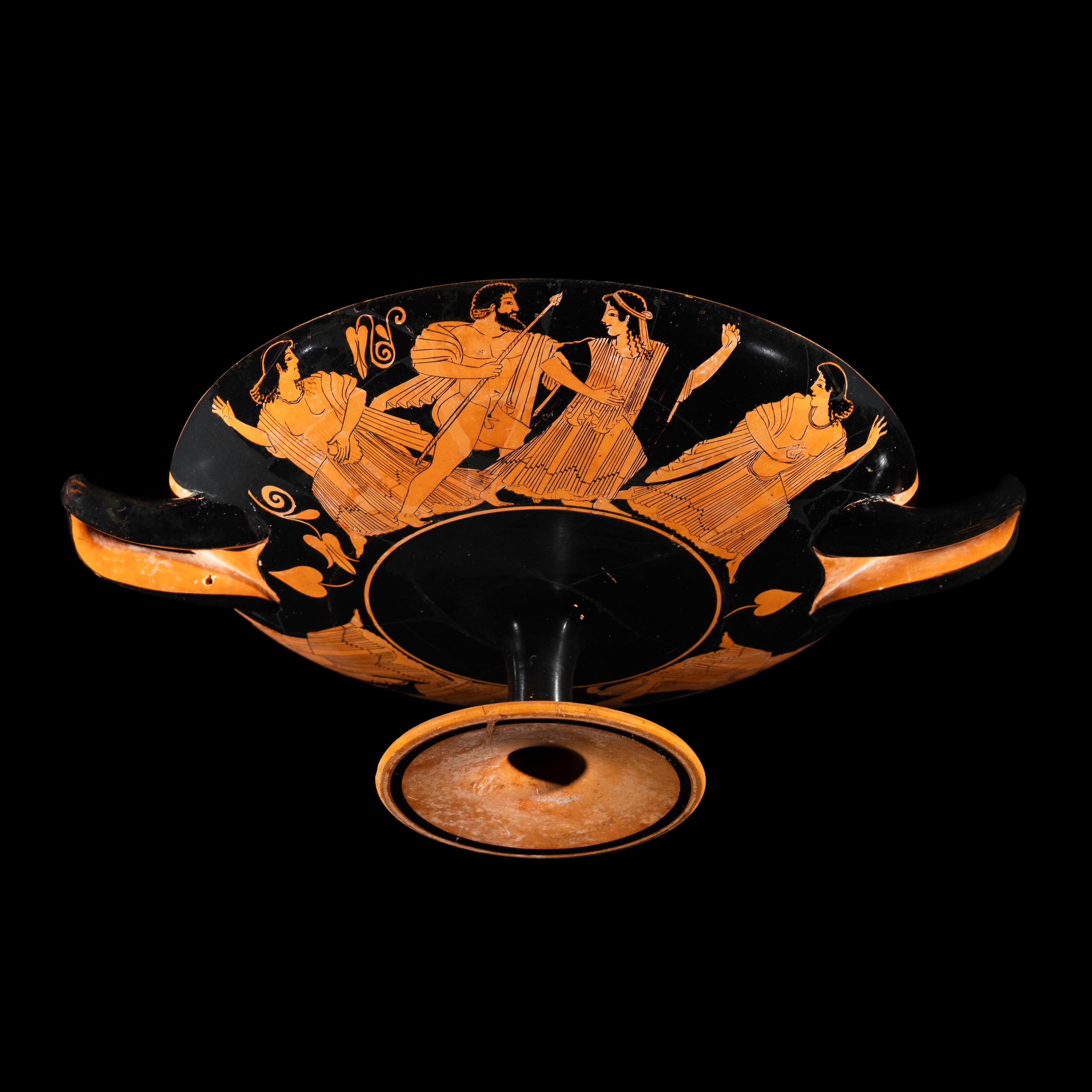
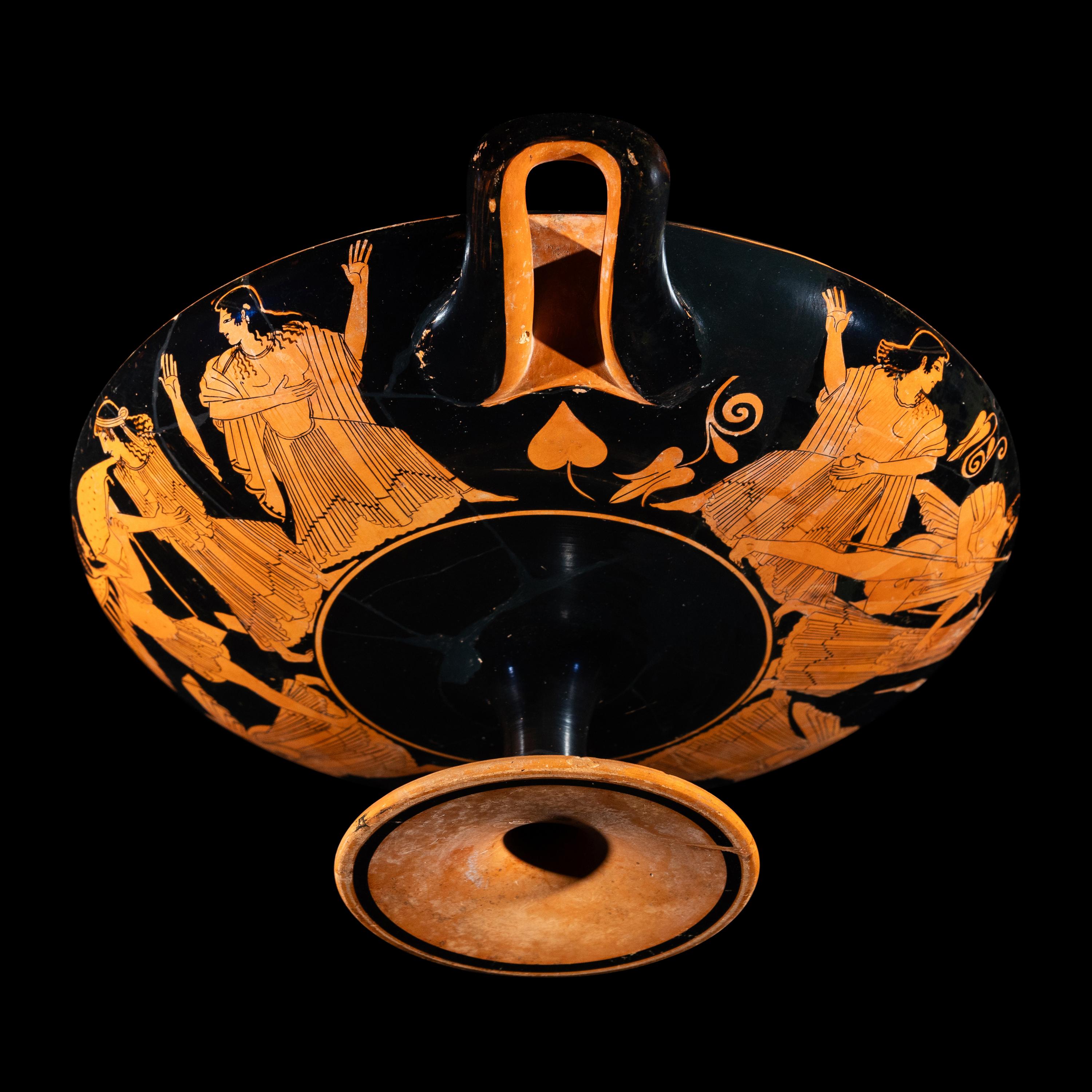
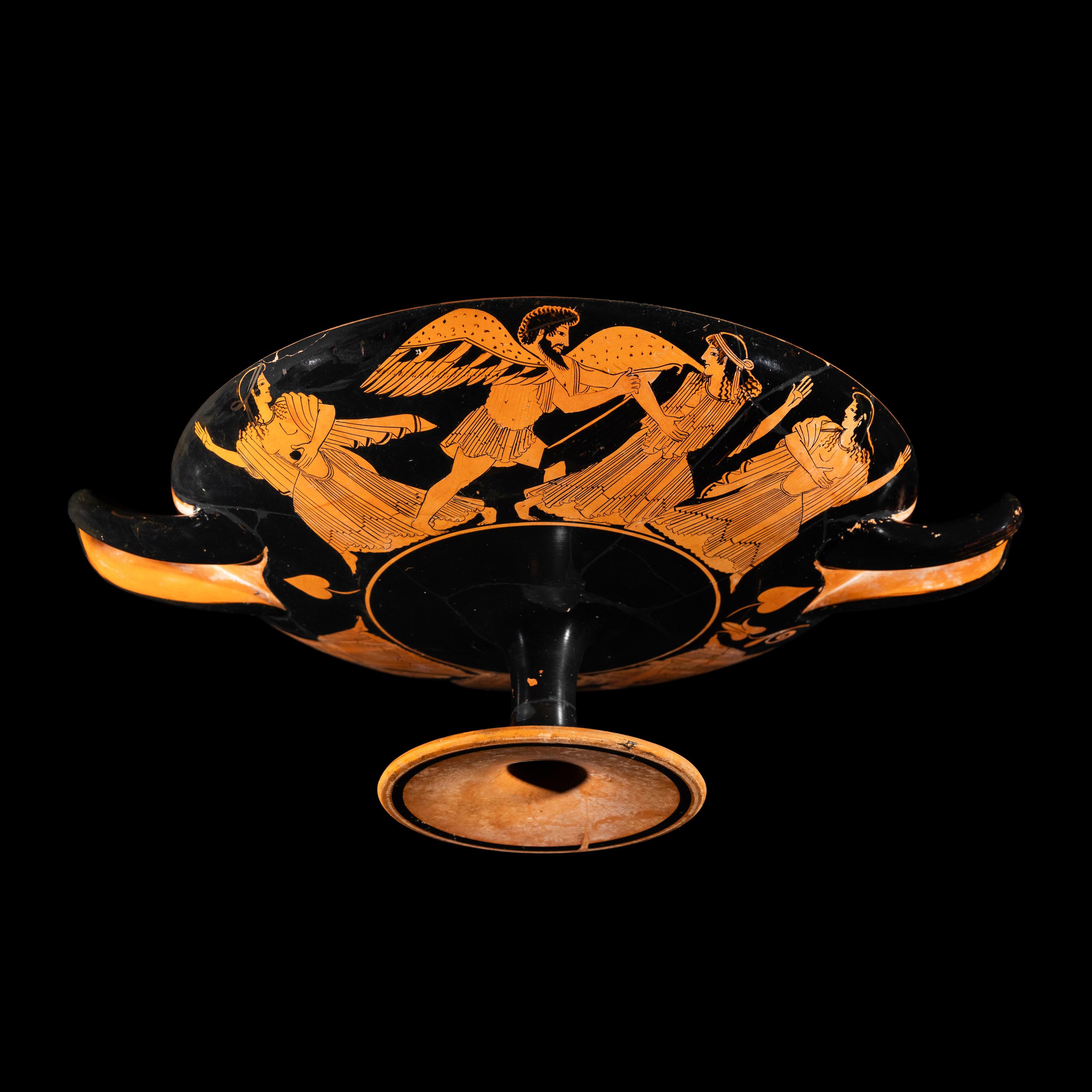
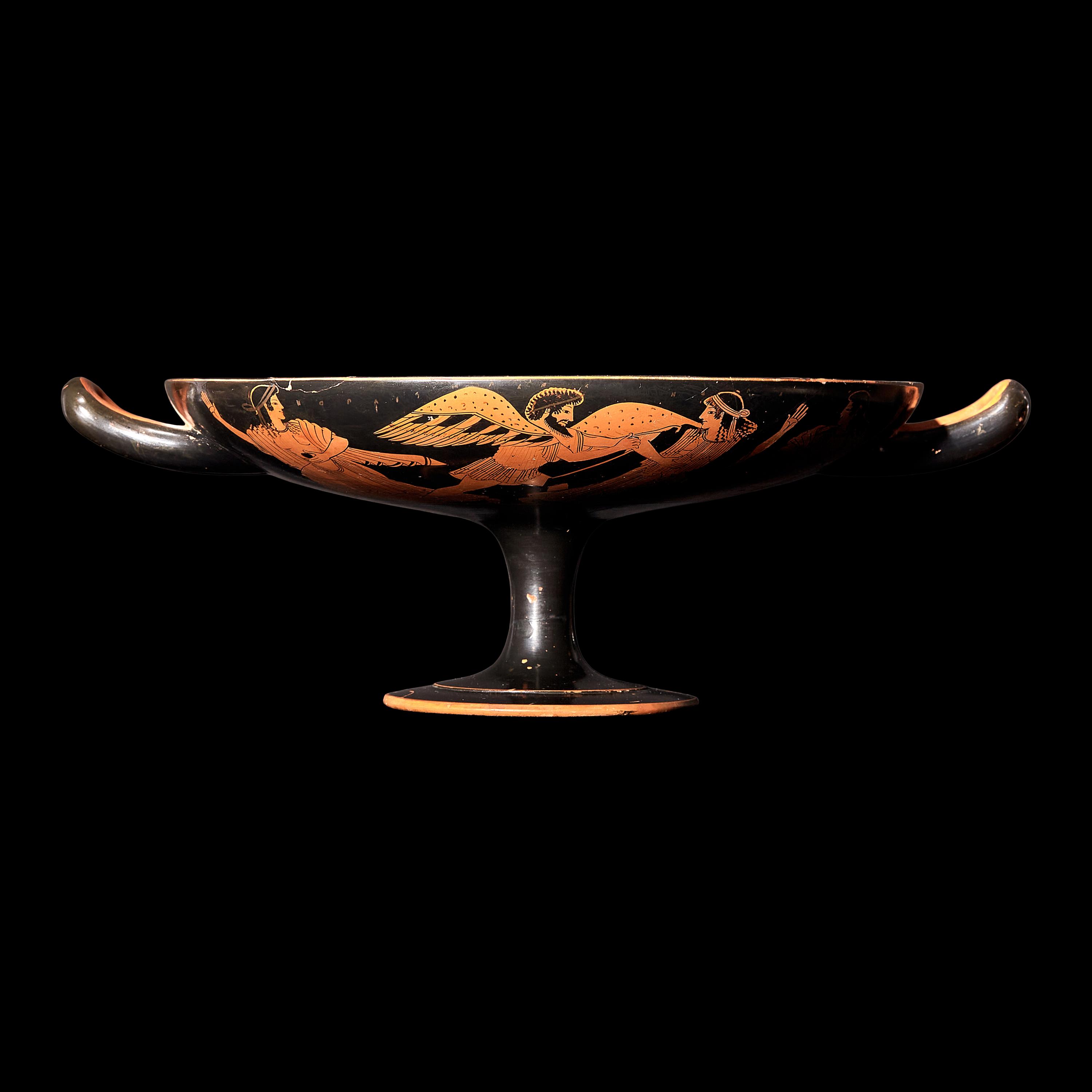
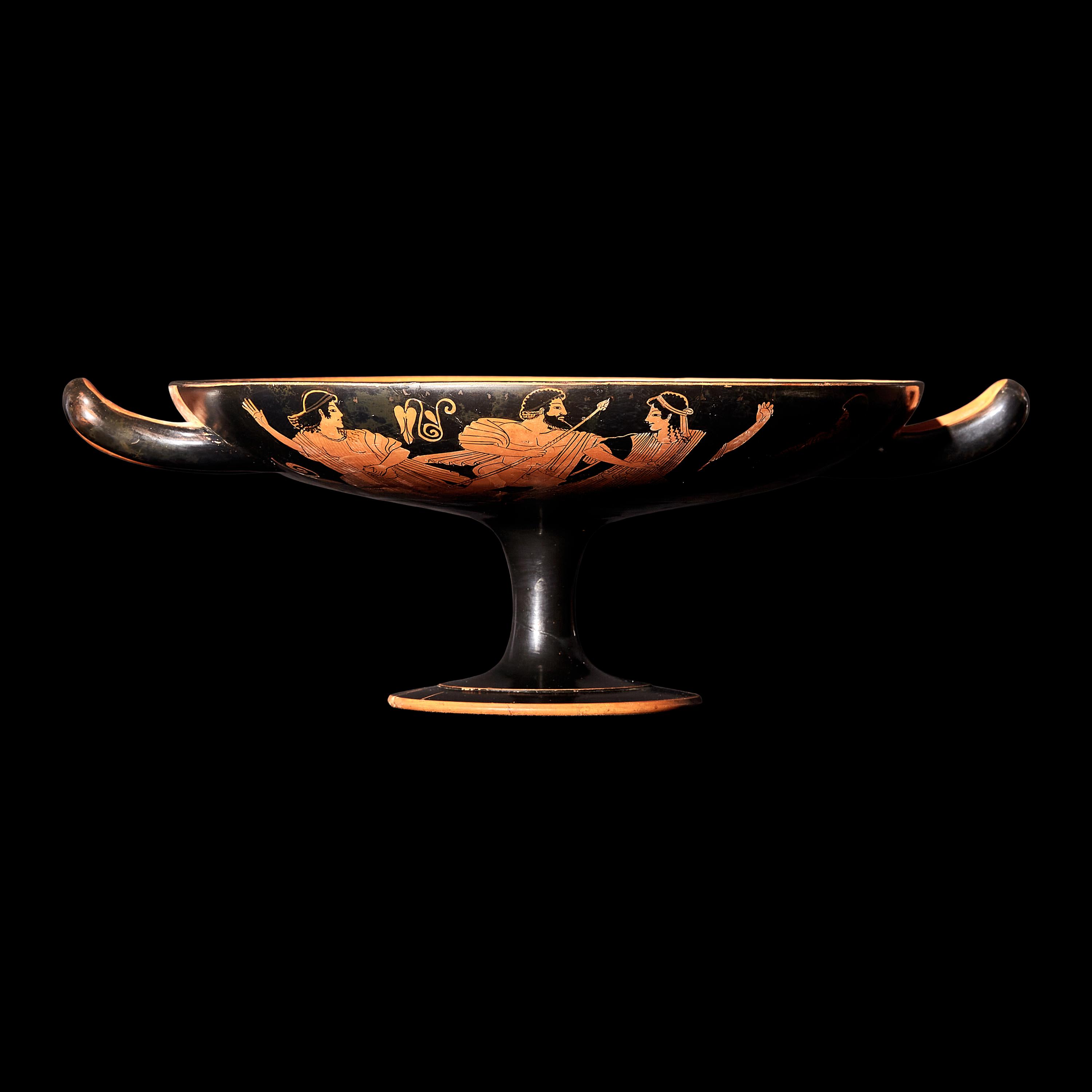
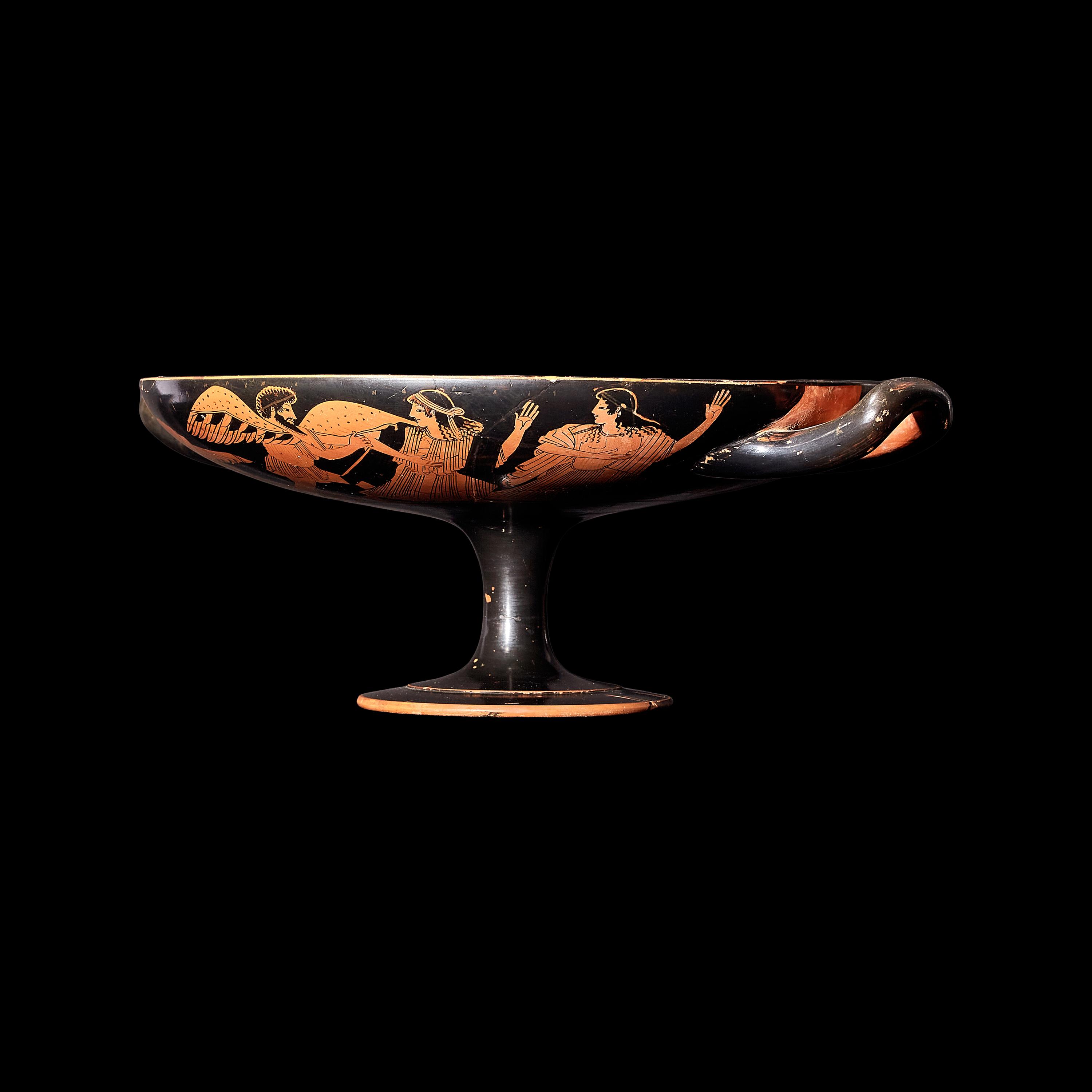
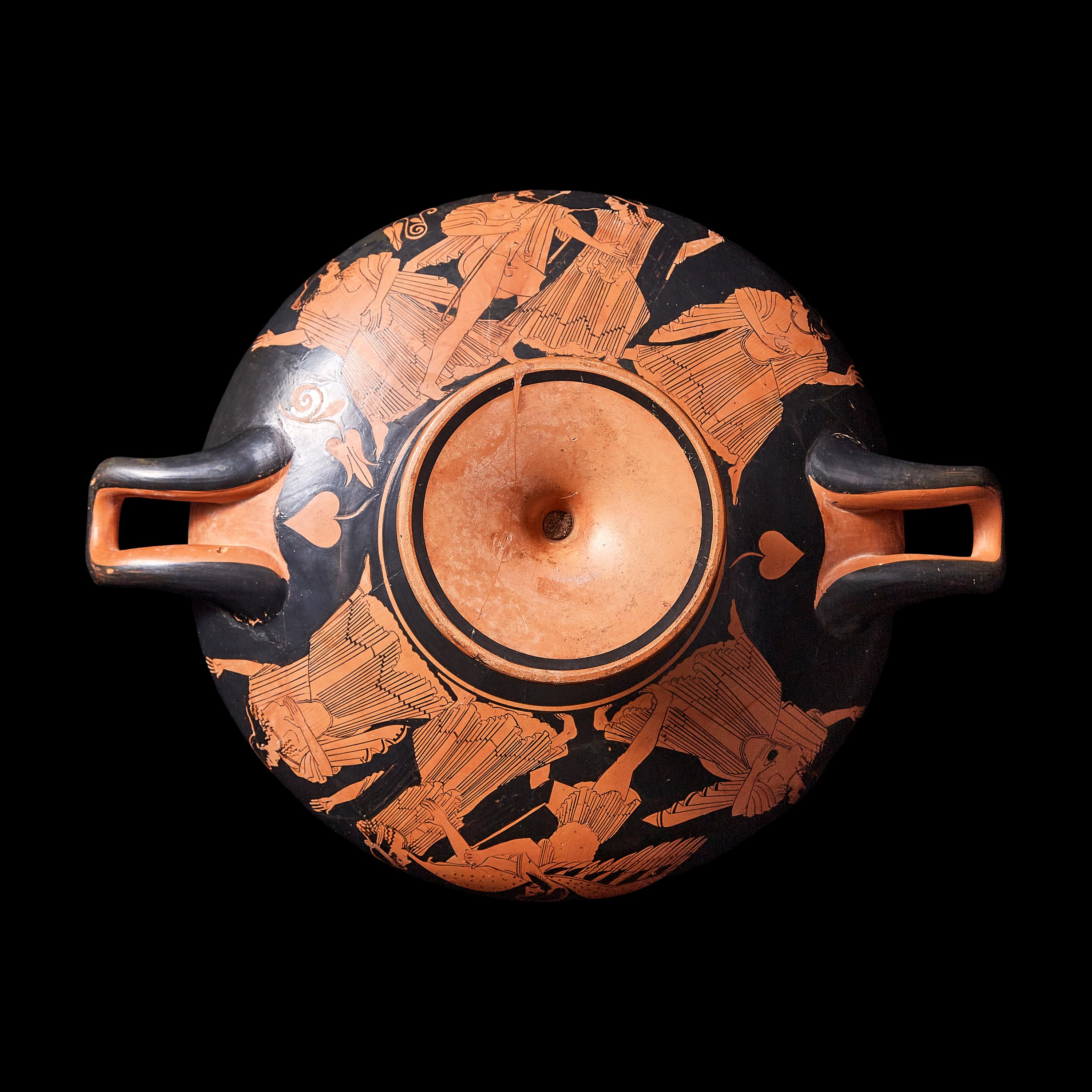
The exterior of the present cup is a significant departure for the painter as, out of the over one-hundred and fifty works attributed to him, it is one of only two showing mythological subjects beyond the most anodyne of Dionysian stock scenes. The two sides are entirely symmetrical in composition, each featuring an amorous chase. On the obverse Boreas (the shaggy-bearded, winged personification of the North Wind) grasps the maiden Oreithyia by the arm as she flees to the right, turning back to stare him down. Her two companions spring away from the central pair, their streaming hair and animated gestures indicating their alarm. The reverse shows a nearly nude and powerfully built Zeus accosting another young woman, often identified as the nymph Aegina, with her flanking attendants escaping to either side, the clusters of their stiffly pleated drapery and zig-zag hems uniting the exterior in a steady rhythm. Four of the maidens carry small egg-shaped objects and, most unusually, the two being pursued wear black mantles over their shoulders. Here the ‘ho pais kalos’ and ‘ho pais’ floating over each side perhaps invoke beauty and youth more generally, given the dearth of young men in the scenes.
The choice of subject matter is Athenocentric and timely. Oreithyia was the beautiful daughter of King Erechtheus (the mythical founder of Athens) and besotted Boreas pursuing the Athenian princess became a hugely popular motif on Attic vases after the Persian Wars, as the fierce North Wind had fortuitously wrecked much of the attacking Achaemenid forces navy at pivotal battles. The nymph Aegina so admired by Zeus, could likewise have been included as a commemorative nod to the naval power of Athens’ island neighbor and short-lived ally in their efforts to repel the Persians. The Colmar Painter has achieved one of his most ambitious compositions, deftly combining interior and exterior scenes to celebrate the beauty and promise of his city’s young people, mortal and divine.
Notes:
Attributed by Dietrich von Bothmer. The Colmar Painter’s only other foray into more complex mythological programs can be found on a cup in Florence, where Theseus and Herakles are shown respectively on the exterior sides and a symposiast occupies the tondo. See J.D. Beazley, Attic Red-Figure Vase-Painters, 2nd edition (Oxford, 1963): 355.46. For the Euandria, see N.B. Crowther, “Male ‘Beauty’ Contests in Greece: The Euandria and Euexia” in L’Antiquité Classique, 1985, T. 54 (1985), pp. 285 – 291. On the Panathenaic Festival, see K. Rhomiopoulou, “The Panathenaic Festival,” in Mind and body: Athletic Contests in Ancient Greece (Athens, 1989), pp. 38-44, with a useful discussion of the euandria and phyllobolia by B. Kaeser in the same volume (no. 199, p. 311). On Boreas’ sudden popularity in the decades after Marathon, see W.R. Agard, “Boreas at Athens”, The Classical Journal (Mar., 1966), Vol. 61, No. 6, pp. 241 – 246 and J. Boardman, Athenian Red Figure Vases: The Archaic Period (London, 1985), p. 224. On erotic pursuit scenes, see C. Sourvinou-Inwood, “A Series of Erotic Pursuits: Images and Meanings,” in The Journal of Hellenic Studies (1987), Vol. 107 (1987), pp. 131-153.
Inspected under UV light and 10x loupe. Built up from large fragments. Some areas of infill. Side A (proper left side) has a bore hole at handle. Some crackling to glaze and minor scratches to surface typical of age. Overall in fine and very attractive condition. See additional images.
The physical condition of lots in our auctions can vary due to age, normal wear and tear, previous damage, and restoration/repair. All lots are sold "AS IS," in the condition they are in at the time of the auction, and we and the seller make no representation or warranty and assume no liability of any kind as to a lot's condition. Any reference to condition in a catalogue description or a condition report shall not amount to a full accounting of condition. Condition reports prepared by Freeman's staff are provided as a convenience and may be requested from the Department prior to bidding.
The absence of a posted condition report on the Freeman's website or in our catalogues should not be interpreted as commentary on an item's condition. Prospective buyers are responsible for inspecting a lot or sending their agent or conservator to inspect the lot on their behalf, and for ensuring that they have requested, received and understood any condition report provided by Freeman's.
Please email antiquities@hindmanauctions.com for any additional information or questions you may have regarding this lot.