To request further details about this lot, please email fineart@hindmanauctions.com

Zack Wirsum
SVP, Head of Department, Post War and Contemporary Art
Sale 2051
| Chicago
| Chicago
To request further details about this lot, please email fineart@hindmanauctions.com
Zack Wirsum
SVP, Head of Department, Post War and Contemporary Art
Estimate$20,000 – $40,000
Provenance:
Marlborough, New York (stock no. 31.969)
Lot note:
"In my experiments with still life it occurs to me that my art really does look very modern; it sometimes almost looks abstract."
-Claudio Bravo
Virtuoso artist Claudio Bravo was influenced by the art of the Renaissance in its emphasis on portraiture that reflected both the social position and the temperament of the sitter, as well as Baroque light and the dream-like pastiches of the Surrealist movement, to hone a style both particularly searing and particularly his own. Born in Valparaíso, Chile, Bravo left his family ranch to study at the Colegio San Ignacio in Santiago, where he would gift portraits to his teachers to raise his grades. The school administration took notice, and far from punishing this cheeky behavior, in reflection of his talent, they instead paid for him to study art professionally from ages 11 to 20, the only formal training he would ever receive. His hyper-realist style developed, as Chile remained relatively untouched by the throes of Modernism that were concurrently spreading throughout Latin America.
Bravo had his first solo show at the age of 17 – in which everything sold -- and would go on to produce over 500 works throughout his six-decade career. A young Bravo dabbled in poetry, professional dancing, and acting, before deciding to dedicate himself to his art full time and beginning to produce the commissioned portraits that would help make his name. Bravo saved his earnings from these commissions and bought a ticket to sail to Paris, but the journey was fraught with storms and Bravo was forced to disembark in Barcelona, eventually making his way to Madrid, where he stayed. It was in Madrid that Bravo was able to establish himself as a society portraitist. It was also in Madrid that he encountered the Spanish Baroque painters at the Prado Museum, particularly Francisco de Zurbarán, which left an indelible mark on him. In 1968, the leader of the Philippines, Ferdinand Marcos, extended the invitation to paint him and his wife in 1968, and the six-month trip allowed for a transformation in Bravo’s work as he found the quality of light to be far more intense there than even his native Chile. Indeed, Bravo’s mastery of light and unerring eye for detail throughout his oeuvre has drawn comparisons to the works of classical masters, including Caravaggio, the father of chiaroscuro himself.
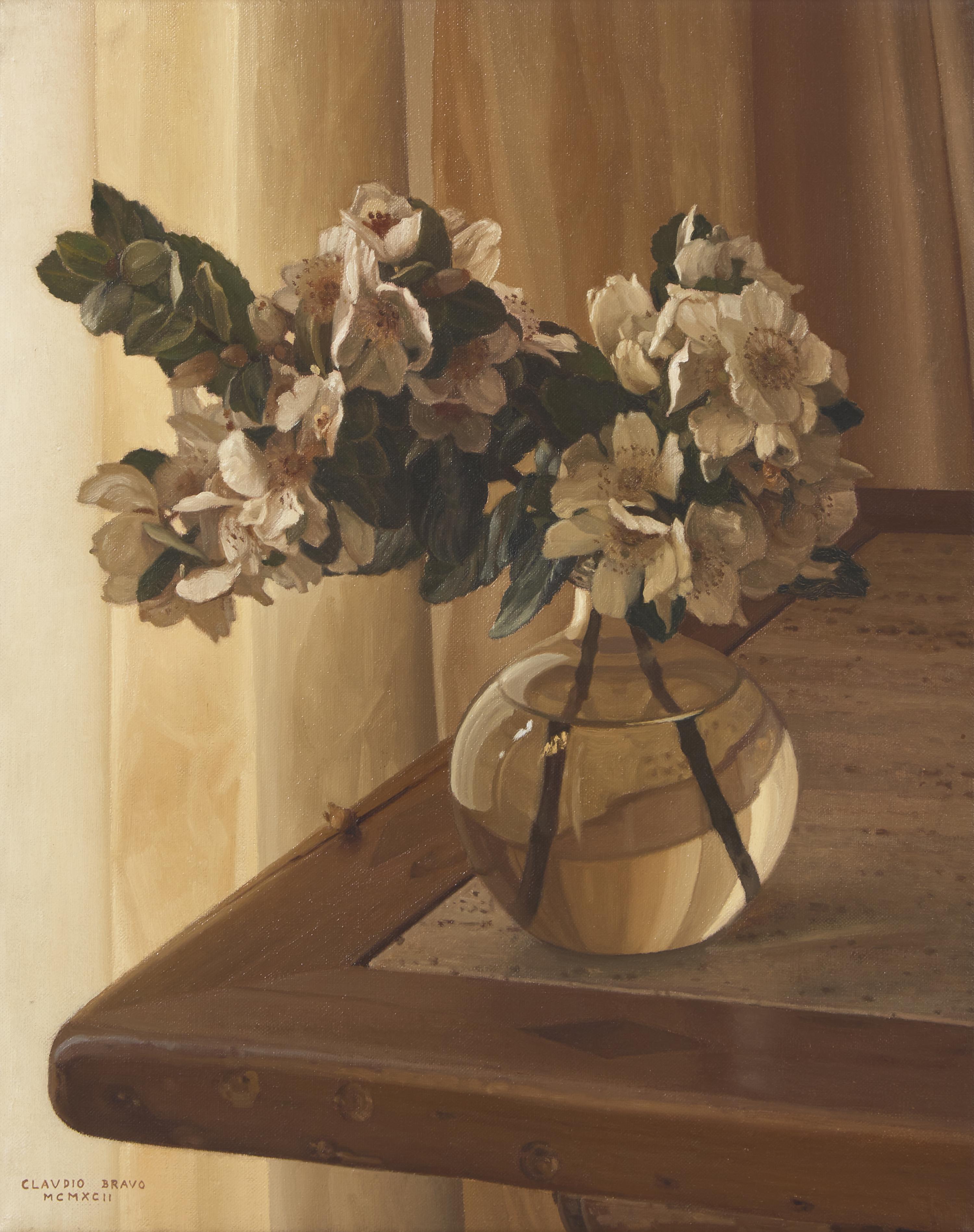
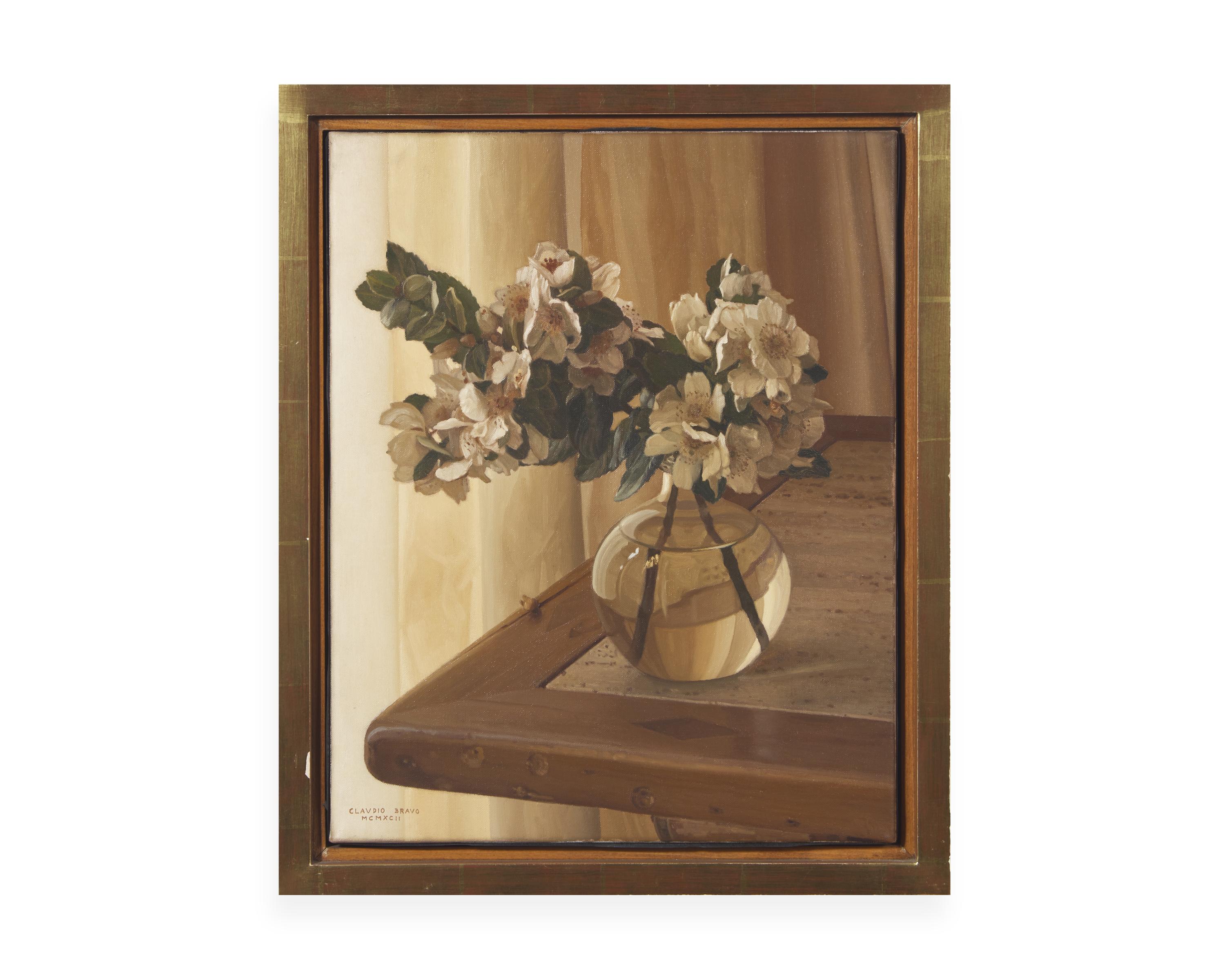
Ramo de Olmo (Branch of Elm Tree), 1992, masterfully reveals Bravo’s skill at using light that transcends and magnifies reality. Softly filtered light casts a vintage glow on the bouquet of elm branches and blossoms, yet details such as the pitted wood along the bar and fallen bud on its edge, places the work firmly in the world. The cropped view and encircling curtains further create a sense of cloistered calm. The treatment of light makes the objects appear more as they are, with a greater substance than mere appearances. As Christian Viveros Faune, writer and curator, notes about the artist’s work, “Rather than fool the eye into believing they represent the real, Bravo's pictures, especially the still lifes, hold us by their unreality. It is ultimately the highly conceptualized and willfully formalized character of their fiction, their elaborate artifice that draws us into them” (C. Viveros-Fauné, "Claudio Bravo," Art Nexus, Nov. 1998-Jan. 1999, vol. 30, no. 147).
The Marlborough Gallery hosted its first exhibition of Bravo’s works in 1981, the first of dozens in the next twenty years. Collected internationally by renowned institutions, Bravo was arguably the most prestigious Chilean painter of his time, until his sudden death at his home in Taroudant, Morrocco in 2011. His legacy of especially introspective still lifes, deployed with a fascinating hyper-realistic style, emphasize that of a true Renaissance man.
Framed: 18 x 15 inches.
The physical condition of lots in our auctions can vary due to age, normal wear and tear, previous damage, and restoration/repair. All lots are sold "AS IS," in the condition they are in at the time of the auction, and we and the seller make no representation or warranty and assume no liability of any kind as to a lot's condition. Any reference to condition in a catalogue description or a condition report shall not amount to a full accounting of condition. Condition reports prepared by Freeman's staff are provided as a convenience and may be requested from the Department prior to bidding.
The absence of a posted condition report on the Freeman's website or in our catalogues should not be interpreted as commentary on an item's condition. Prospective buyers are responsible for inspecting a lot or sending their agent or conservator to inspect the lot on their behalf, and for ensuring that they have requested, received and understood any condition report provided by Freeman's.
Please email fineart@hindmanauctions.com for any additional information or questions you may have regarding this lot.