To request further details about this lot, please email conditionreports@freemansauction.com
Please email conditionreports@freemansauction.com for any additional information or questions you may have
Sale 2506
| Philadelphia
| Philadelphia
To request further details about this lot, please email conditionreports@freemansauction.com
Please email conditionreports@freemansauction.com for any additional information or questions you may have
Estimate$30,000 – $50,000
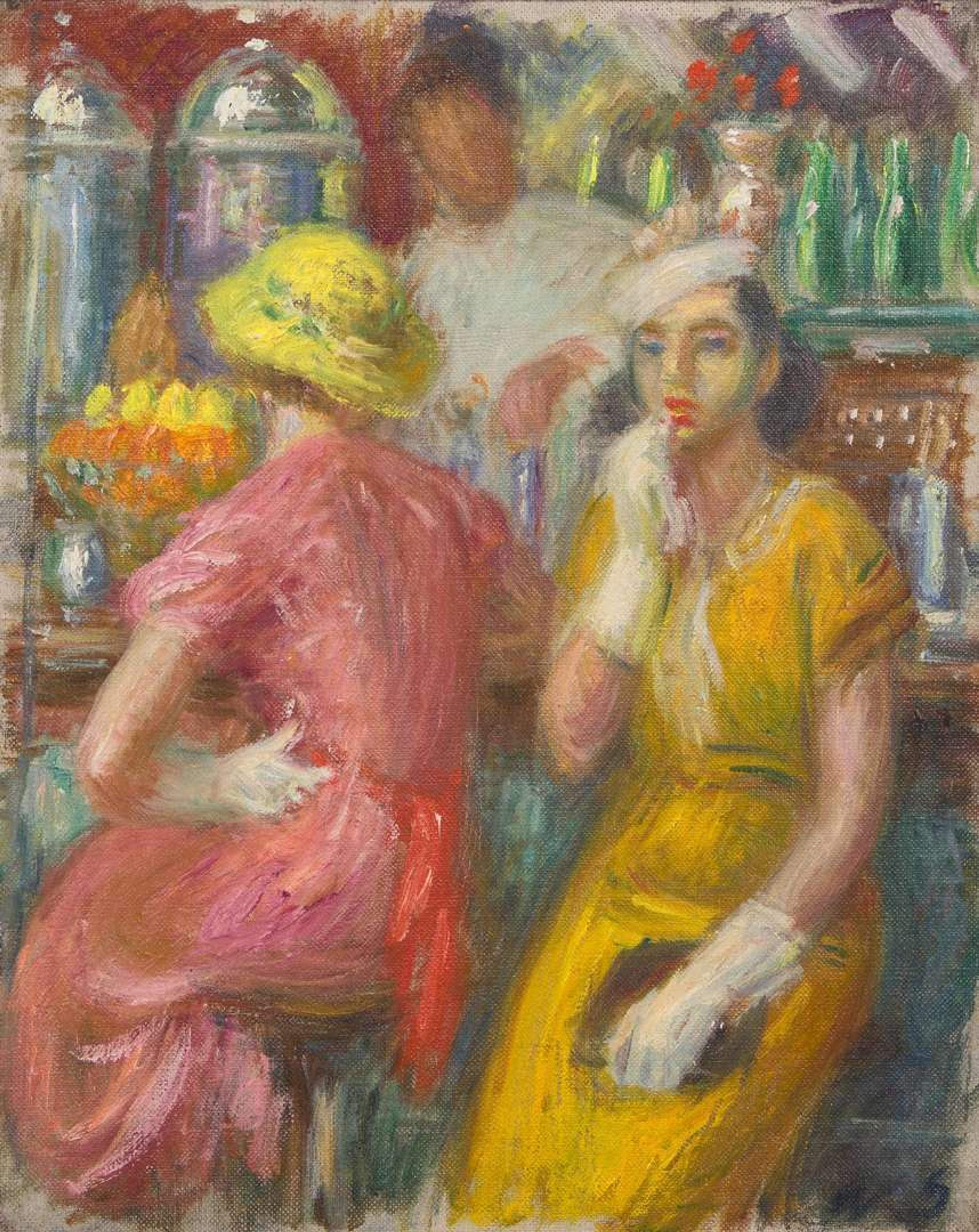
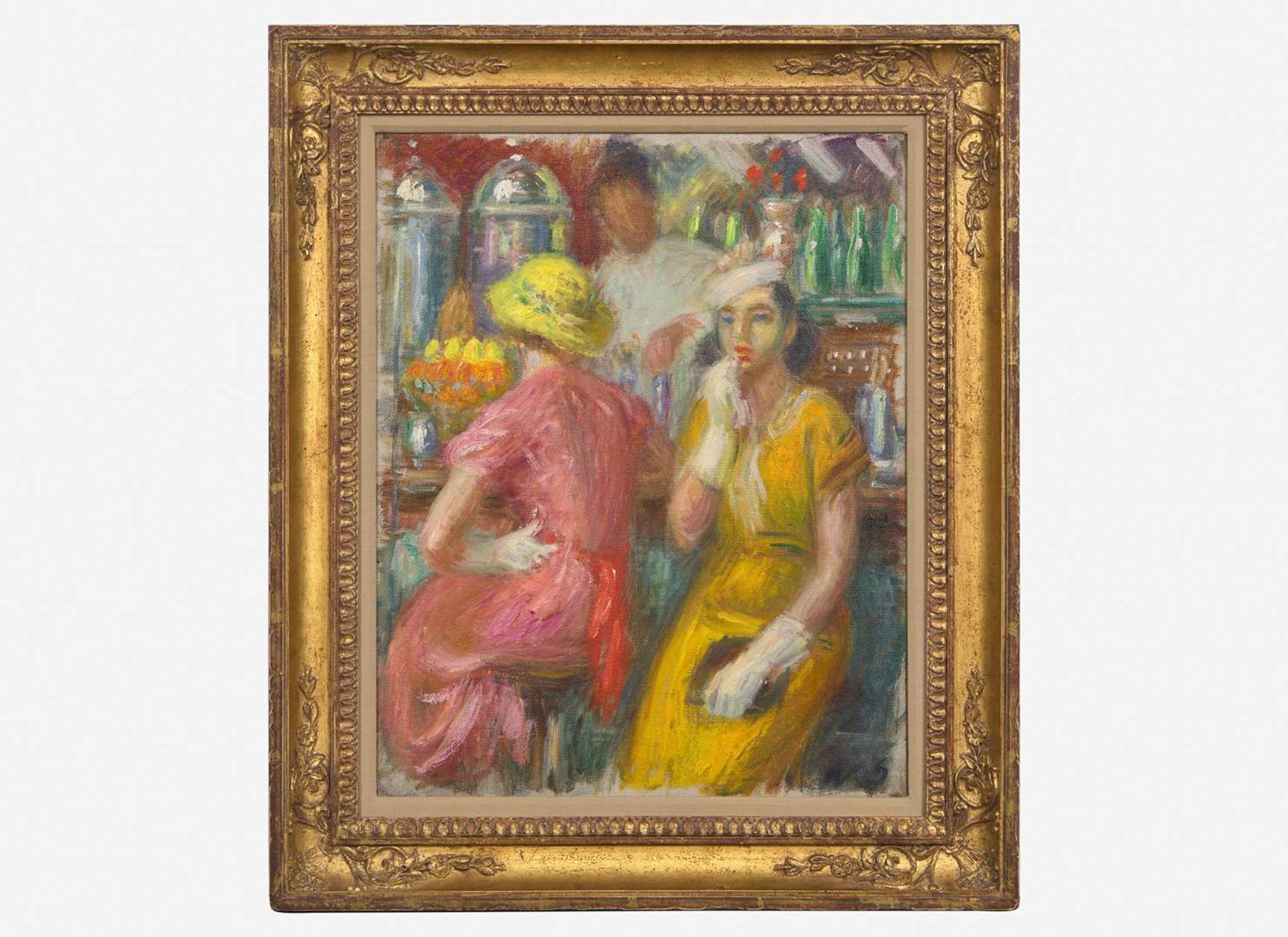
The present work is a study for William Glackens' The Soda Fountain (1935), now in the permanent collection of the Pennsylvania Academy of the Fine Arts. The pair, nearly identical save for size, is a testament to Glackens' preoccupation with urban sites and spaces. Unlike earlier paintings that depict bustling social settings or outdoor scenes, The Soda Fountain–both preliminary study and final version–offers a more intimate and nuanced view.
The central grouping includes a young woman seated confidently at the counter, one gloved hand clutching her purse while the other dabs the corner of her mouth. A second figure, possibly a companion, sits with her left arm akimbo; her yellow hat offers a chromatic parallel to her counter-mate's dress and a nearby arrangement of lemons. Glackens bathes the pair in warm light which, in turn, accentuates their self-assured postures and fashionable, yet unpretentious attire. Delicate brushwork and a pastel-like palette reveal the artist's indebtedness to Renoir, to whom he was often compared. The soda clerk, who, in the final version was modeled after Glackens' son, Ira, fills a glass behind the counter.
It is within this subtle portrayal that Glackens captures the essence of his subject. The women are not defined by the company they keep, but rather by a kind of comfortable independence. Occupying the soda fountain on their own terms, they partake in a leisure activity traditionally associated with couples, but without the need for male accompaniment. (Even the soda clerk, the composition's lone male figure, is at some remove, both physically and psychologically.) While the present study (and PAFA's version) do not directly address social or political matters, together they reflect a changing social landscape–one that Glackens understood and appreciated all too well. Claiming public spaces and leisure activities for themselves, his female protagonists embody a newfound sense of self and individual agency, and attest to the evolving role of women in the first few decades of the 20th century.
Collection of Gail and Michael Rosenberg, New York.
Gerald Peters Gallery, New York, New York.
Acquired directly from the above.
Collection of Charles and Virginia Bowden, San Antonio, Texas.
The Estate of Charles and Virginia Bowden, San Antonio, Texas.
By descent.
Private Collection, Tennessee.
The wax-lined canvas in overall very good condition, with very lush colors and some nice impasto. Examination under UV light reveals pinpoint dots of inpainting on the dress of the sitter at left (bottom center left), and similar unpainted dots (old losses) on the yellow dress, to the right of the white glove at bottom right. Some hues do appear purplish, but this is due to the pigments used by the artist. See Specialist's pictures for more details.
The physical condition of lots in our auctions can vary due to age, normal wear and tear, previous damage, and restoration/repair. All lots are sold "AS IS," in the condition they are in at the time of the auction, and we and the seller make no representation or warranty and assume no liability of any kind as to a lot's condition. Any reference to condition in a catalogue description or a condition report shall not amount to a full accounting of condition. Condition reports prepared by Freeman's staff are provided as a convenience and may be requested from the Department prior to bidding.
The absence of a posted condition report on the Freeman's website or in our catalogues should not be interpreted as commentary on an item's condition. Prospective buyers are responsible for inspecting a lot or sending their agent or conservator to inspect the lot on their behalf, and for ensuring that they have requested, received and understood any condition report provided by Freeman's.
Please email for any additional information or questions you may have regarding this lot.