To request further details about this lot, please email conditionreports@freemansauction.com
Please email conditionreports@freemansauction.com for any additional information or questions you may have
Sale 2720
| Philadelphia
| Philadelphia
To request further details about this lot, please email conditionreports@freemansauction.com
Please email conditionreports@freemansauction.com for any additional information or questions you may have
Estimate$30,000 – $50,000
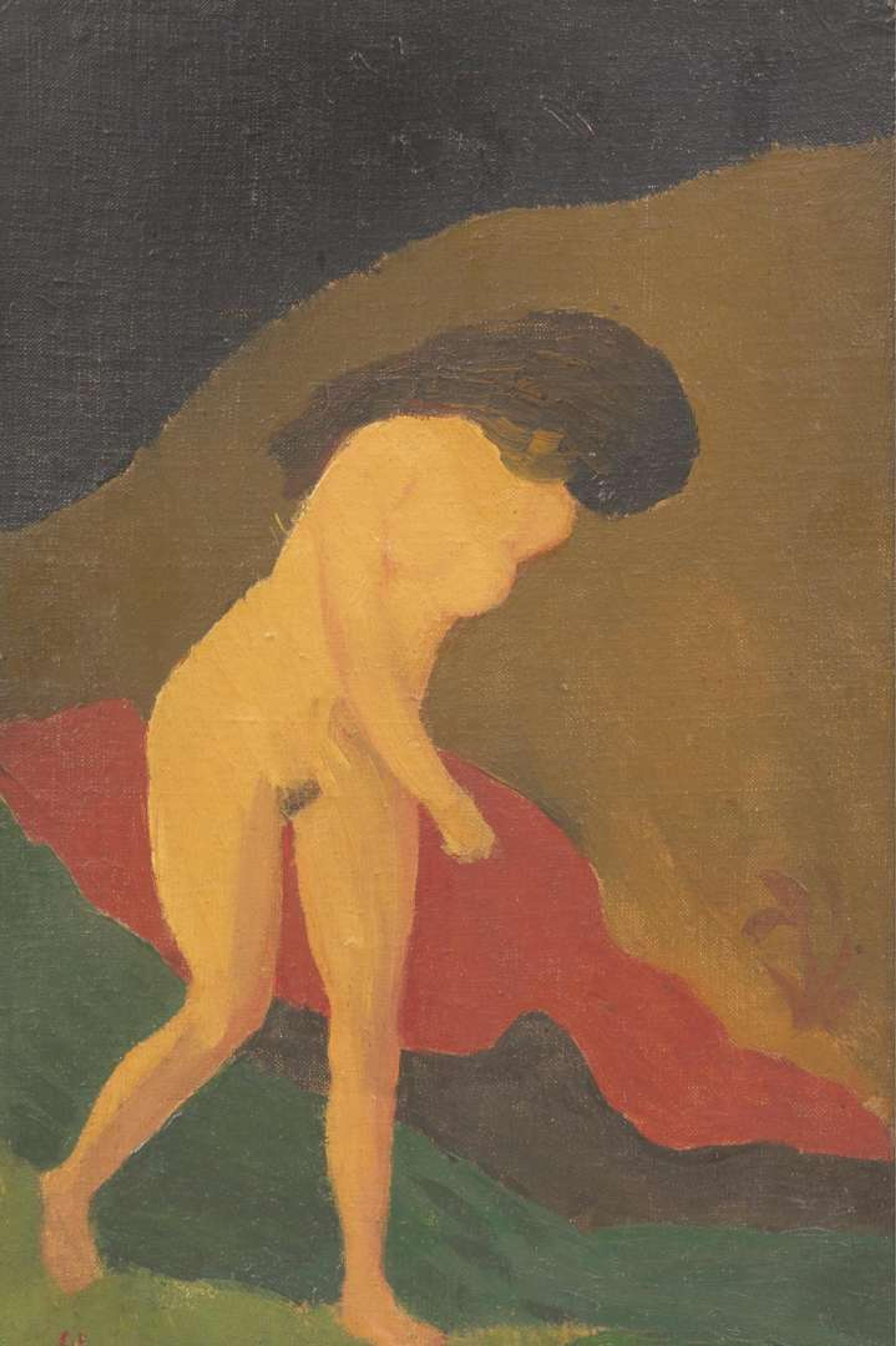
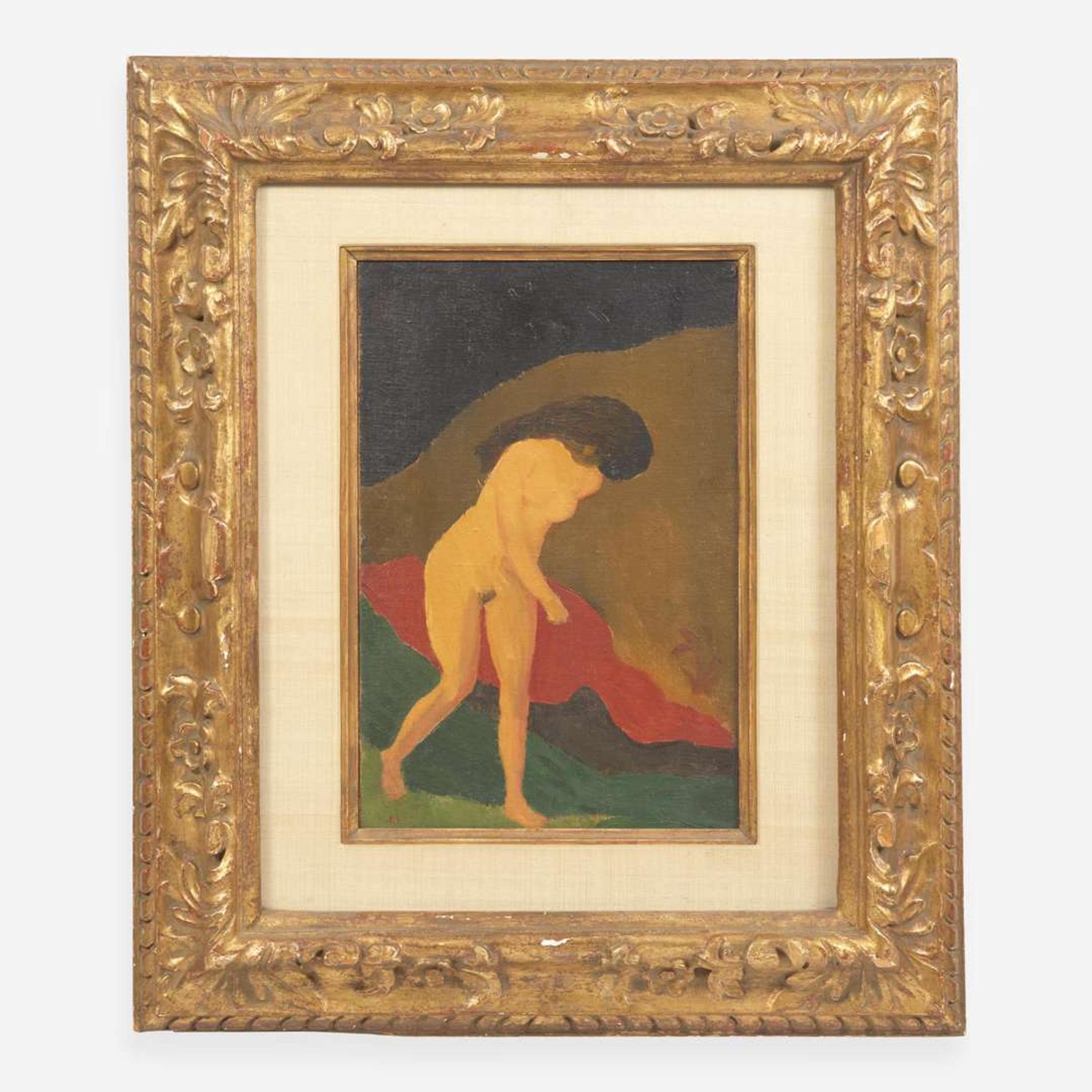
Probably more than any other work in the Rothberg Collection, Vuillard’s Nu dans une Grotte really begs the viewer: What do you see? According to the authors of Vuillard’s Catalogue Raisonné, this is indeed, “without question the young Vuillard’s strangest nude.” In an undetermined setting which resembles a schematic landscape, we see a passing nude woman with long black hair, about to exit the picture plane to the right. It is obviously not a study of a model the artist would have captured in his studio: although Vuillard did paint some nudes in the early 1890s, the pose of the present figure is intriguing and does not resemble an academic nude. It seems instead, that the woman is walking across a cave by the sea judging from the blue-green undulations and broad swaths of sand-tone land in the background. Concealed by her hair, the figure looks down, her face entirely turned away from the viewer–an attitude which appears often in Vuillard’s early work, and which is generally understood by scholars as an expression of suffering, sadness, and shame.
Through its flat expanses of matte colors, flattened perspective, and sense of decorative design, the work shines as the epitome of Vuillard’s early Synthesist style, which very much recalls the art of Maurice Denis, and which can be linked to Vuillard’s contemporary Octagonal Self-Portrait, and Lilacs. Vuillard met Maurice Denis at the Lycée Condorcet and would remain his close friend throughout his life. Together, along with Paul Sérusier and other graduates from the Académie Julian, they would coin the Nabi movement. Meaning “The Prophet” in Hebrew, the (sometimes mystical) term Nabi would be used to refer to these schematic, falsely simplistic, and colorful works that would evoke the artist’s feeling, and perception rather than the close-hand observation of his surroundings. Each member of the group had his own style, sensibility and nickname; Vuillard being known as “The Zouave Nabi” (originally a term for an Algerian soldier wearing a remarkably colorful uniform, later used to refer to someone eccentric).
Vuillard’s small, and therefore rare, corpus of Nabi works from 1890s is often considered among the best of the artist’s entire career. Conceived as a dream-like invitation to new, untouched lands, Vuillard’s Nabi works are intimate and touching. The present oil clearly embraces the precepts of Paul Gauguin’s and Paul Sérusier’s art, namely a bold composition, innovative shapes on the verge of abstraction and reminiscent of decoration, as well as a restricted, yet harmonious color palette. Halfway between a ukiyo-e Japanese print and an archaic fresco, Femme dans une Grotte recalls Gauguin’s 1889 In the Waves, which not only depicts a similar subject but also captures it in a very similar color palette made of dark greens, red and brown (it is quite telling to notice that our Nude’s skin tone is a direct citation to Gauguin’s famous yellow-fleshed characters). More so, one could argue to see in Nu dans une Grotte the illustration of Maurice Denis’ famous quote, which defined his artistic movement: “A picture—before being a warhorse, a nude, or an anecdote of some sort—is essentially a flat surface covered with colours assembled in a certain order.”
So who is this woman, and what are Vuillard’s motives? Some scholars identify the nude as Mélisande, a modern day Yseult searching for her wedding band lost in the sea. However, the Belgian play, Pelléas et Mélisande, was not published by Maeterlink until 1893. The authors of the Catalogue Raisonné, on the other hand, note that in November 1891, Vuillard was involved in the production of Berthe au Grand Pié–a play that retold the fable of the French princess wrongly accused of adultery and forced to retreat naked to a menacing forest. Vuillard could possibly have been moved by the character and her treacherous journey, yet there is no proof of this.
What is certain, is that Femme dans une Grotte reflects Vuillard’s interest in theatre, and it sits perfectly at the crossroads of painting and scenography, of perception and sensation. Deliberately cryptic, it relies on a simplicity of form and color to create an emotional connection–an individual artwork that is also a full-blown sensory experience.
The Artist's studio.
Arnoé, Paris.
Jan Krugier, Geneva, Switzerland.
Arthur Tooth & Sons, London, United Kingdom.
Sotheby's, London, sale of December 6, 1979, lot 572.
Galerie Koller, Zurich, sale of May 15, 1981, lot 5153.
Albert Loeb and Jan Krugier Gallery, New York, New York.
Weintraub, New York.
Private Collection, Chicago, Illinois.
Christie's, New York, sale of May 13, 1993, lot 136.
Acquired directly from the above sale.
Collection of Sidney Rothberg, Philadelphia, Pennsylvania.
The relined canvas in overall very good, close to excellent original condition. With a slightly exposed canvas along the left outer edge of the work, as well as in the upper right corner (most likely due to the old lining). Under UV light, the work is protected by a thick layer of varnish. In our opinion, the work would benefit from a light cleaning. No evidence of restoration as seen under UV light, save for a soft highlight alongside her profile to the right: most likely a sign of residual varnish, which would disappear with a clean. See Specialist's pictures.
To receive more images, please contact Specialist Raphael Chatroux at rchatroux@freemansauction.com
The physical condition of lots in our auctions can vary due to age, normal wear and tear, previous damage, and restoration/repair. All lots are sold "AS IS," in the condition they are in at the time of the auction, and we and the seller make no representation or warranty and assume no liability of any kind as to a lot's condition. Any reference to condition in a catalogue description or a condition report shall not amount to a full accounting of condition. Condition reports prepared by Freeman's staff are provided as a convenience and may be requested from the Department prior to bidding.
The absence of a posted condition report on the Freeman's website or in our catalogues should not be interpreted as commentary on an item's condition. Prospective buyers are responsible for inspecting a lot or sending their agent or conservator to inspect the lot on their behalf, and for ensuring that they have requested, received and understood any condition report provided by Freeman's.
Please email for any additional information or questions you may have regarding this lot.