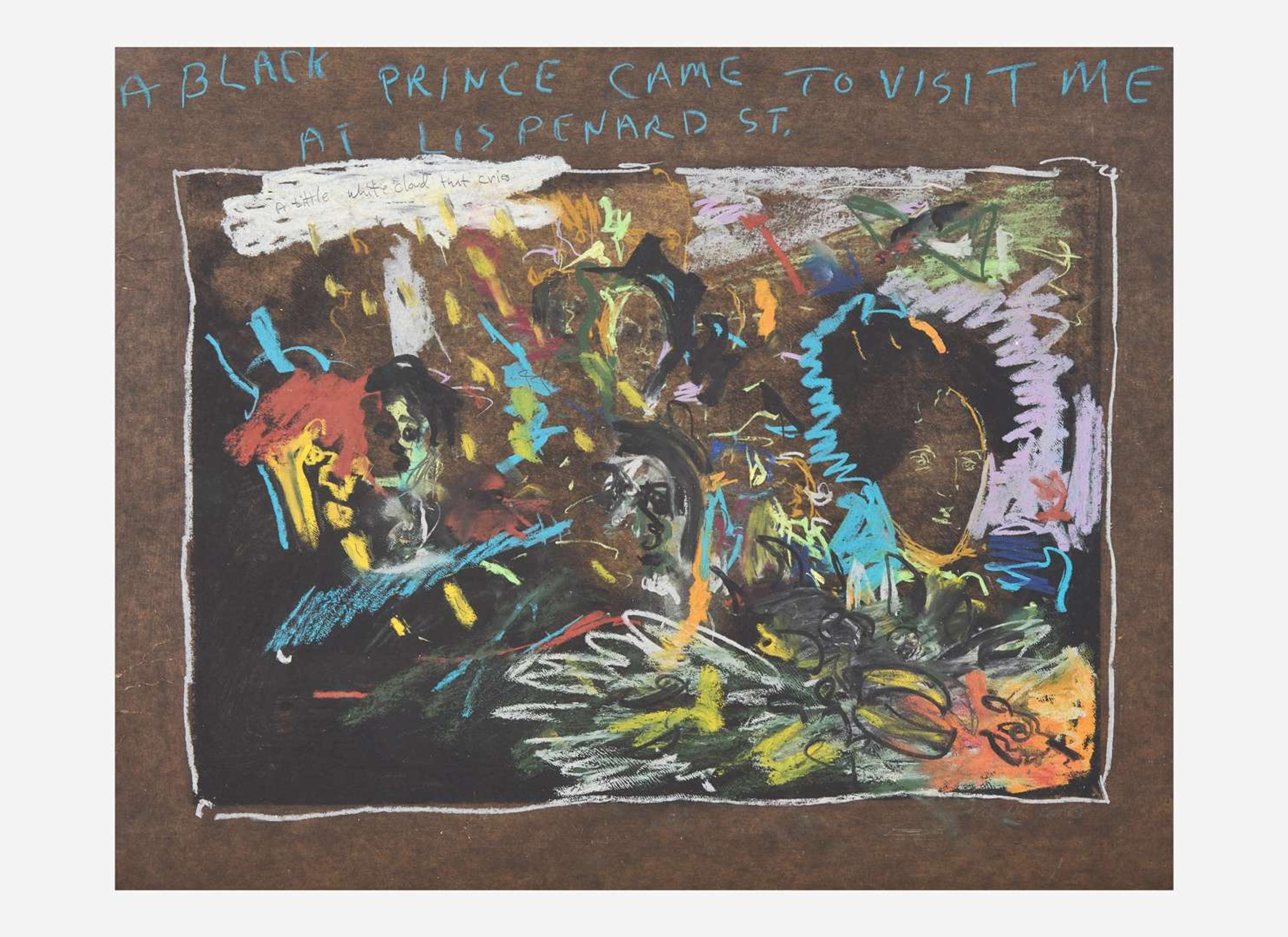
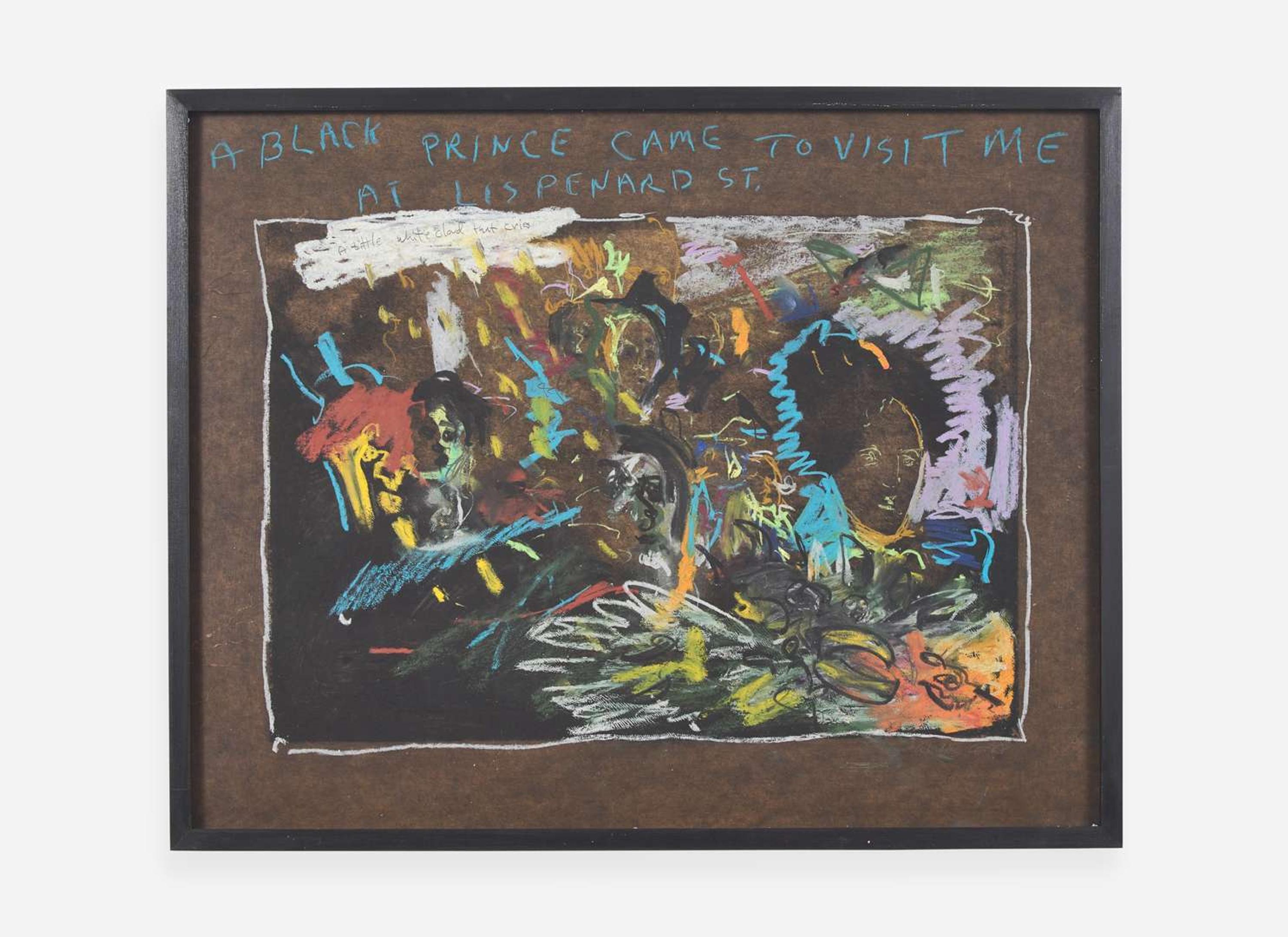
Jack Whitten (American, 1939-2018), A Little White Cloud That Cries
1966-68
Signed and dated 66-68 bottom right, titled top center, oil pastel on paper.
21 1/4 x 26 1/2 in. (54 x 67.3cm)
Jack WhittenWhen Jack Whitten moved from Alabama to New York City in 1960 to study painting at Cooper Union, he met Jacob Lawrence, Romare Bearden and Willem de Kooning, all of whom greatly impacted the young artist’s work. He also began looking closely at the paintings of Arshile Gorky, a direct link to Whitten’s early Surrealist style. He later moved toward what he called “Figurative Expressionism” in the late 1960s. "The Little White Cloud that Cries" comes from this moment, before his shift to an abstract style focused on materiality and surface, layering colors and dragging them across large surfaces.Whitten and the artist Adger Cowans first met in the 1960s at Whitten’s studio on Lispenard Street in Tribeca, connecting at once over shared perspectives on art. Whitten gave Cowans the present drawing at this first meeting, adding the inscription at the top for Cowans: “A black prince came to visit me at Lispenard St.” When Whitten later went on an extended trip to Greece in the early 1970s, he rented his studio space to Cowans, who at this time was painting with combs, his own hand-made tools and a textured, layered technique. Influenced by his friend’s innovations upon his return, Whitten built a large wooden tool that he used to pull acrylic paint quickly across canvases on the floor, calling them “Slab” paintings.The present work’s title "The Little White Cloud that Cries” refers to a 1951 song written by Johnnie Ray and performed by Ray and The Four Lads that same year. The lyrics include: “A little white cloud that cried / He told me he was very lonesome / And no one cared if he lived or died / And said sometimes the thunder and lightning / Make all little clouds hide/ He said “Have faith in all kinds of weather” / “For the sun will always shine” / “Do your best and always remember” / “The dark clouds pass with time.”Adger CowansThe prolific photographer, painter and musician Adger Cowans is also a prominent art collector in his own right. Like his artistic output, his collection is a testament to his relationships, strong friendships and the crucial importance of these connections in his life. Cowans was born in Ohio in 1936 and became a talented musician at a young age. In his teenage years, his attention shifted to photography and he enrolled as one of the first African American students in the Ohio State University photography program. There he was greatly influenced by his teacher Clarence White, Jr., the son of photographer Clarence White, Sr., an early champion of photography as a fine art medium. The Whites shared their extensive photography collection with the young Cowans, introducing him to photographers like Ansel Adams, Edward Weston, Alfred Stieglitz, Minor White, and W. Eugene Smith who would serve as major influences moving forward.Steeped in current events and the news of the day from a young age, Cowans was drawn to create representations of everyday life around him, particularly as it related to the African American experience in the 1950s and 1960s. Cowans moved to New York City in 1958, where he worked at Life Magazine as an assistant to photographer Gordon Parks. Parks would become a supporter and friend of the younger artist, referring to him later as “one of America’s finest photographers.” Cowans’ most readily recognizable images are film stills from Hollywood movie sets, portraits of jazz musicians and fellow artists and scenes capturing life around him. Concurrently, Cowans experimented with more abstract compositions in photography and painting, mastering techniques of light and form that produce stirring images. In a 2022 exhibition catalogue the artist said: “I take a picture with my heart, not with my eyes. The eyes see what the heart feels. You must be there first – recognizing pain, joy, or whatever – to show it to the viewer. That is the artist’s job.” [1]Cowans’ avid collecting and support of his fellow artists comes from the heart as well. From his early days in New York City, Cowans collaborated with other artists to create venues and audiences for their work. Along with renowned Black photographers Roy DeCarava, Anthony Barboza, Daniel Dawson, Louis Draper, Albert Fennar, Ray Francis, Herman Howard, James Mannas, Herbert Randall, Herb Robinson, Beuford Smith, Ming Smith, Shawn Walker and Calvin Wilson, Cowans helped found The Kamoinge Workshop, a Civil Rights art collective. “Kamoinge” references a word from the Kikuyu people of Kenya that means “working together,” and the group sought to disrupt racist stereotypes and promote artists in the Black Art Movement. He later joined the AfriCOBRA (African Commune of Bad Relevant Artists) group based in Chicago, an artists’ collective that created and promoted a specifically “Black aesthetic.” Now in his late 80s, Cowans continues to be a force in the art world, painting with his signature tools and layers of color, and advocating for an inclusive and equitable history of art.[1] “Adger Cowans: Sense and Sensibility,” Fairfield University Museum, Fairfield, Connecticut, January 28-June 18, 2022, exh. cat.
The Artist.
Adger Cowans (acquired directly from the above).