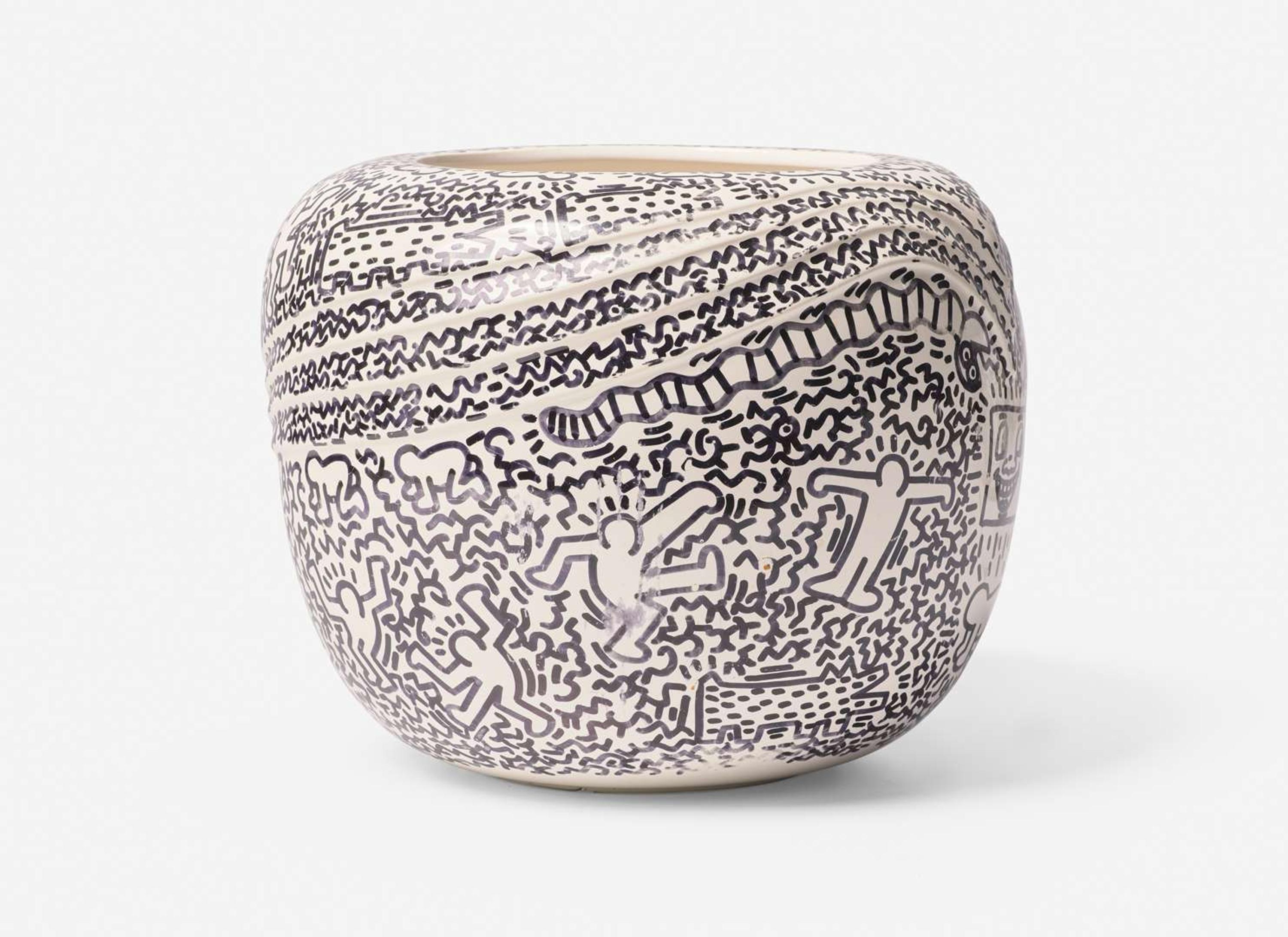
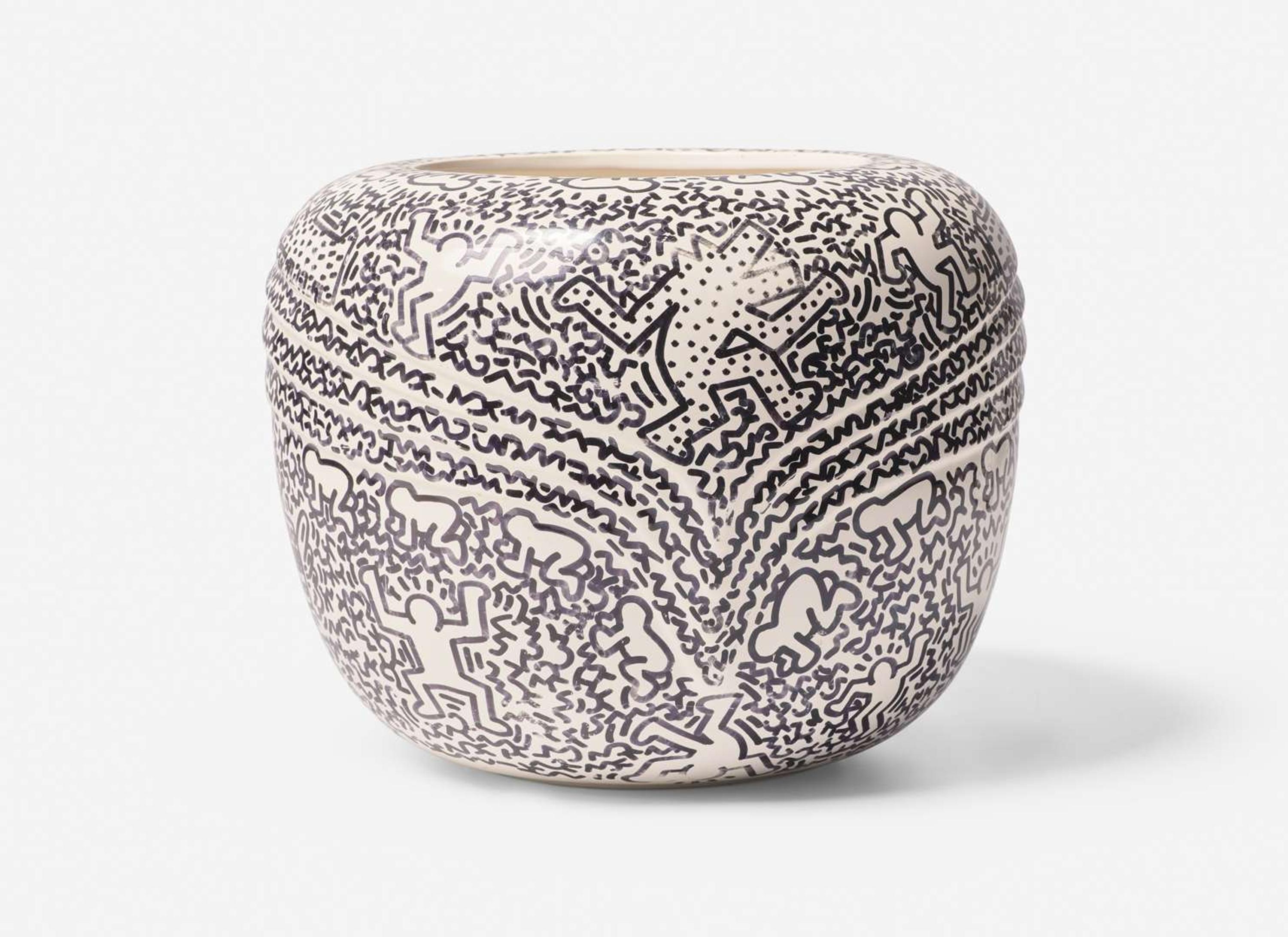
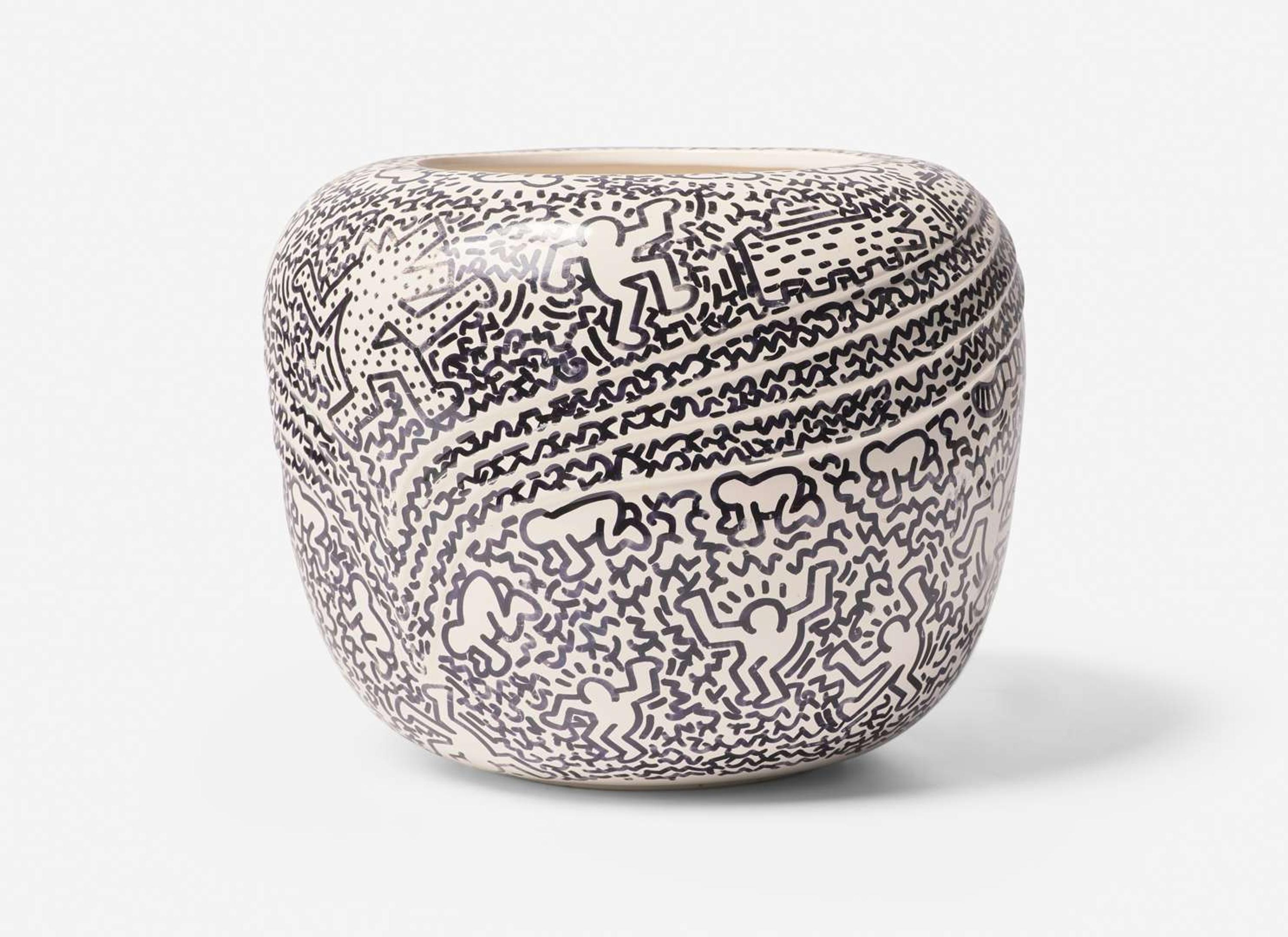
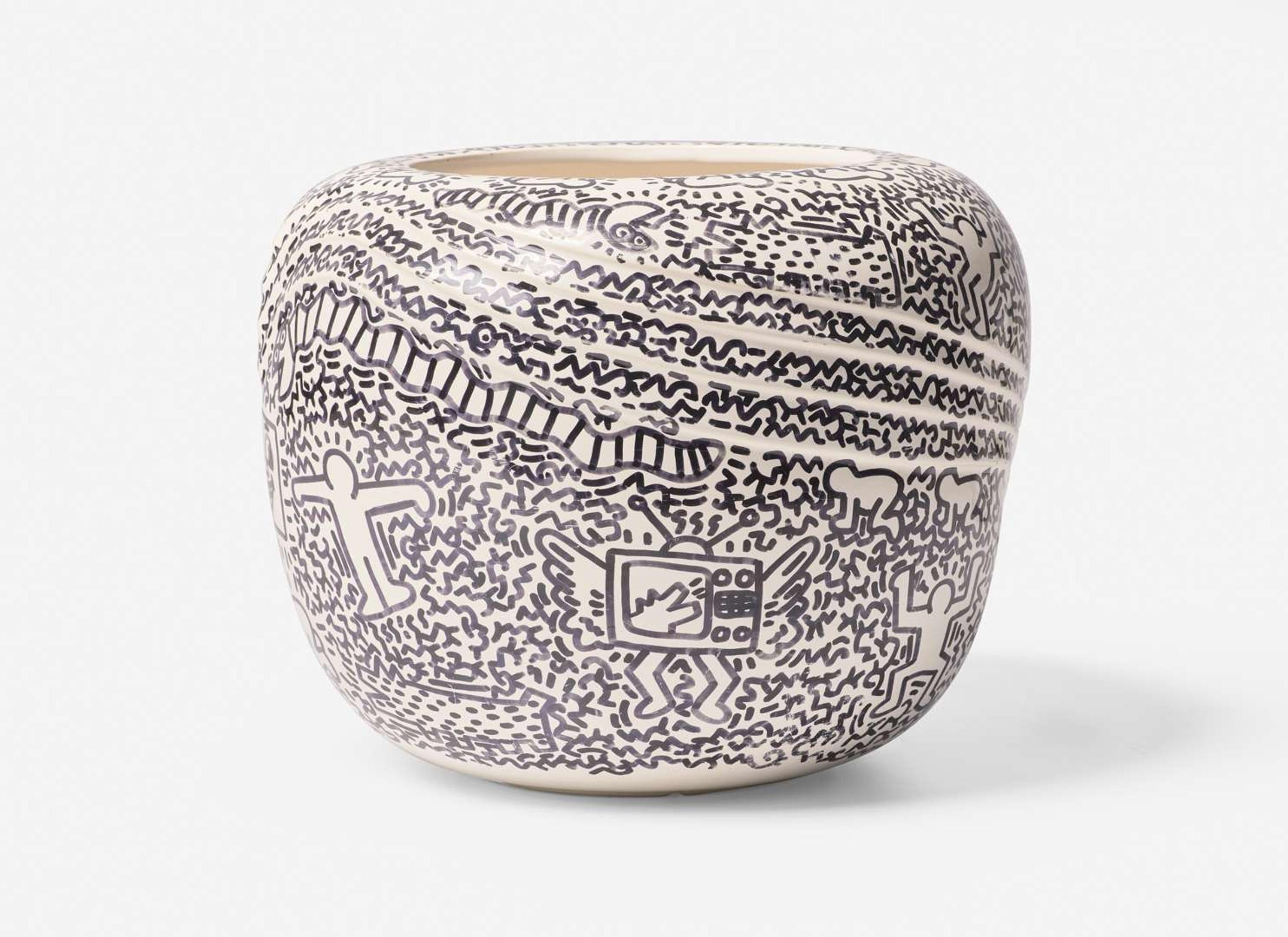
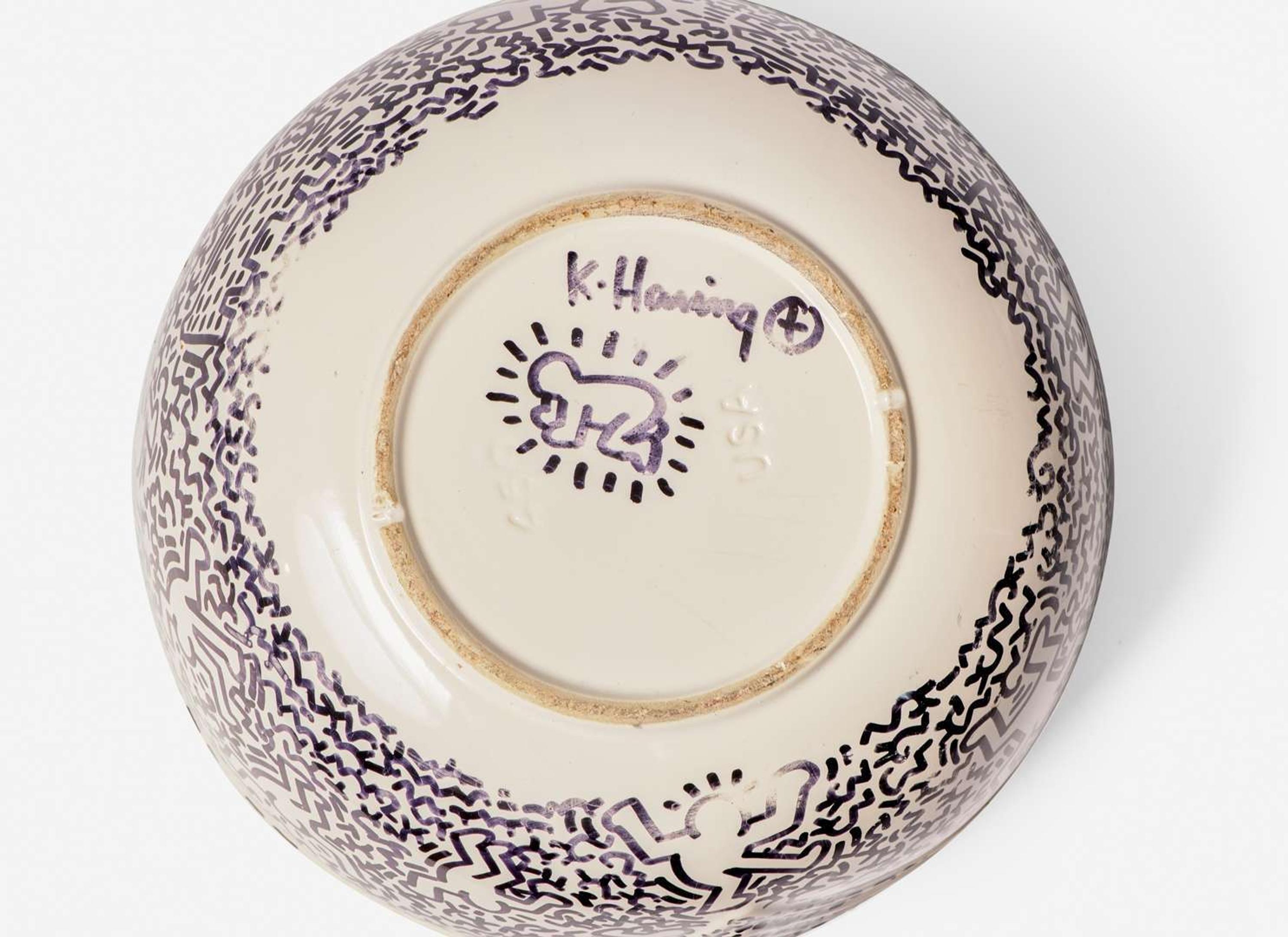
Keith Haring (American, 1958-1990), Untitled
marker
Graffiti artist Keith Haring drew everywhere and on everything - the world around him was his canvas. He was specifically attracted to certain forms and began working with pottery and ceramic pieces after visiting a terracotta workshop outside of Milan. Of this experience, he wrote: “I chose several vases of different sizes and shapes and began the next day to systematically sand, wash, and then embellish the surface with marking ink. The largest of these was big enough for me to stand inside of. There were several small vases which I was attracted to because of their similarity to the shape of nuclear cooling towers. The confrontation between the history of vase paintings and the contemporary approach of drawing with marker and the mixture of contemporary and ancient symbols produces an ironic mixture of opposites." [1]Keith Haring grew up in Kutztown, Pennsylvania in the 1960s, later attending school in Pittsburgh and finally moving to New York City in 1978 to study at the School of Visual Arts. In New York, Haring began creating his instantly recognizable drawings in the subway system and public spaces, using vibrant colors and deceptively simple lines, often to convey powerful messages of social justice and AIDS awareness. His art dealer, Tony Shafrazi, later encouraged him to create work to exhibit in the gallery setting, launching his career in the realm of fine art. Tragically, Keith Haring's life was cut short at age 31, due to complications related to AIDS, but his imagery remains accessible and popular and his legacy in Contemporary Art is evident.Despite centering his adult life in New York City, Haring often introduced himself as “Keith from Kutztown,” and made a noted effort to visit and work in the community. He was a guest artist at Kutztown University in 1982, and installed an exhibition at the New Arts Program in 1987, both times offering talks and programming for the arts community. His high school art teacher, Nita Dietrich, tried to see him when he was in town, and remembered: “From the first, Keith loved line. He wasn’t too interested in rendering a realistic, three-dimensional drawing. But anything that lent itself to line pattern, he loved. He loved pen and ink and he worked so intricately!” [2] The two ceramics here belonged to Mrs. Dietrich, who retired from teaching in 1983 and continued to live in Kutztown. For a time, she rented an apartment to Thomas Lewis, a student teacher in the 1980s, who later taught art history at Kutztown University. When circumstances changed and Lewis had to move out, Dietrich gave him the ceramics as a gift.Both of the ceramic works on offer here, one a “nuclear cooling tower” shape and the other a round striated pot, are covered over every inch with Haring’s signature imagery. Radiant babies abound, but barking dogs, slithering snakes and dancing figures join the mix as well. There is even a Campbell’s “Pop Soup” can with a figure springing forth, a playful homage to his contemporary and friend Andy Warhol. Much like historical vase paintings of Greek and Roman antiquity, the surfaces of these works come alive, as figures move and dance across the surfaces, a late 20th century connection to this ancient form. [1] Keith Haring, quoted on the Artist's Foundation website, https://www.haring.com/!/art-work/185[2] John Gruen, Keith Haring: The Authorized Biography, New York: Thames & Hudson, 1991, pp. 17-18.
Nita A. Dietrich, Kutztown, Pennsylvania.
Thomas Lewis, Kutztown, Pennsylvania (acquired directly from the above).
Private Collection, Pennsylvania (by family descent).