Sale 1346
| Chicago
| Chicago
Estimate$30,000 – $50,000
We are grateful for the research conducted by Susan Weininger, Professor Emerita, Roosevelt University.
Provenance:
The Artist
John Beck, Chicago, acquired from the Artist, 1958
Shirley Mann, Chicago
Thence by descent to the present owners
Lot note:
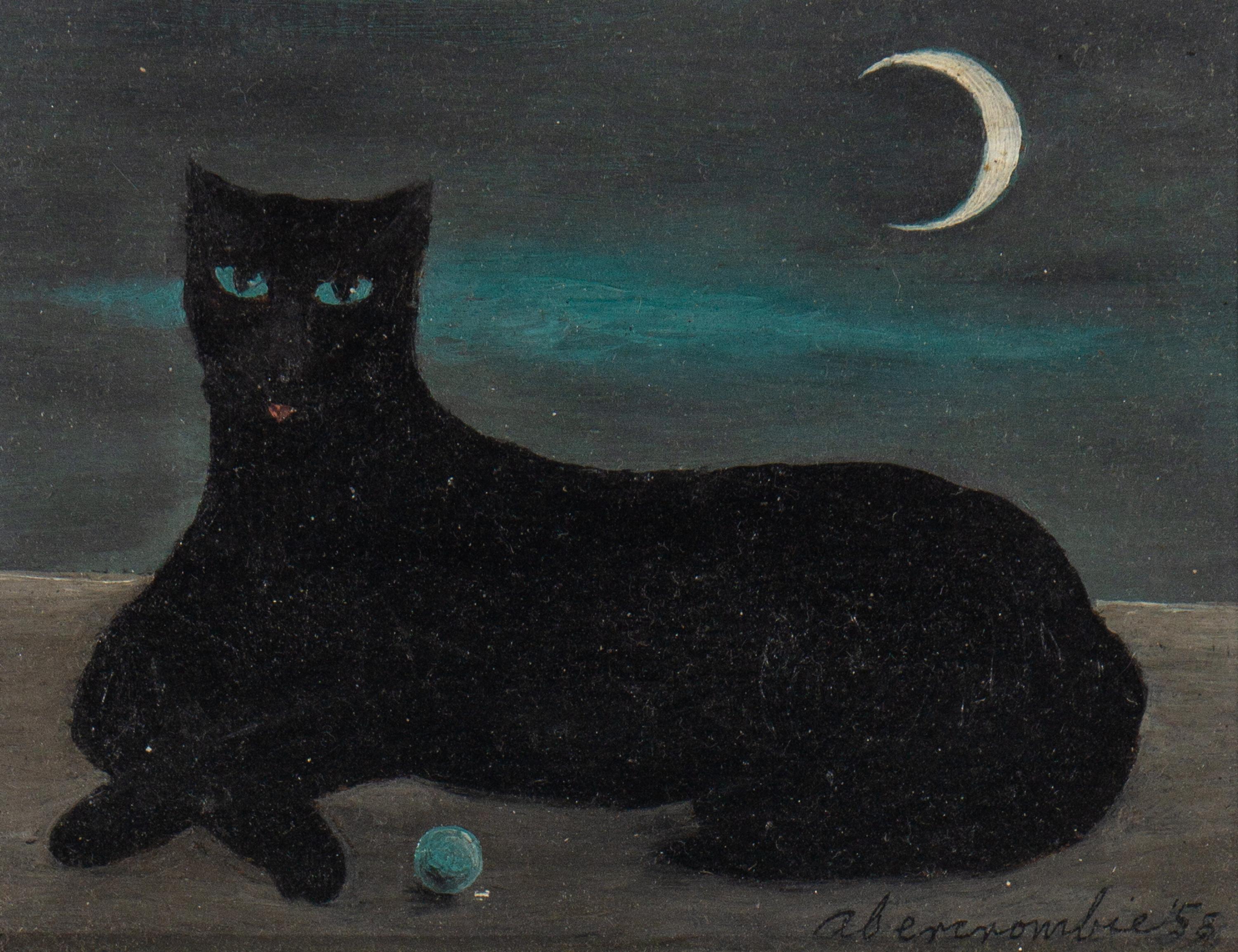
Gertrude Abercrombie was a cat lover and always had multiple cats in her home. Cats were not only beloved pets for the artist, but also served as an alter ego. From the beginning of her career, the animals appeared in her work, alone or accompanying the solitary woman (always Abercrombie herself). In her frequent guise as a witch, Abercrombie was accompanied by her familiar, the cat, who aided in the creation of the powerful persona that she projected in her work to counter the self-doubt she felt in her life. So close did the artist feel to these creatures that in her woodcut print, Cat and I (1940), the pale Abercrombie and the black cat share facial features in reverse colors.
Although she often claimed to be untutored, Abercrombie studied perspective and chiaroscuro in the traditional art classes offered when she was at the University of Illinois. She learned to render believable three-dimensional objects, still lifes, and architectural structures, but it seems that she did not make it to figure drawing, where she would have learned to render people and other animate creatures However, Abercrombie learned to work with her limitations, devising flat silhouettes for the ubiquitous female figures in her work. The cats who appear in more complicated compositions are often depicted as undifferentiated shapes, as well. But in the paintings where the cat is the focus, she had to attempt to create a plausible animal. The artist seems to have settled on a couple of templates for cats in different poses. The seated cats, for example, are all in similar still and simplified poses, legs stiffly in front, tail curled decoratively around their bodies. The same is true of the reclining cats, whose front paws are crossed, the visible back leg echoed in the tail curled in front of it. Yet the heads are somewhere between animal and human, the eyes rendered as elegant, elongated, upward turning forms, much like Abercrombie rendered her own eyes in her numerous self-portraits.
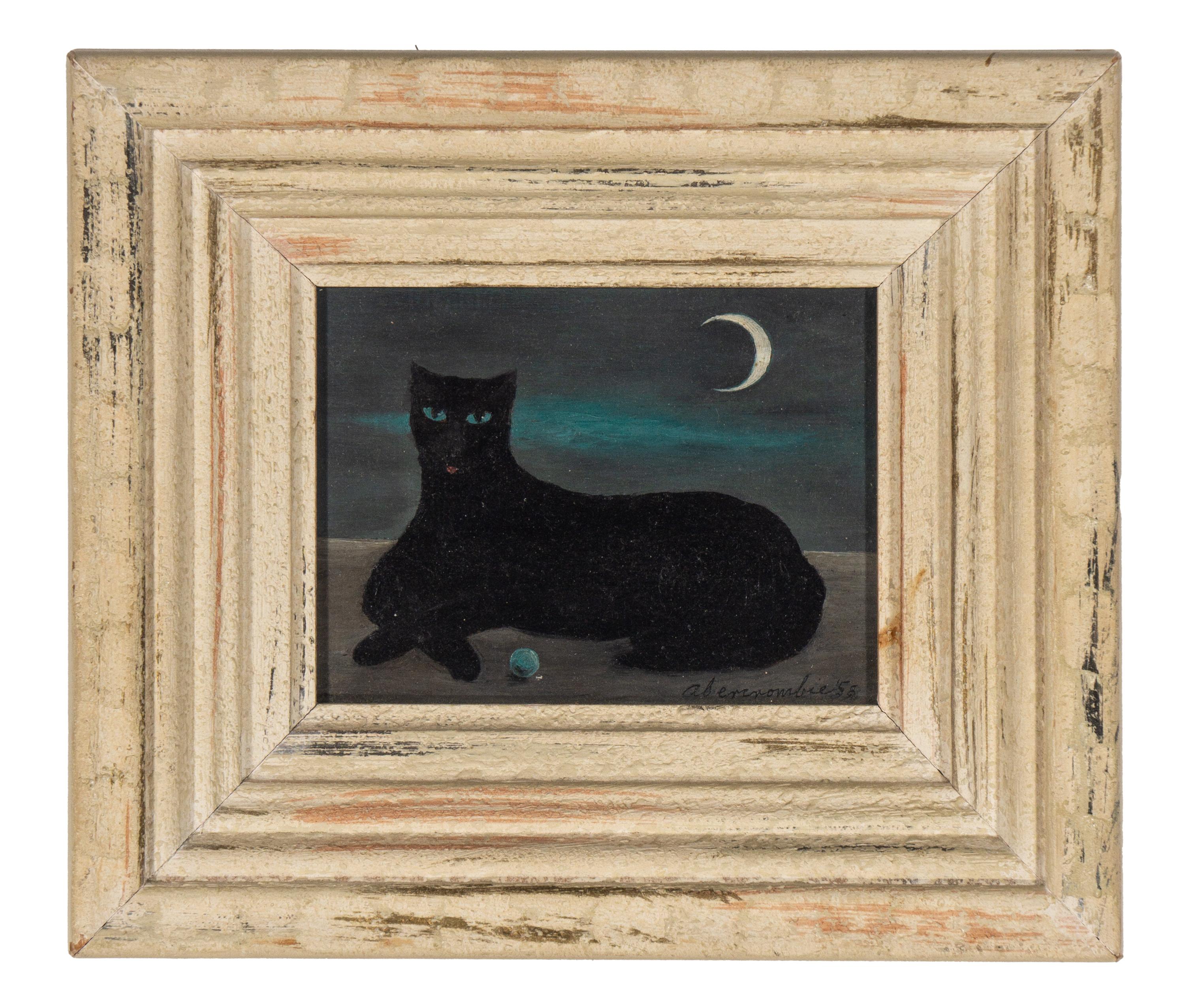
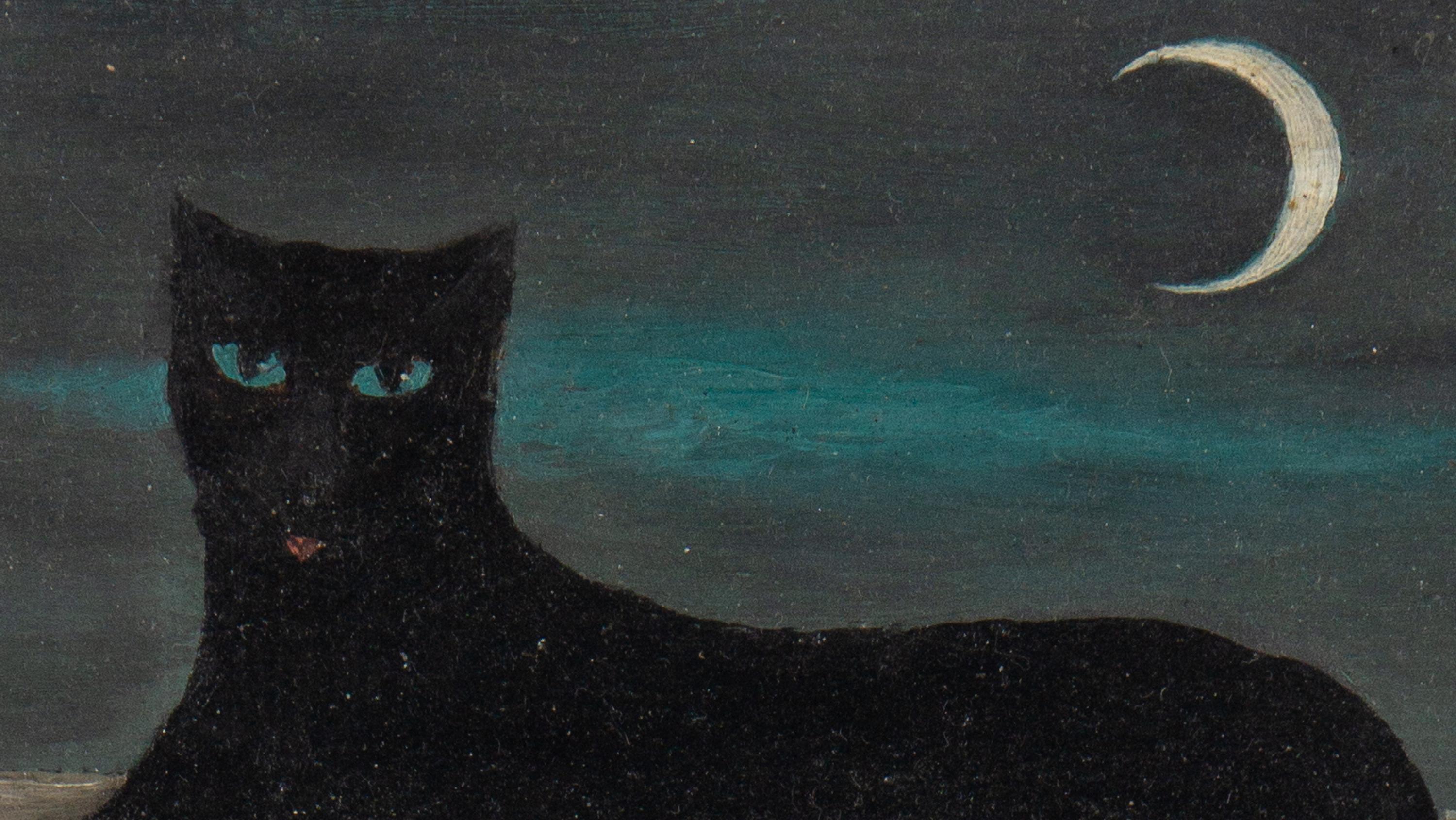
In Little Black Cat, the cat’s eyes are a brilliant turquoise, one of Abercrombie’s signature colors. It is not surprising that the pupils of Abercrombie’s eyes in some of her best self-portraits (see, for example, Self Portrait of My Sister, 1941, Art Institute of Chicago) are a similar vivid color. The face of Little Black Cat is eerily human, unsurprising in the work of a woman who identified so closely with cats that when she was pregnant with her only child, Dinah, she commented that she could imagine giving birth to a cat but not to a human. Abercrombie’s paintings, even miniscule ones such as the present artwork, are completely original and beautifully composed. Here the turquoise of the cat’s eyes is repeated in the small ball in the foreground, as well as in the wispy cloud that drifts behind the cat’s head. This cloud links the cat to the crescent moon in the upper right of the composition, which itself echoes the ball. The less skilled passages in the anatomical rendering of the cat are compensated by the almost human connection we feel with this animal, a self-portrait of the artist without her presence. Abercrombie asserted that, “It is always myself that I paint,” and this extends to the many humanoid cats in her oeuvre. Despite the painting’s small size, it has an enormous emotional impact, full of the mystery and ambiguity, the nuance and subtlety, so characteristic of all the artist’s work.
Framed: 6 1/2 x 7 3/8 inches.
The physical condition of lots in our auctions can vary due to age, normal wear and tear, previous damage, and restoration/repair. All lots are sold "AS IS," in the condition they are in at the time of the auction, and we and the seller make no representation or warranty and assume no liability of any kind as to a lot's condition. Any reference to condition in a catalogue description or a condition report shall not amount to a full accounting of condition. Condition reports prepared by Freeman's staff are provided as a convenience and may be requested from the Department prior to bidding.
The absence of a posted condition report on the Freeman's website or in our catalogues should not be interpreted as commentary on an item's condition. Prospective buyers are responsible for inspecting a lot or sending their agent or conservator to inspect the lot on their behalf, and for ensuring that they have requested, received and understood any condition report provided by Freeman's.
Please email fineart@hindmanauctions.com for any additional information or questions you may have regarding this lot.