To request further details about this lot, please email antiquities@hindmanauctions.com

Jacob Coley
Senior Vice President, Head of Department, Antiquities and Ancient Art
Sale 1343
| Chicago
| Chicago
To request further details about this lot, please email antiquities@hindmanauctions.com
Jacob Coley
Senior Vice President, Head of Department, Antiquities and Ancient Art
Estimate$60,000 – $80,000
Provenance:
The Parvin Collection (Allan Krammer), Chicago, formed in the 1960s-70s and disbanded by the early 1980s. [Inv. no. 381]
Art Market, New York.
Published:
L. Berge & K. Alexander, 'Ancient Gold Work and Jewelry from Chicago Collections' in The Ancient World, Vol. 11, 1 & 2, 1985, p. 32, no. 171.
Exhibited:
Illinois, Chicago, Art Institute of Chicago, Ancient Gold Work from Chicago Collections, 10 April - 31 May 1985.
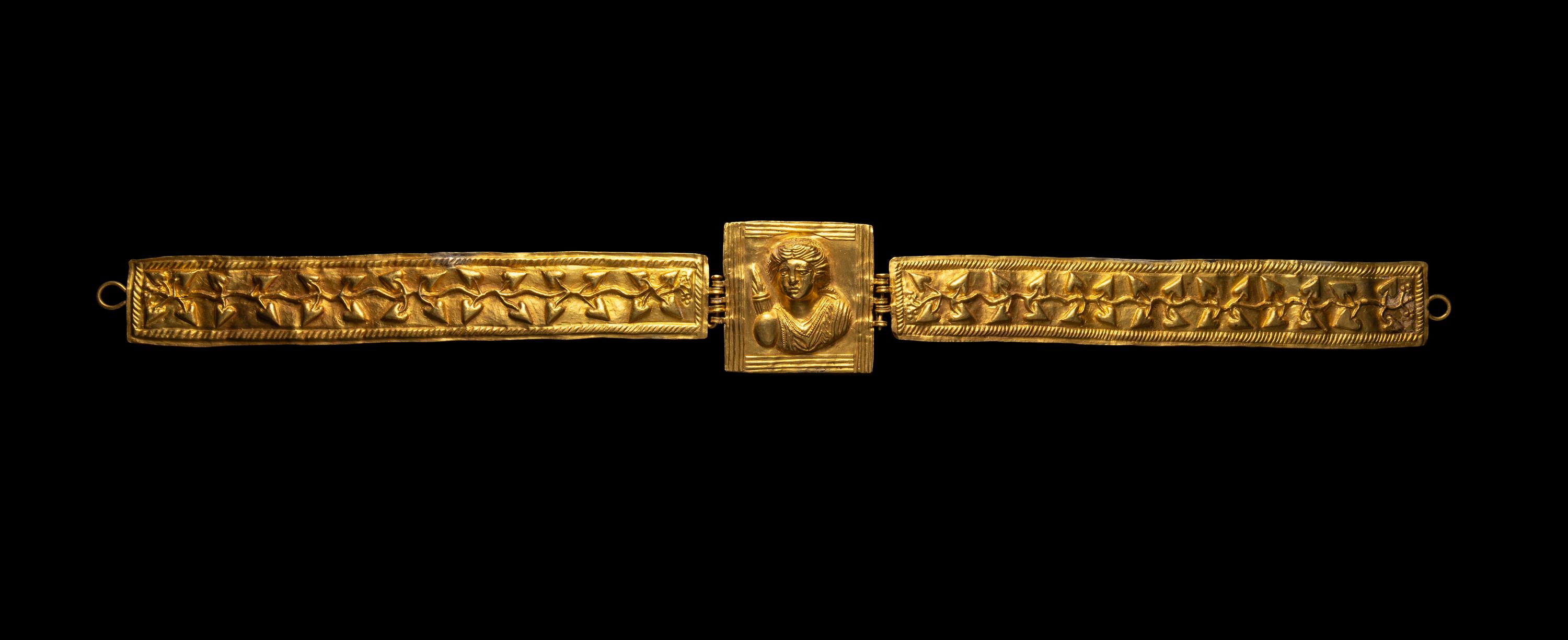
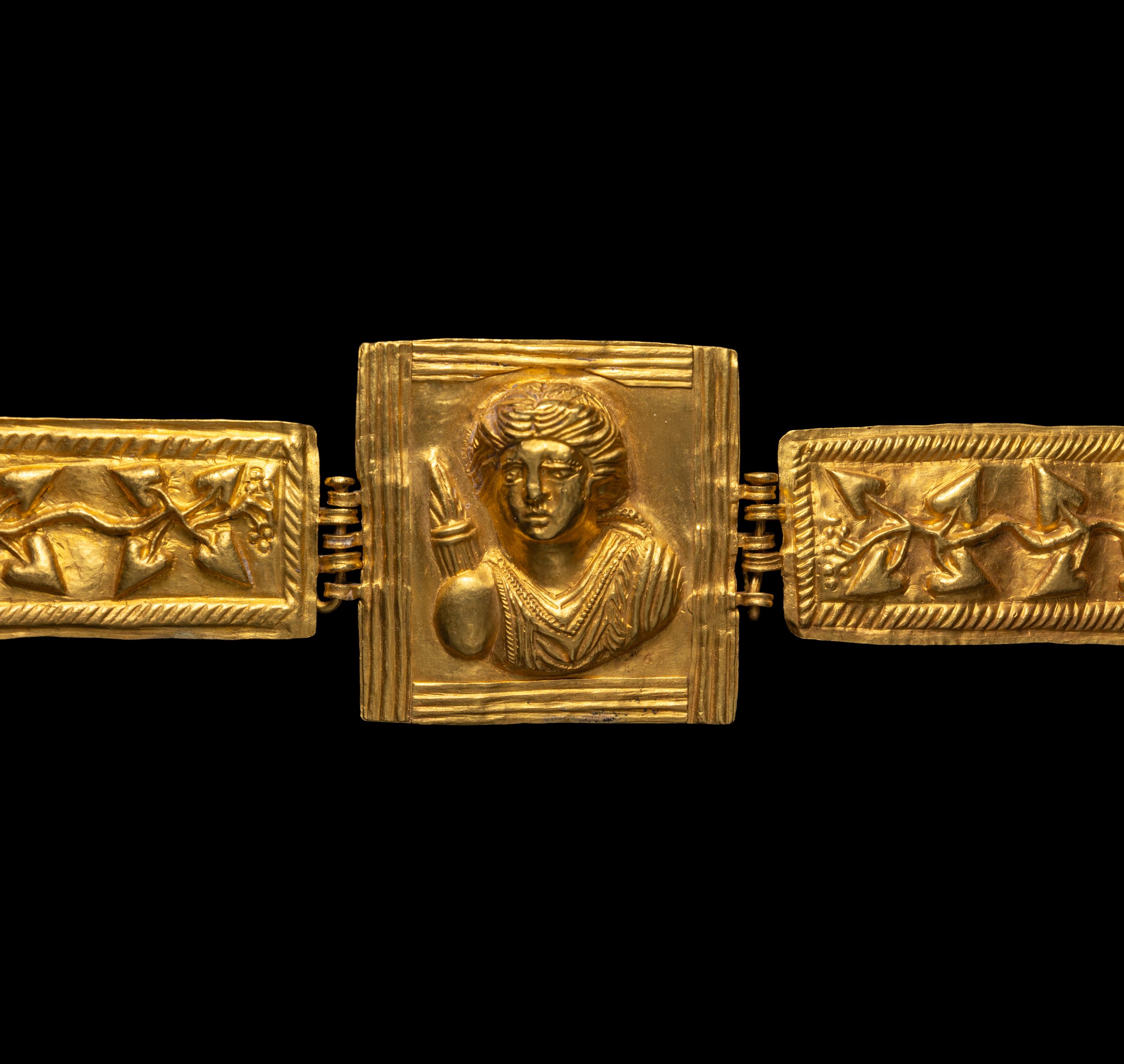
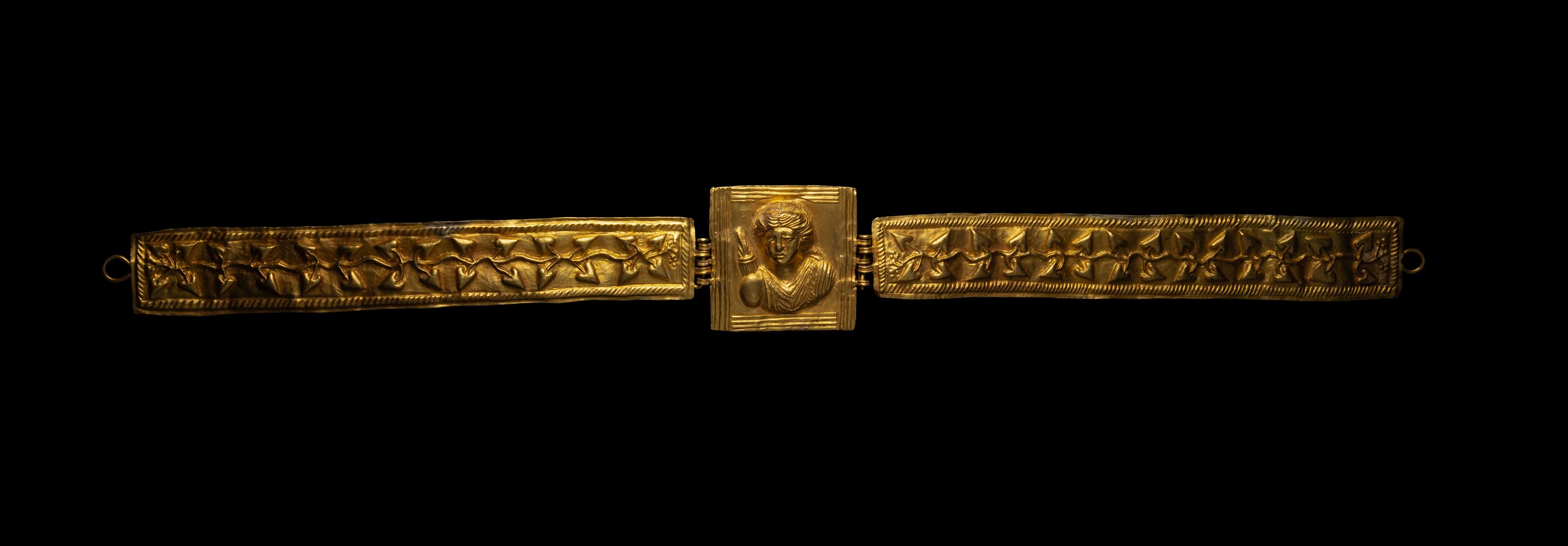
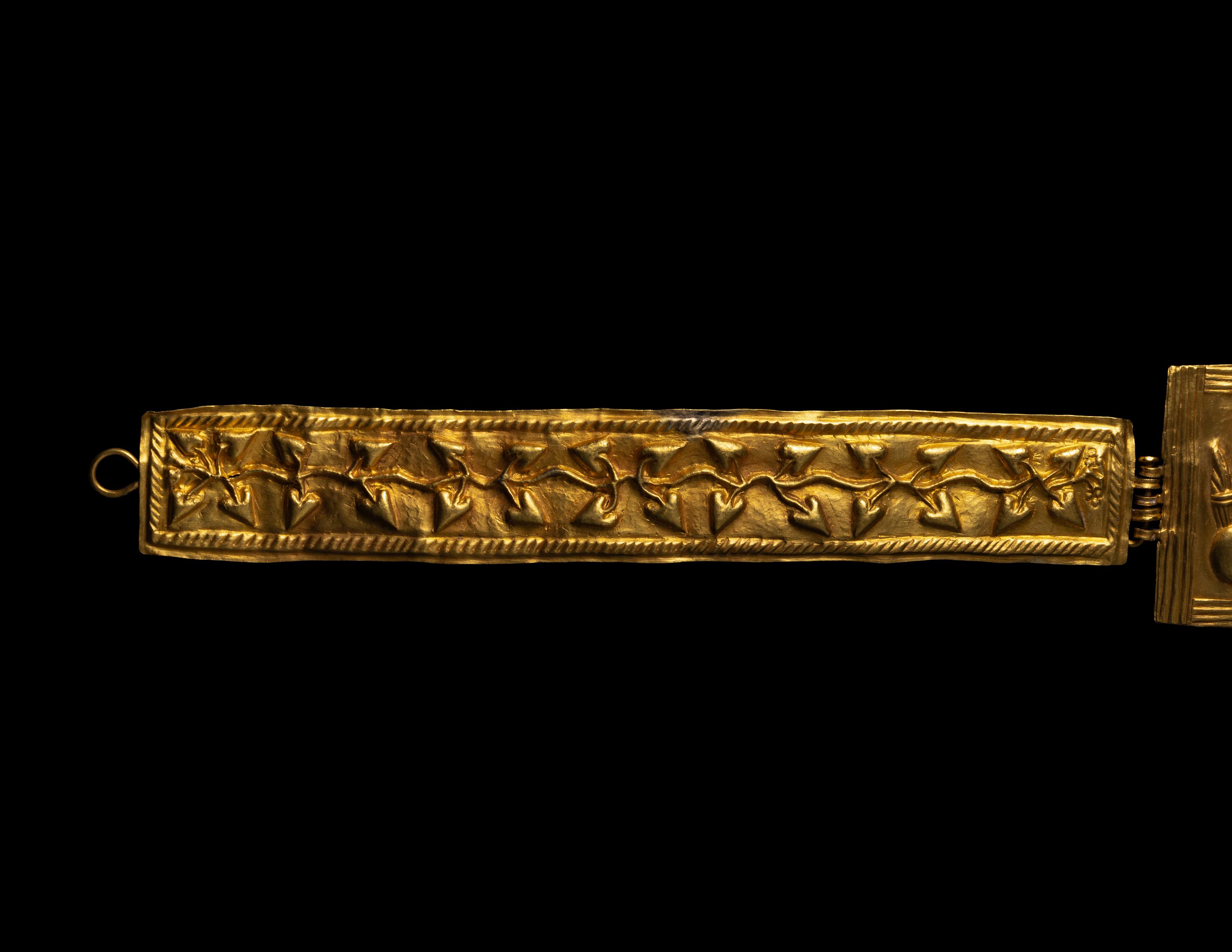
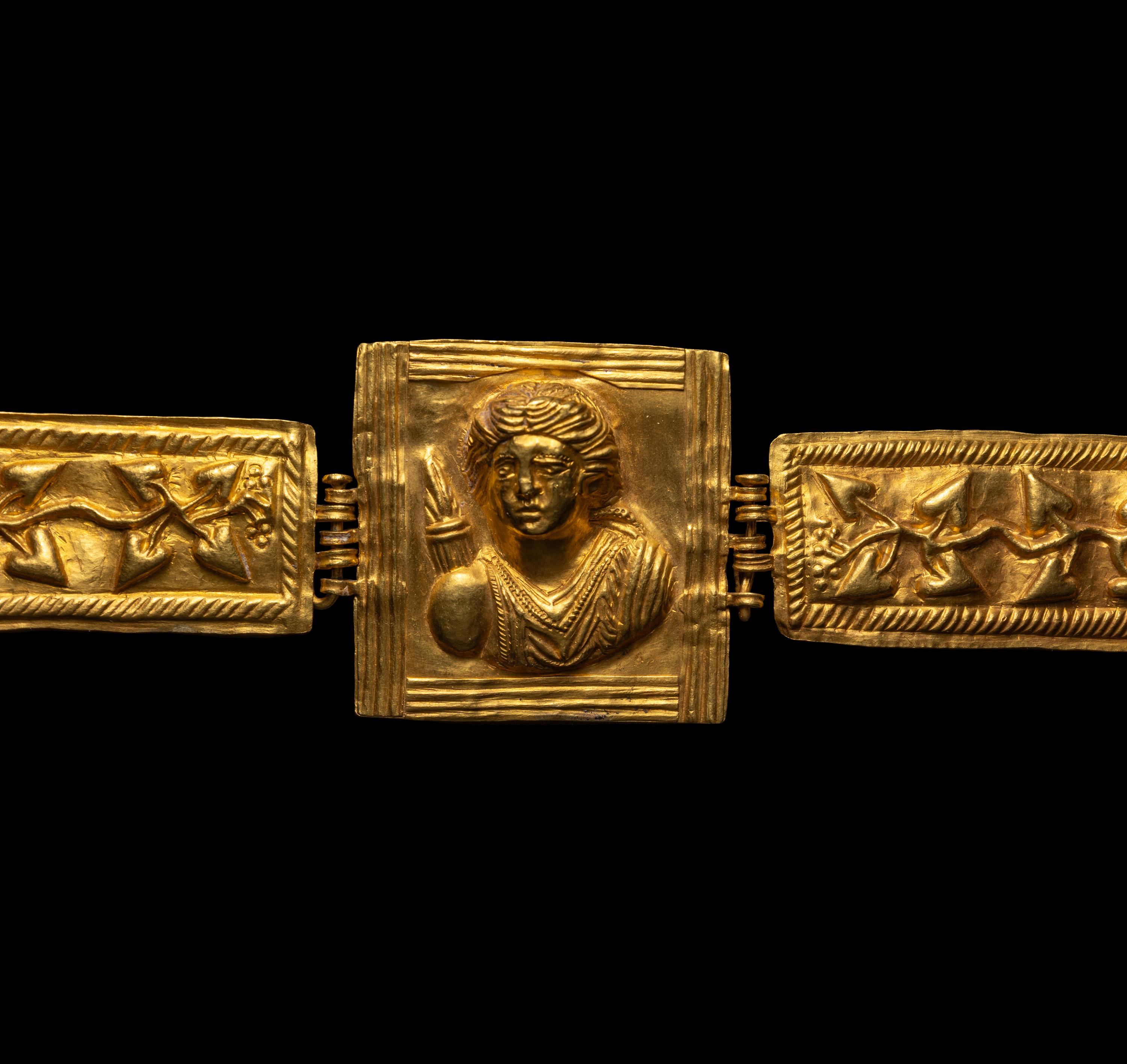
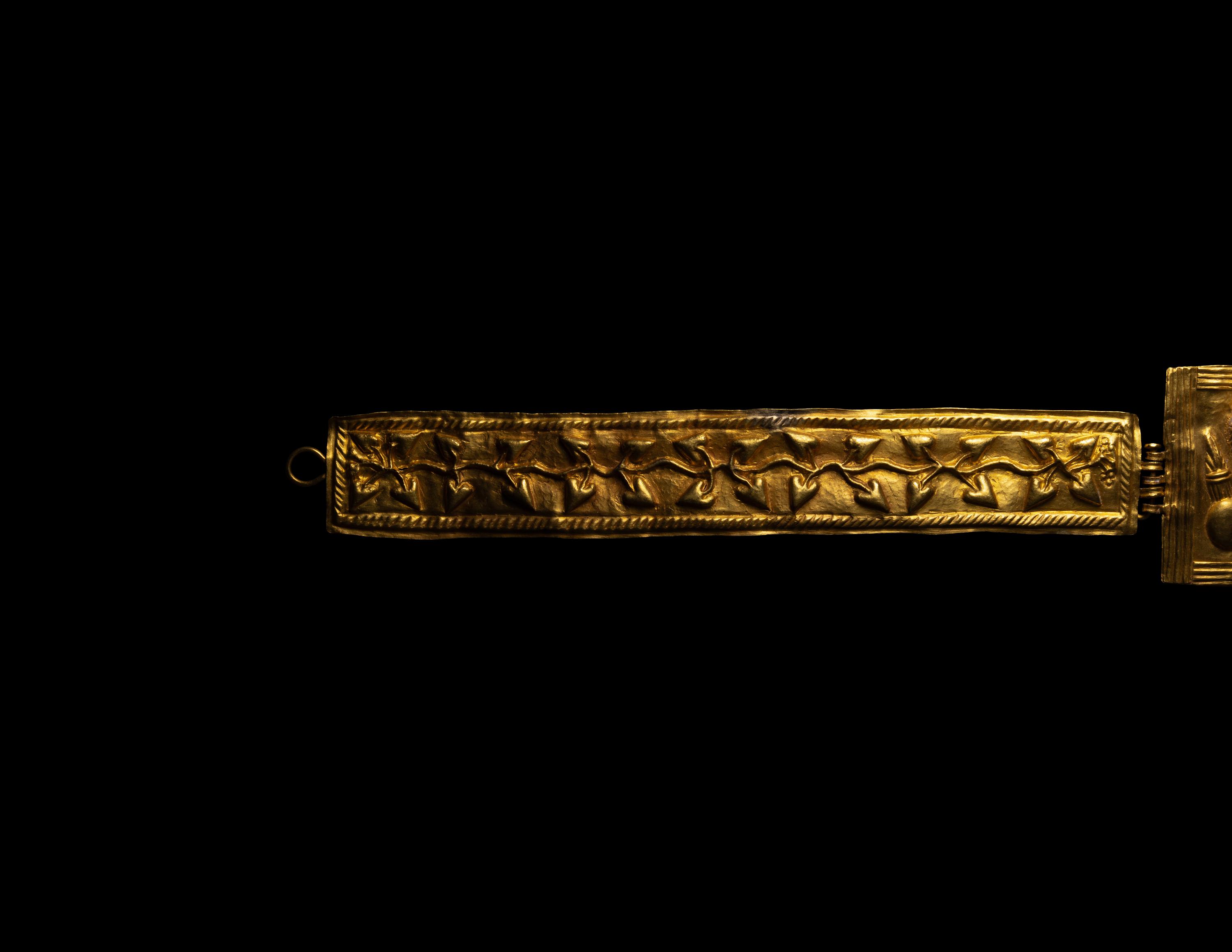
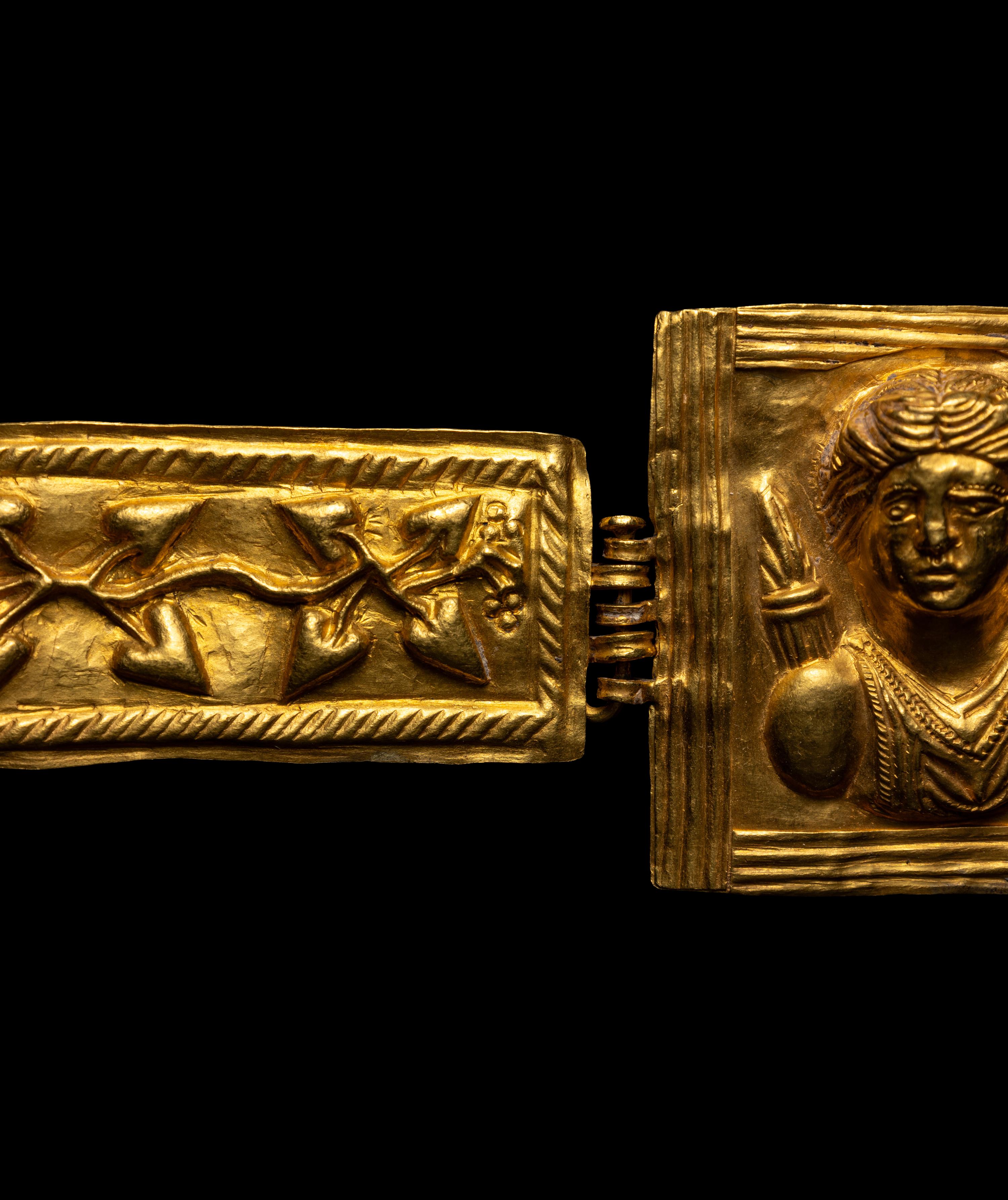
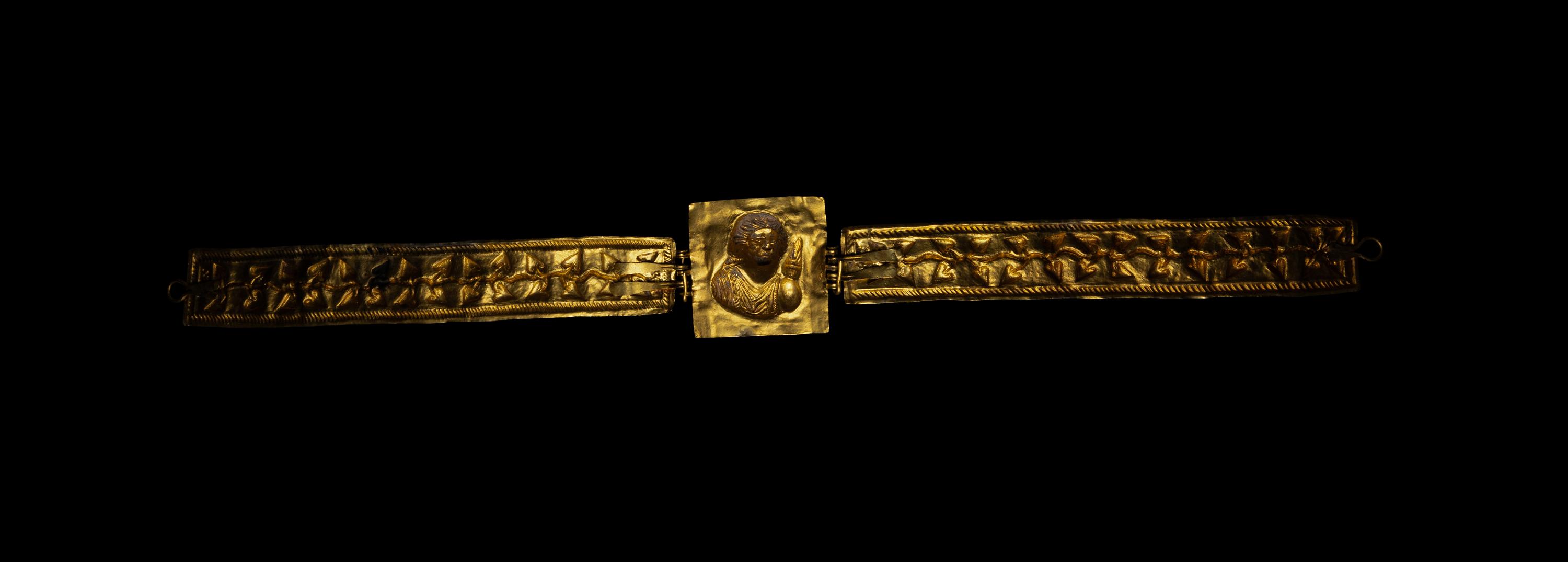
Diana, the virginal Roman goddess of the hunt, projects forcefully in high relief from the central repoussé plaque. Shown bust-length, she wears a sleeveless chiton, a somewhat troubled expression, and a full quiver over her right shoulder. Chasing is evident in the detailed edge of her garment and fine strands of hair. Applied corrugated strips form a border around the central square element, which is hinged to two slimmer rectangular sections on each side. These are formed of sheet gold and embossed with a stylized ivy-leaf pattern bounded above and below by a rope motif. The adornment’s precise function is not abundantly clear: it might have been worn alternately as a diadem or a girdle to secure a garment beneath the breasts. Loops at the ends of the slim rectangular sections might have facilitated either modality, fastened together to encircle the brow or stitched into a garment.
Gold jewelry was always prized in the Greco-Roman world, but was relatively scarce until the conquests of Alexander the Great opened new channels for the precious metal to pour into the region. Even with the new wealth of the Hellenistic period, gold ornament was only ever the prerogative of the wealthiest elite. With high intrinsic value, gold jewelry was frequently melted down and repurposed in antiquity, particularly during times of upheaval. Much has been irretrievably lost, and most important examples survive because they were buried for one of two reasons: they were entombed with their owners as prestigious symbols of their wealth or they were buried in caches for safe-keeping during turbulent periods and never retrieved.
Because it was made to be worn and displayed on the body, gold jewelry was always especially meaningful – its decoration taking on special significance for the wearer. The format of the bust-length goddess emerging from a central element seems to have originated in the Hellenistic period, with the best-known lavish examples now in Athens (see note below). The motif in gold jewelry was popular into Late Antiquity, with the wearer imbued with some of the deity’s power and under her protective auspices. Given Diana’s tutelary function for women approaching marriage and childbirth, one can well imagine the goddess’ image worn as both powerful and attractive protection, perhaps even by a young woman on her wedding day. Certainly, the charged imagery and luxurious nature of this ornament would have been well suited as an aristocratic wedding gift, treasured throughout the bride’s life, and perhaps even buried with her as a lasting testament to her social status and femininity.
For more on figures emerging from central elements, see F.H. Marshall, British Museum Catalogue of Jewellery. London, 1911. nos. 2883, 3046, for plaque, and plates LXVIII, LXX; H. Hoffmann and V. von Claer. Antiker Gold und Silverschmuck. Museum für Kunst und Gewerbe. Hamburg, 1968, p. 17.
Inspected under UV light and 10x loupe. Areas of mild encrustation. Minor dents and scratches typical of age. Areas of reddish and black patina. Mild tears through the girdle near proper edges. Pinkish deposits in back of central plaque. Authenticated by Independent Art Research, London in 1990. Generally in fine and very attractive condition.
The physical condition of lots in our auctions can vary due to age, normal wear and tear, previous damage, and restoration/repair. All lots are sold "AS IS," in the condition they are in at the time of the auction, and we and the seller make no representation or warranty and assume no liability of any kind as to a lot's condition. Any reference to condition in a catalogue description or a condition report shall not amount to a full accounting of condition. Condition reports prepared by Freeman's staff are provided as a convenience and may be requested from the Department prior to bidding.
The absence of a posted condition report on the Freeman's website or in our catalogues should not be interpreted as commentary on an item's condition. Prospective buyers are responsible for inspecting a lot or sending their agent or conservator to inspect the lot on their behalf, and for ensuring that they have requested, received and understood any condition report provided by Freeman's.
Please email antiquities@hindmanauctions.com for any additional information or questions you may have regarding this lot.