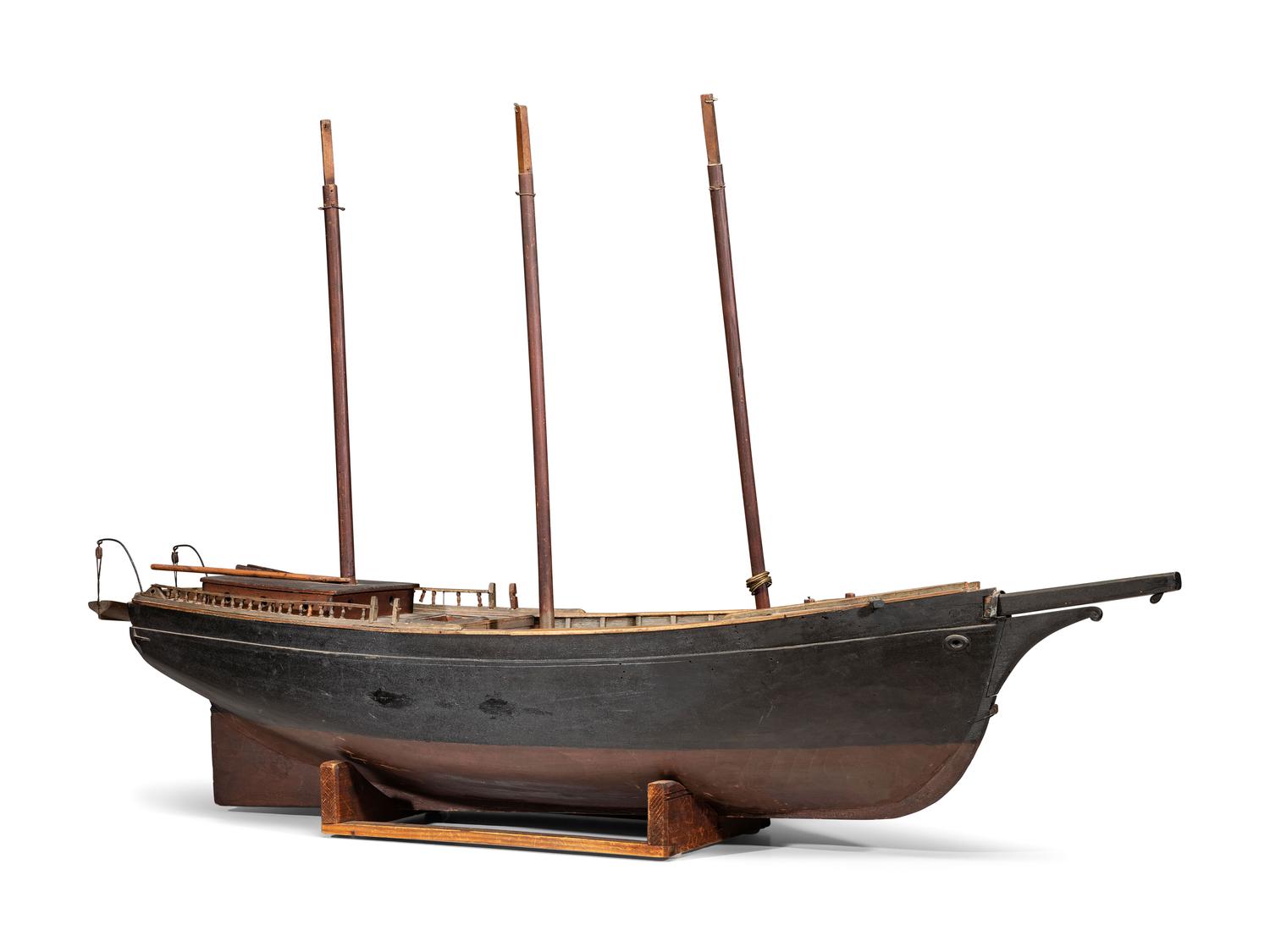
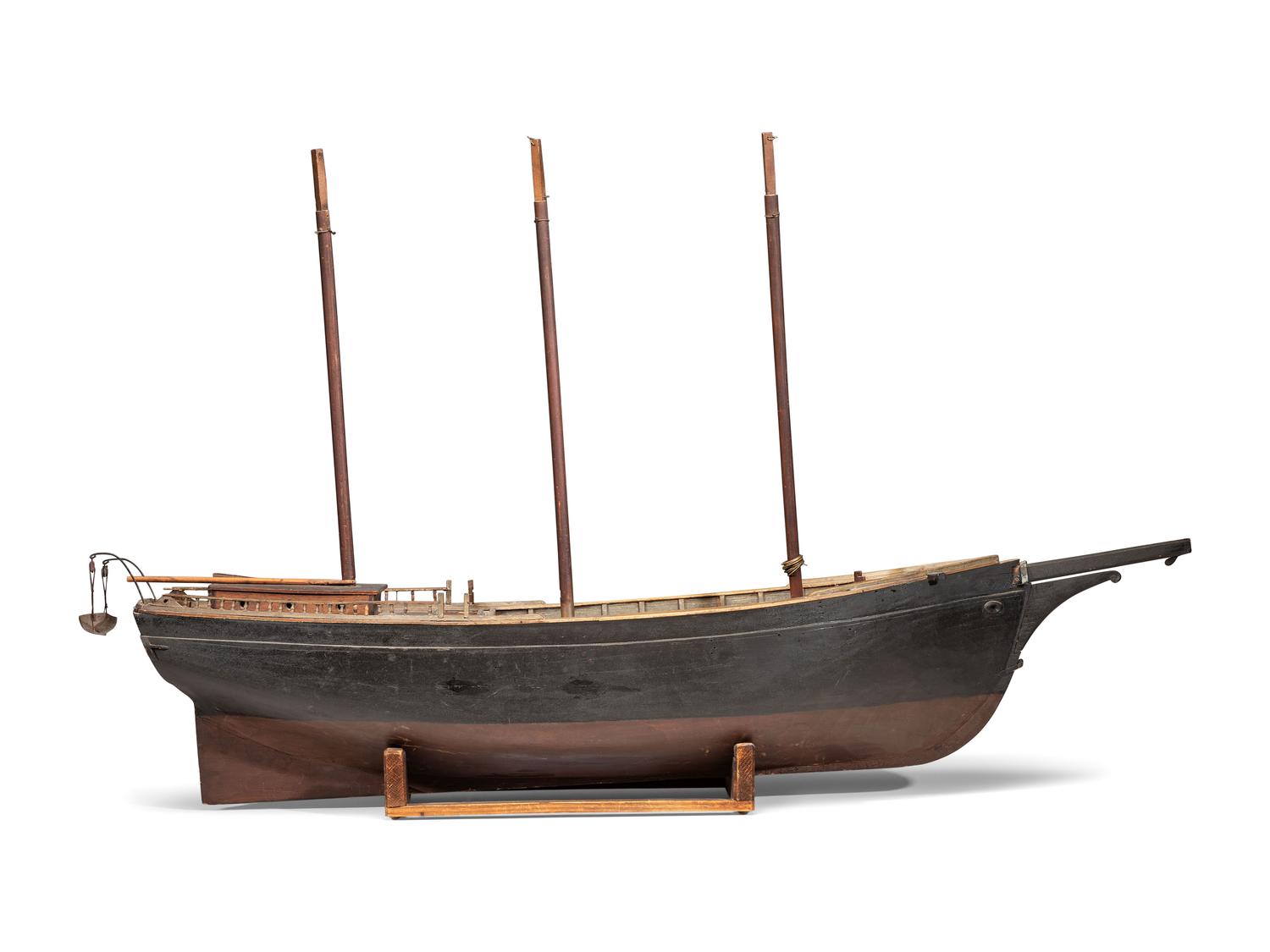
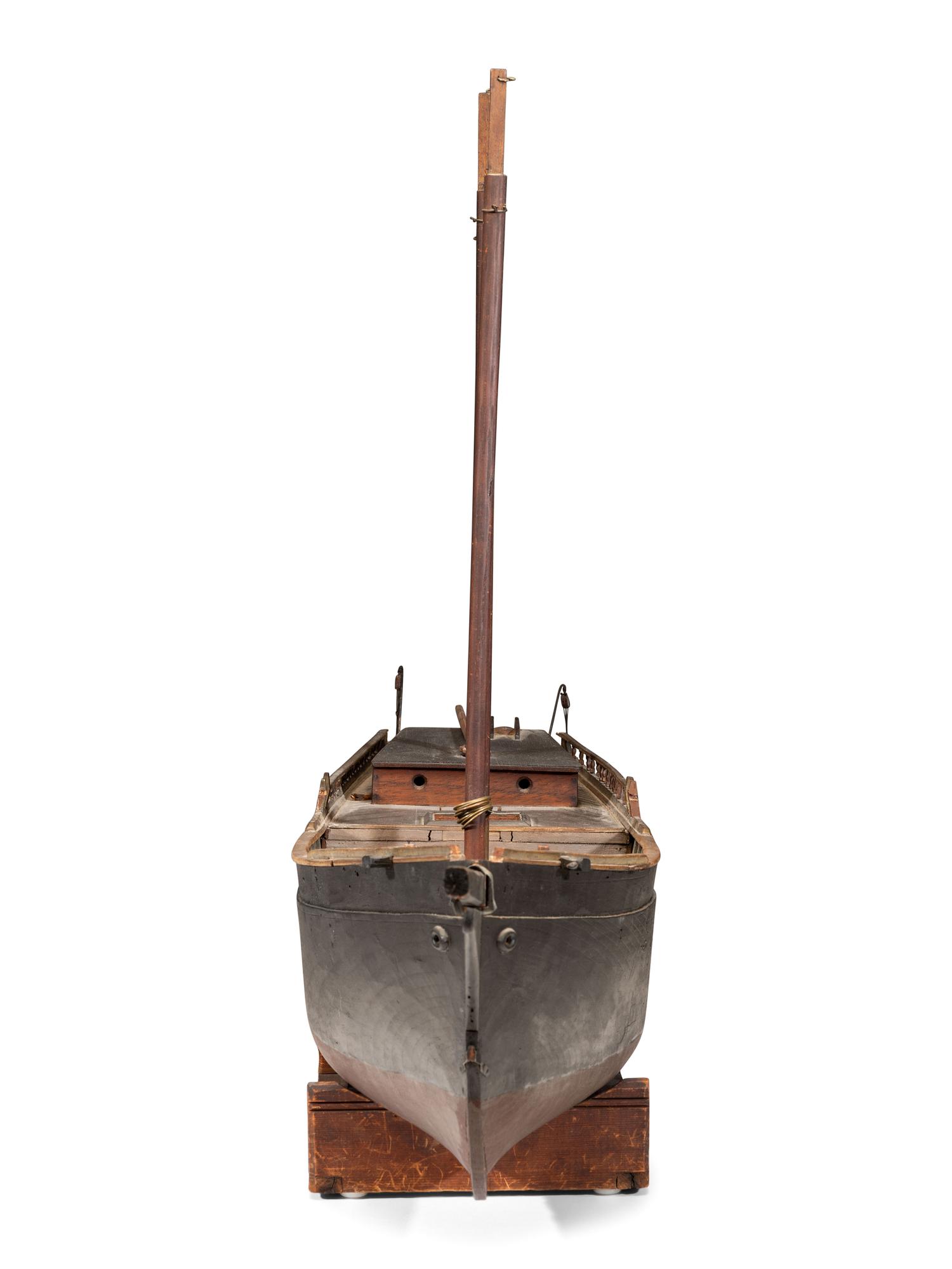
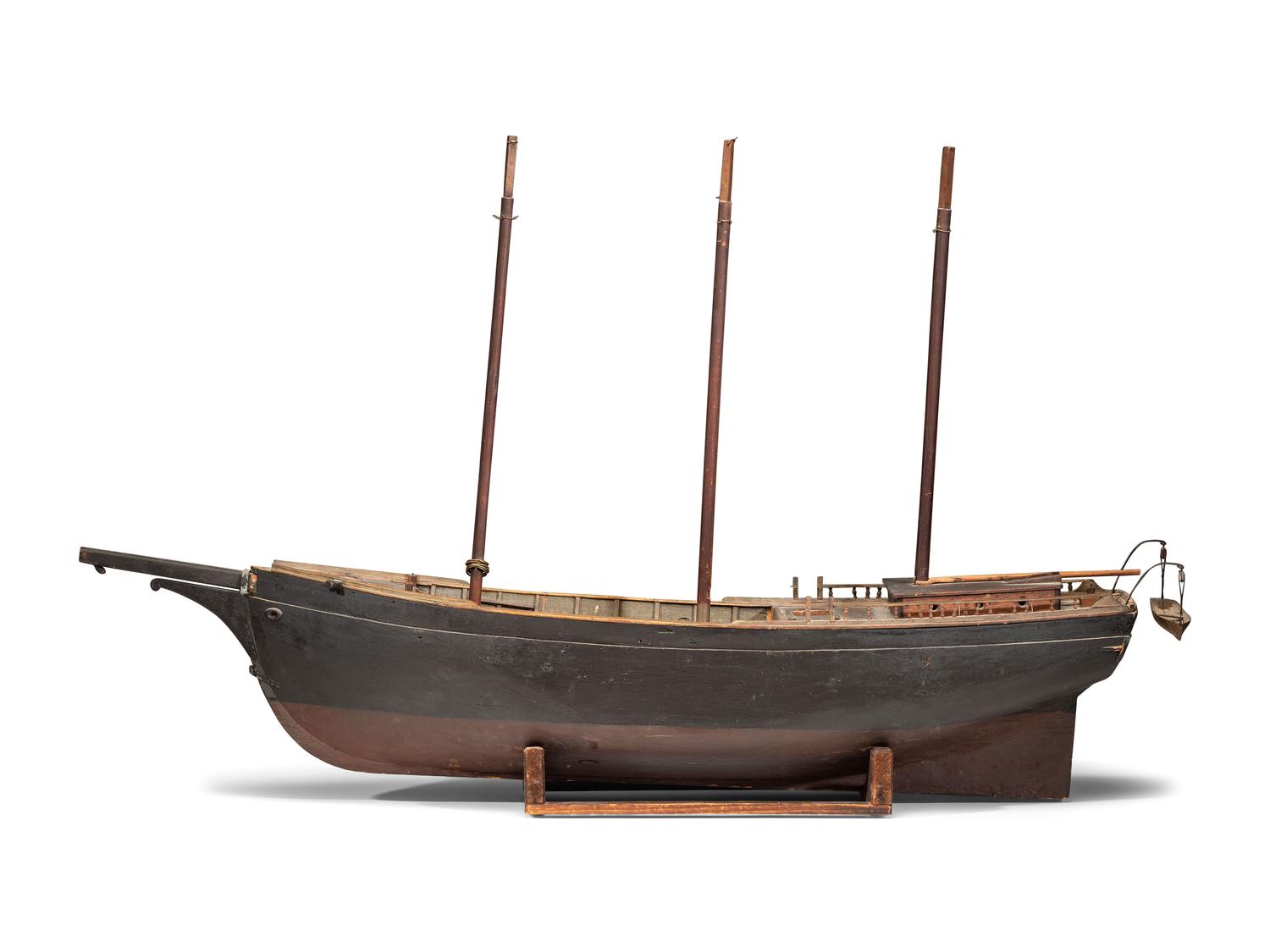
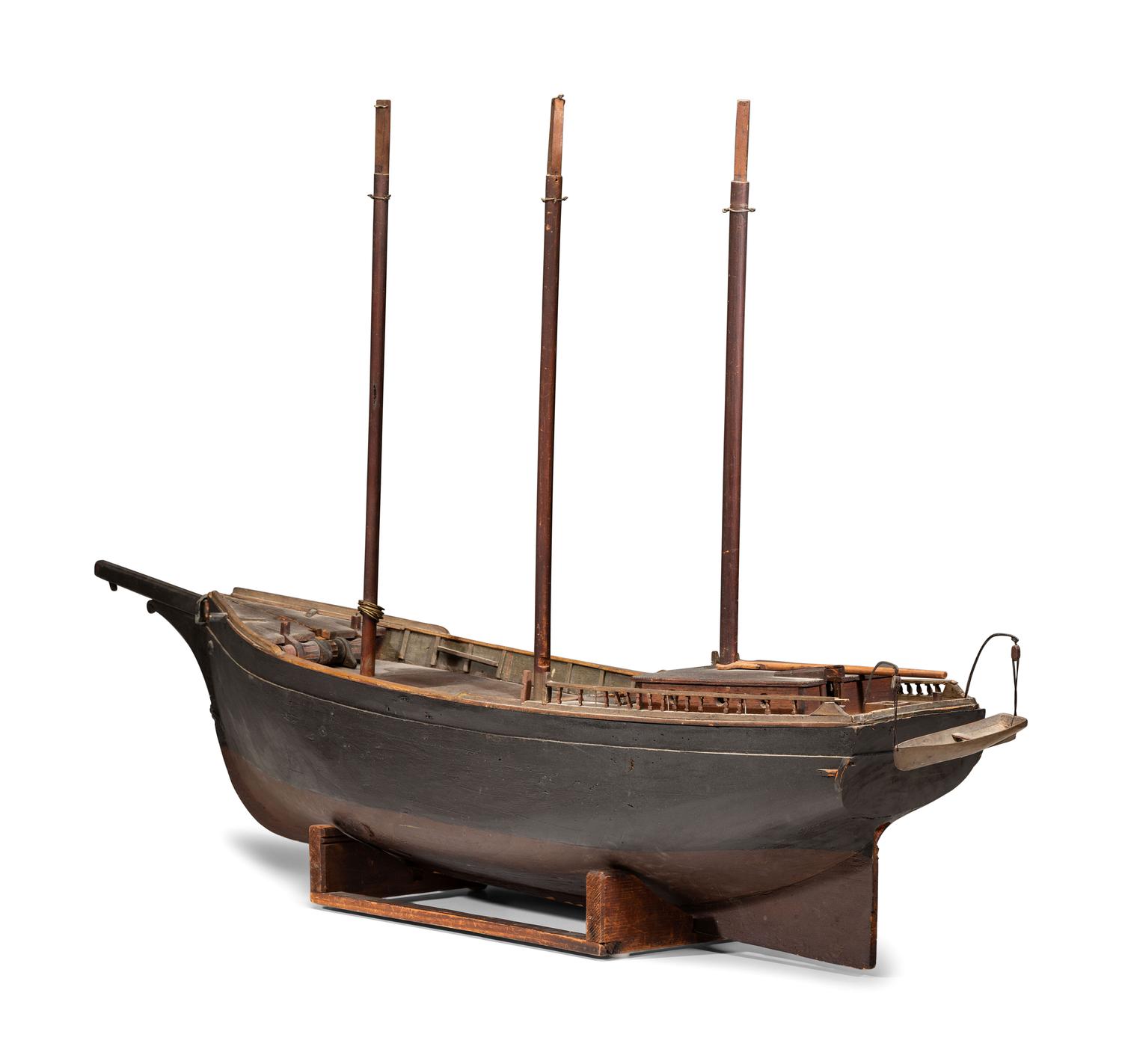
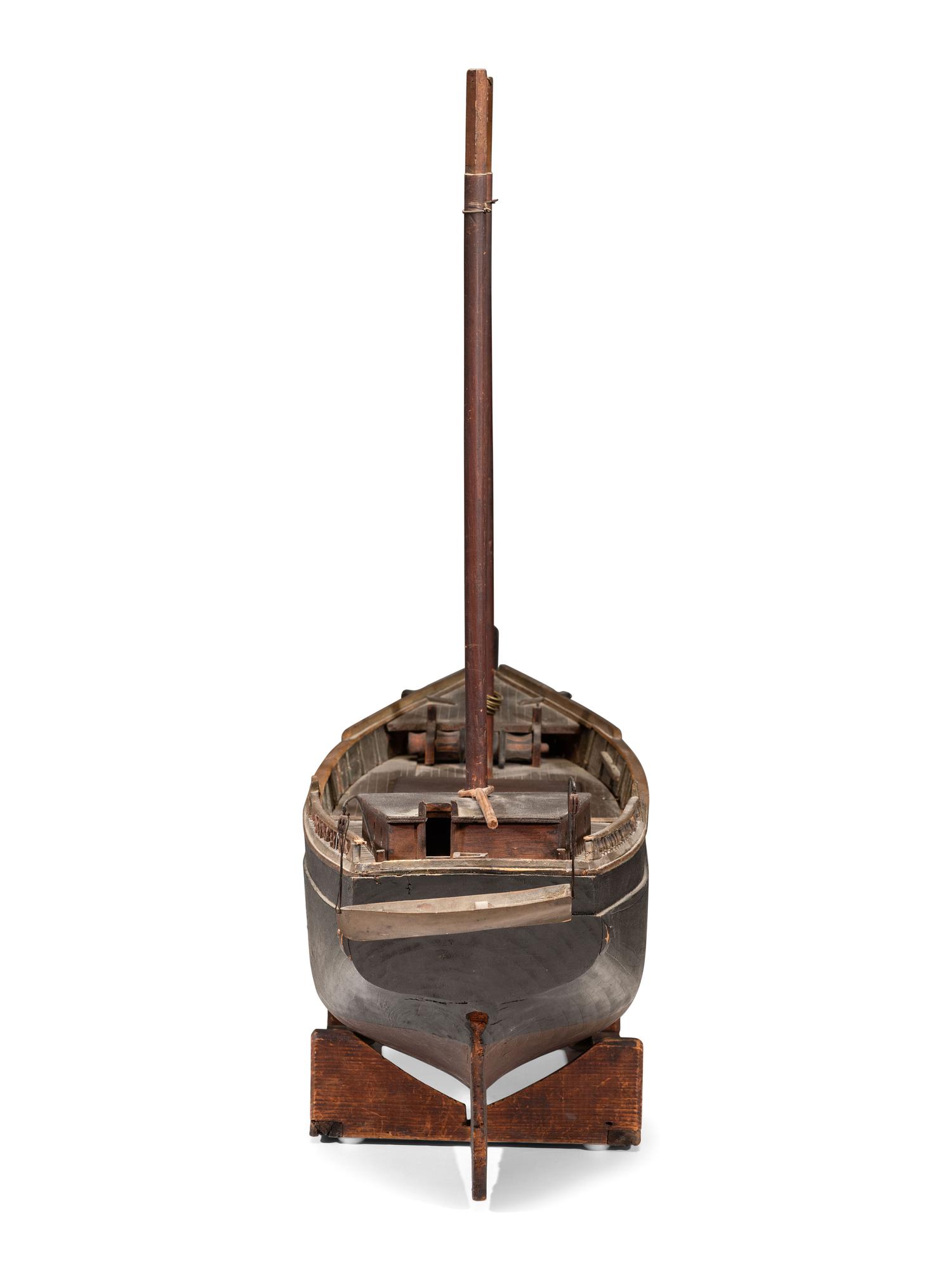
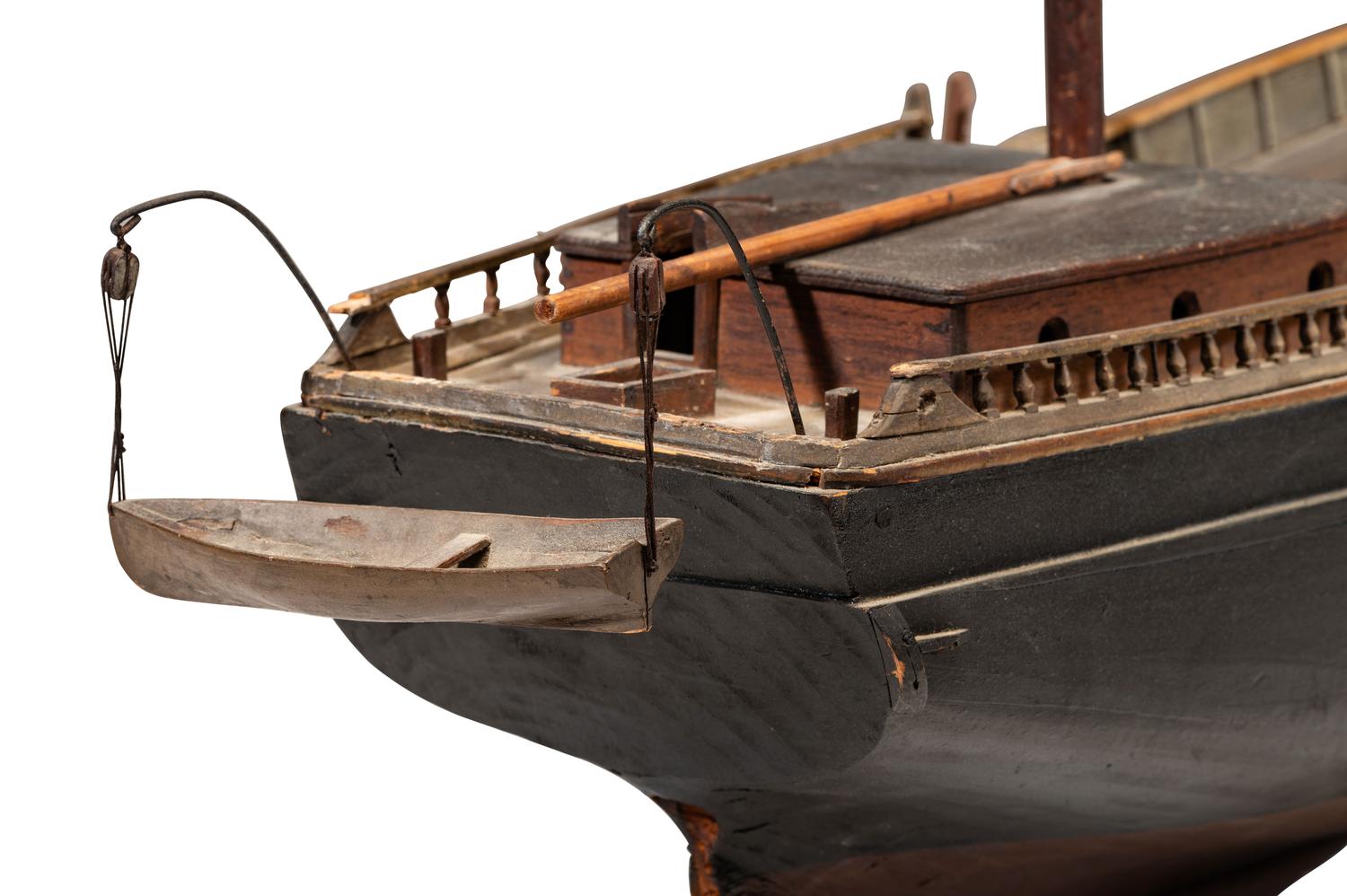
A Carved and Painted Wood Model of the Whaling Ship Essex
Likely Nantucket, Circa 1860s
Height 28 x length 44 1/2 x depth 9 inches.
Accompanied by a manuscript document identifying the maker as a "ship-mate of James Irving Ramsdall who was the son of Ramsdall a cabin boy of the whaler Essex out of Nantucket. The Essex was wrecked and the Captain and Ramsdall were afloat in a dory 60 days." A note in a different hand records that the boat was "built while on whaling trip 1860-1865 - out of Nantucket to San Francisco and Bering Sea." The sinking of the Essex inspired Herman Melville's iconic whaling novel, Moby Dick, in large part, and Melville even traveled to Nantucket, where he met with the captain of the Essex after the harrowing ordeal.
with a printed pamphlet entitled The Loss of the "Essex" by Edouard A. Stackpole, published by the Inquirer and Mirror Press, Nantucket Island, Massachusetts, 1950.
James Irving Ramsdell was born on June 6, 1844, to Charles and Mercy Fisher Ramsdell in Nantucket, Connecticut. His father, Charles (1804-1866), is recorded in the U.S. Federal Census of 1850 as working as a mariner in the water transportation industry. Subsequent census records and city directories indicate that the younger Ramsdell worked as a day laborer at a shoe factory -- his pursuit of a seafaring career paralleling that of his father was seemingly short-lived. He married and had three children before his death in April 1906.
The infamous tale of the Essex is well-known to most Nantucket natives and is thoroughly documented by the Nantucket Historical Association. According to the Fall 2021 issue of Historic Nantucket, the organization's quarterly publication, Charles Ramsdell was one of the eight survivors of the 1820 whaleship Essex disaster. He, along with three friends, joined the crew of the South Pacific-bound vessel in 1819. After mear;y a year at sea. in August of 1820, a massive sperm whale rammed the boat twice, rendering her completely wrecked. The crew divided into three small whaleboats, with Ramsdell assigned to Captain George Pollard Jr.’s boat. The boats were quickly separated, and Ramsdell's boat drifted at sea for three months before making its way back to land, during which time the men turned to extreme measures, including cannibalism, to ensure their survival.
Despite this undoubtedly traumatic experience, Ramsdell returned to the sea following his harrowing ordeal, sailing aboard the Thames to Cape Horn in 1822. His mental health struggles during this period are remarkably well-documented, and records from the voyage suggest that he engaged in a form of proto-talk therapy with a group of Protestant missionaries seeking passage from New England to Honolulu, Hawaii aboard the Thames. Upon his return, he married Mercy Fisher and ultimately rose to command the ship Lydia of Salem on two successful voyages from 1835 to 1840. Charles Ramsdell died on July 8, 1866.
Provenance:
By descent within the Ramsdell family;
thence acquired by the present owner.